
AI-powered monitoring detected over 50 000 earthquakes during intense seismic crisis in Santorini, Greece
Researchers at the 10th Delphi Economic Forum on April 13, 2025, revealed that the use of advanced machine learning technology enabled them to detect over 50 000 earthquakes in Santorini, some of which occurred before the intense earthquake swarm in February 2025. This early detection enhanced earthquake forecasting and improved warning procedures during the crisis.
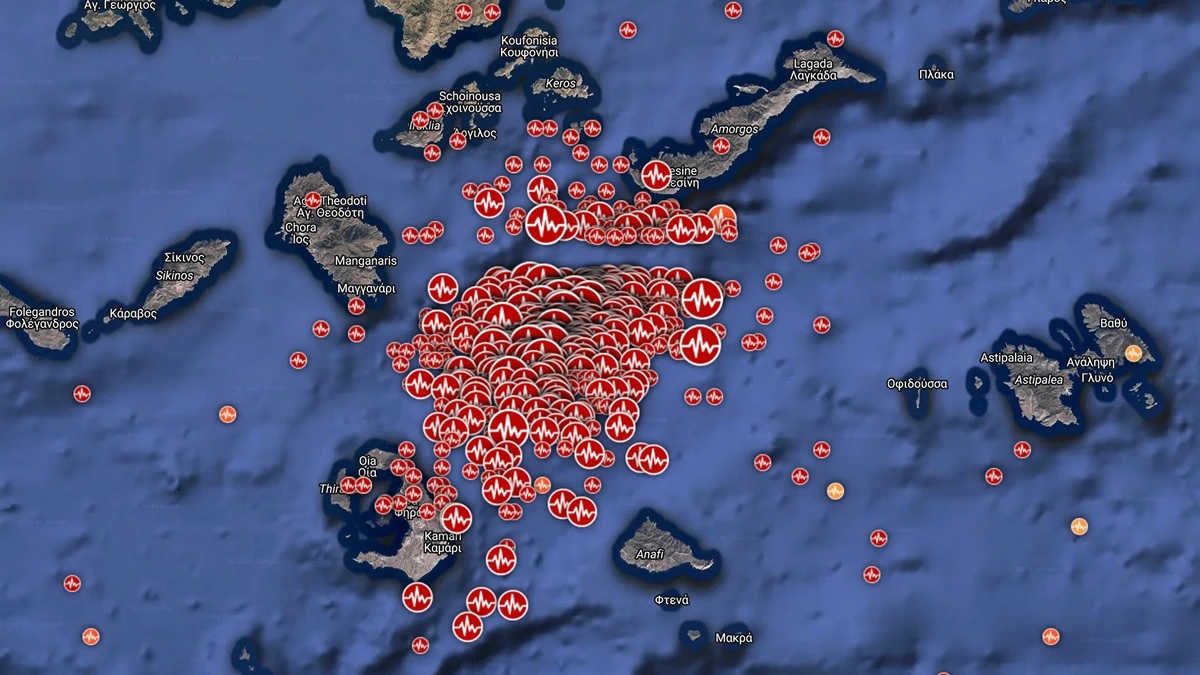
Image credit: TW/SAM, Google
Researchers presenting at the recently held 10th Delphi Economic Forum revealed that they had used artificial intelligence to detect more than 50 000 earthquakes in Santorini since December 2024—by some measures, ten times more than traditional methods.
Dr. Margarita Segou’s team at the British Geological Survey (BGS) utilized a machine learning algorithm known as QuakeFlow to process seismic data in real-time using cloud computing. This advanced technology allowed for continuous and precise monitoring of seismic activity.
By applying QuakeFlow, the team was able to detect around 1 500 smaller earthquakes beginning in December 2024, well before the significant spike in seismic activity that occurred in January 2025.
By February, intensifying seismic activity had evolved into a serious crisis, leading to infrastructural damage, mass evacuations, and the declaration of an emergency.

According to Professor Evi Nomikou from the National and Kapodistrian University of Athens (EKPA), the seismic excitation was related to the intrusion of magma at a depth of 3–5 km (2–3 miles) below Anydros, causing tectonic stresses and activating faults. “The phenomenon will continue as long as the magma chamber is fed,” Nomikous said.
Thanasis Ganas of the National Observatory of Athens reported that AI identified four seismic phases suggesting the presence of a magmatic vein extending northeast toward Anydros.
Geodetic data presented by Ganas indicated a 4 cm (1.6 inches) elevation of the caldera by January 2025, followed by a 12 cm (4.7 inches) subsidence near Anydros within two weeks. This indicated magma movement from Kammeni’s chamber toward Anydros, with approximately 8 million m3 (282 million feet3) of magma. By March 2025, deformation continued at a reduced rate in the eastern caldera.
Kostas Synolakis, a member of the Academy of Athens, referenced the 1956 tsunami, which reached 20 m (66 feet) inland. He pointed out Greece’s limited monitoring infrastructure, which includes only 12 tidal gauges and no real-time underwater seismographs, proposing the establishment of a volcanic observatory modeled on the SANTORY system for continuous observation.
Greek scientists reported a gradual decline in seismic swarm activity later in February, with both the frequency and strength of tremors decreasing. However, AI systems, such as Stanford’s QuakeFlow, continued to monitor and analyze smaller seismic events to refine assessments.
A Lloyd’s assessment cited by Dr. Seguo estimated that a volcanic eruption could result in losses of 40 billion EUR for Greece and up to 1.4 trillion USD globally over five years.
Tourism in Santorini, which contributed 5.9 billion EUR to Greece’s GDP in 2022, faced significant disruptions due to mass evacuations in early February 2025. Despite the challenges, hoteliers expressed optimism by March, looking ahead to a strong recovery during the 2025 summer season.
Read more:
References:
1 Σαντορίνη: Η συμβολή της τεχνητής νοημοσύνης στην κατανόηση των σεισμών – Naftemporiki.gr – April 13, 2025
2 Artificial intelligence is proving a game changer in tracking the Santorini earthquake swarm – British Geological Survey – February 7, 2025

I’m a science journalist and researcher at The Watchers, contributing to the Epicenter edition, where I cover peer-reviewed scientific research and emerging discoveries across Earth and space sciences. With a background in astronomy and a passion for environmental science, I’ve worked in shark and coral conservation in Fiji, conducting reef and shark-behavior research, contributing to mangrove restoration, and earning PADI Open Water and Coral Reef Certifications. I bring a blend of scientific rigor and storytelling to illuminate the discoveries shaping our planet and beyond.

Commenting rules and guidelines
We value the thoughts and opinions of our readers and welcome healthy discussions on our website. In order to maintain a respectful and positive community, we ask that all commenters follow these rules.