
Intense earthquake swarm beneath Santorini and Kolumbo volcano caused by magma intrusion
More than 28 000 earthquakes shook Santorini and neighboring islands between late January and February 2025. At the time, the cause was only speculated, but a new Nature study led by GFZ and GEOMAR shows the swarm resulted from a mid-crustal dike intrusion that linked Santorini and Kolumbo.
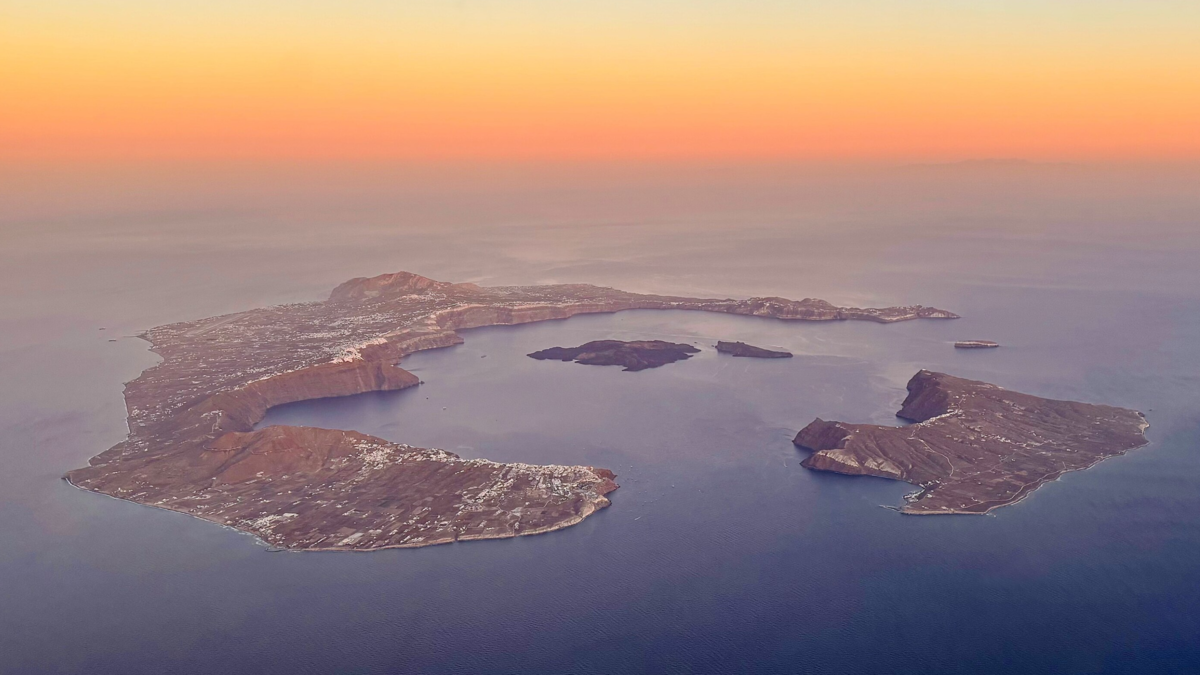
Photograph of Santorini caldera from the air. Credit: Kallerna
At 19:00 UTC on January 27, 2025, the ground beneath the Aegean Sea northeast of Santorini began to shake. The swarm intensified quickly, producing thousands of earthquakes per day. By late February, more than 28 000 events had been recorded, with the strongest exceeding M5.0.
Authorities declared a state of emergency on Santorini and nearby islands from February 6 to March 3. The intensity of shaking and the uncertainty about its cause created widespread alarm. In a region scarred by past eruptions and earthquakes, the question was urgent: were these quakes tectonic, or volcanic precursors?
The answer came later in a Nature study. A collaboration of scientists from GFZ Helmholtz Centre for Geosciences, GEOMAR Helmholtz Centre for Ocean Research Kiel, and international partners, used land-based seismic stations, ocean-bottom instruments, and satellite data to map the crisis with a level of detail not previously possible.
Magma intrusion hidden beneath the seafloor
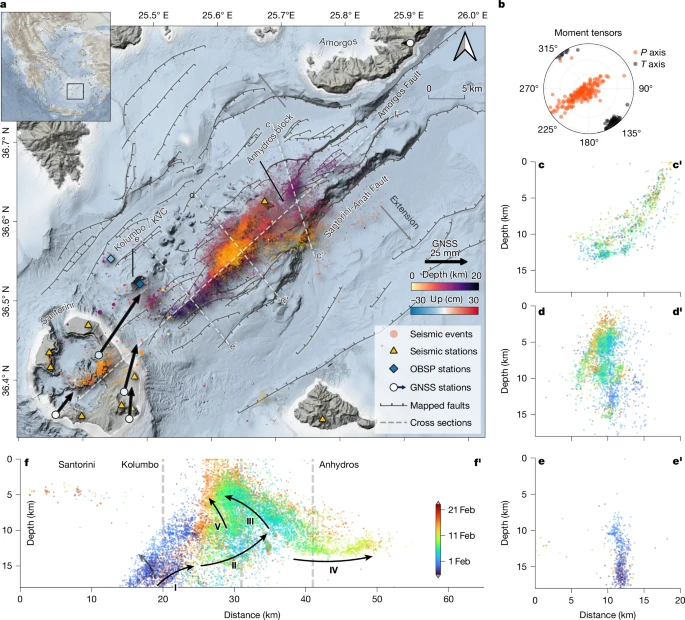
The researchers found that the swarm resulted from the movement of about 310 million m³ (11 billion ft³) of magma intruding into the crust. The intrusion formed a 13 km (8 miles) long dike that extended from depths of 18 km (11 miles) to just 3–5 km (2–3 miles) below the seafloor.
As the molten rock pushed upwards, it fractured the crust, reactivated faults, and triggered thousands of earthquakes. This was a magmatic event expressed through seismic energy, not simply tectonic stress release.
“The seismic activity was typical of magma ascending through Earth’s crust,” Dr. Marius Isken of GFZ explained. “The migrating magma breaks the rock and forms pathways, which causes intense earthquake activity. Our analysis enabled us to trace the path and dynamics of the magma ascent with a high degree of accuracy.”
Precursors that went unnoticed
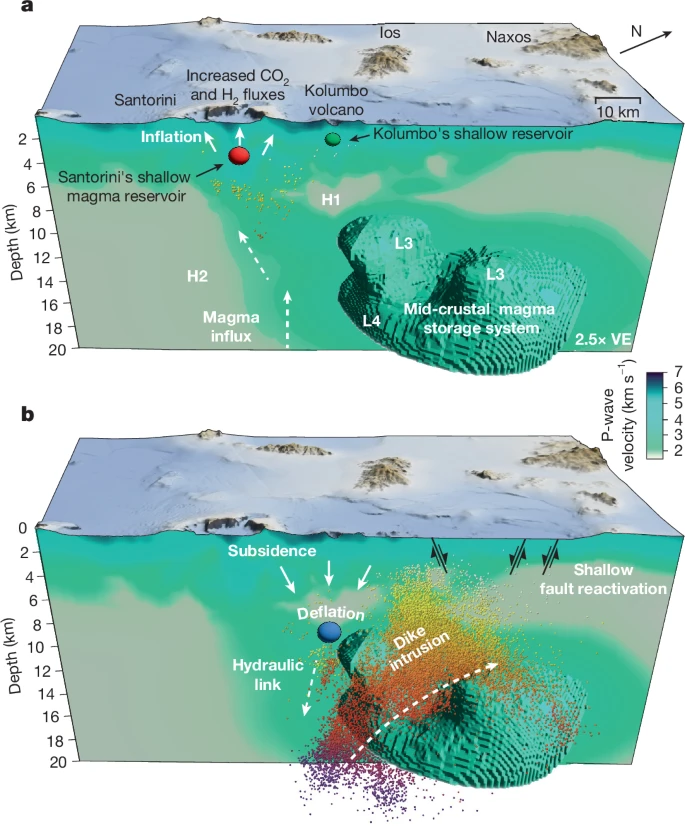
From July 2024, GNSS and InSAR satellite data detected about 45 mm (1.8 inches) of uplift inside the Santorini caldera, caused by inflation of a shallow reservoir at 3.8 km (2.4 miles) depth. Similar inflation had been observed during unrest in 2011 and 2012.
By early January 2025, seismic activity intensified beneath Santorini. At the end of the month, the earthquakes migrated northeastward, moving more than 10 km (6 miles) away from the caldera. Earthquake foci rose in pulses from 18 km (11 miles) depth to as shallow as 3 km (2 miles), suggesting that magma was on the move.
To residents and authorities, the sudden shift raised fears of either tectonic rupture or imminent volcanic eruption. Later analysis confirmed it was magma forcing its way upward.
Two volcanoes acting as one
Santorini and Kolumbo volcanoes lie only 7 km (4 miles) apart. Their plumbing systems were considered mostly separate but the 2025 crisis challenged that assumption.
The data show that while Santorini inflated at first, the January 2025 intrusion originated from a mid-crustal reservoir beneath Kolumbo. As the dike propagated northeastward, Santorini began to subside while Kolumbo deflated.
“Through close international cooperation and the combination of various geophysical methods, we were able to follow the development of the seismic crisis in near real time and even learn something about the interaction between the two volcanoes,” Dr. Jens Karstens of GEOMAR said. “This will help us to improve the monitoring of both volcanoes in the future.”
This suggests a hydraulic or stress-linked coupling between the two systems. If correct, future unrest could affect both volcanoes rather than one in isolation.
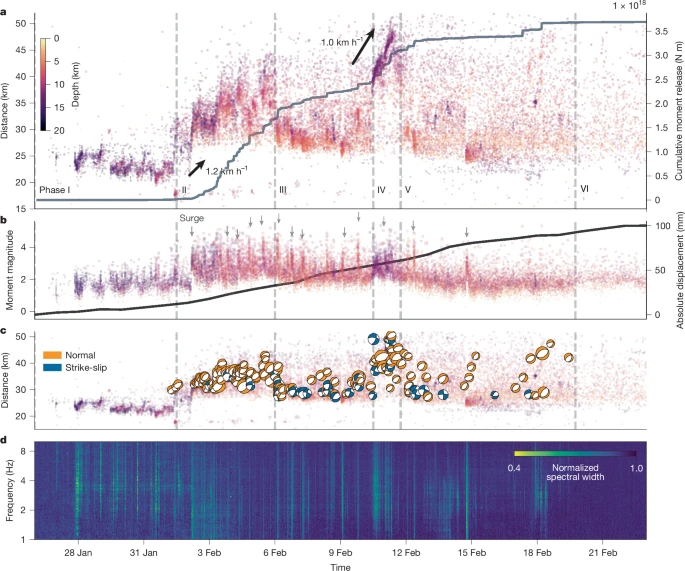
Six phases of earthquake migration
Thanks to an AI-driven earthquake detection method, scientists built a detailed catalogue of more than 30 000 events. Analysis revealed six phases of activity:
- Phase I (Jan 27–31): earthquakes initiated at 12–18 km (7–11 miles) depth with accompanying tremor.
- Phase II (Feb 1–5): activity migrated northeastward at about 1 km/h (0.6 mph), reaching 8 km (5 miles) depth, with magnitudes above 5.0.
- Phase III (Feb 6–10): seismicity shifted southwestward, clustering shallower than 5 km (3 miles).
- Phase IV (Feb 10–11): a rapid 25 km (15 miles) northeastward propagation across the Anhydros block.
- Phase V (Feb 12–19): repeated bursts of shallow earthquakes below 5 km (3 miles).
- Phase VI (after Feb 20): gradual decline in activity while ground deformation continued.
The stepwise sequence mirrors dike intrusions recorded in Iceland, Hawaii, and Japan, showing common patterns of magma movement in extensional volcanic settings.

A region with a violent geological past
The Santorini volcanic field has a long record of destructive eruptions and earthquakes. The Bronze Age Minoan eruption around 1600 BCE was one of the largest volcanic events of the Holocene, reshaping the island and producing tsunamis across the Mediterranean.
Kolumbo erupted explosively in 1650 CE, killing dozens and generating a tsunami. More recently, Santorini erupted in 1950. In 1956, two powerful earthquakes, M7.4 and M7.2, struck between Santorini and Amorgos only 13 minutes apart, triggering another tsunami.
Their history explains the anxiety that surrounded the 2025 swarm. Even without an eruption, the parallels to past crises were clear.
New tools changed the outcome
Two innovations made the 2025 reconstruction possible.
First, GFZ applied the Qseek pipeline, built on the PhaseNet model, to automatically detect and locate earthquakes in real time. This increased the catalogue resolution and improved the accuracy of earthquake locations.
Second, GEOMAR had deployed ocean-bottom sensors in January 2025 at Kolumbo as part of the MULTI-MAREX project. These recorded both seismic activity and pressure changes, showing that Kolumbo’s crater floor subsided by 12–32 cm (4.7–12.5 inches).
Prof. Heidrun Kopp of GEOMAR said that results were shared with Greek authorities throughout the crisis to ensure a rapid response, while Prof. Paraskevi Nomikou of the University of Athens expressed the importance of long-standing German–Greek cooperation in managing the event.
References:
1 Volcanic crisis reveals coupled magma system at Santorini and Kolumbo – Marius P. Isken et al. – September 24, 2025 – Nature – https://doi.org/10.1038/s41586-025-09525-7 – OPEN ACCESS
2 Magma displacement triggered tens of thousands of earthquakes, Santorini swarm study finds – Helmholtz Association of German Research Centres – September 24, 2025

I’m a science journalist and researcher at The Watchers, contributing to the Epicenter edition, where I cover peer-reviewed scientific research and emerging discoveries across Earth and space sciences. With a background in astronomy and a passion for environmental science, I’ve worked in shark and coral conservation in Fiji, conducting reef and shark-behavior research, contributing to mangrove restoration, and earning PADI Open Water and Coral Reef Certifications. I bring a blend of scientific rigor and storytelling to illuminate the discoveries shaping our planet and beyond.

Commenting rules and guidelines
We value the thoughts and opinions of our readers and welcome healthy discussions on our website. In order to maintain a respectful and positive community, we ask that all commenters follow these rules.