
First evidence of a solar-style magnetic switchback in Earth’s space environment
NASA’s Magnetospheric Multiscale mission detected a magnetic “switchback” near Earth for the first time, confirming that these zigzag reversals in magnetic field direction can also form in planetary space environments.
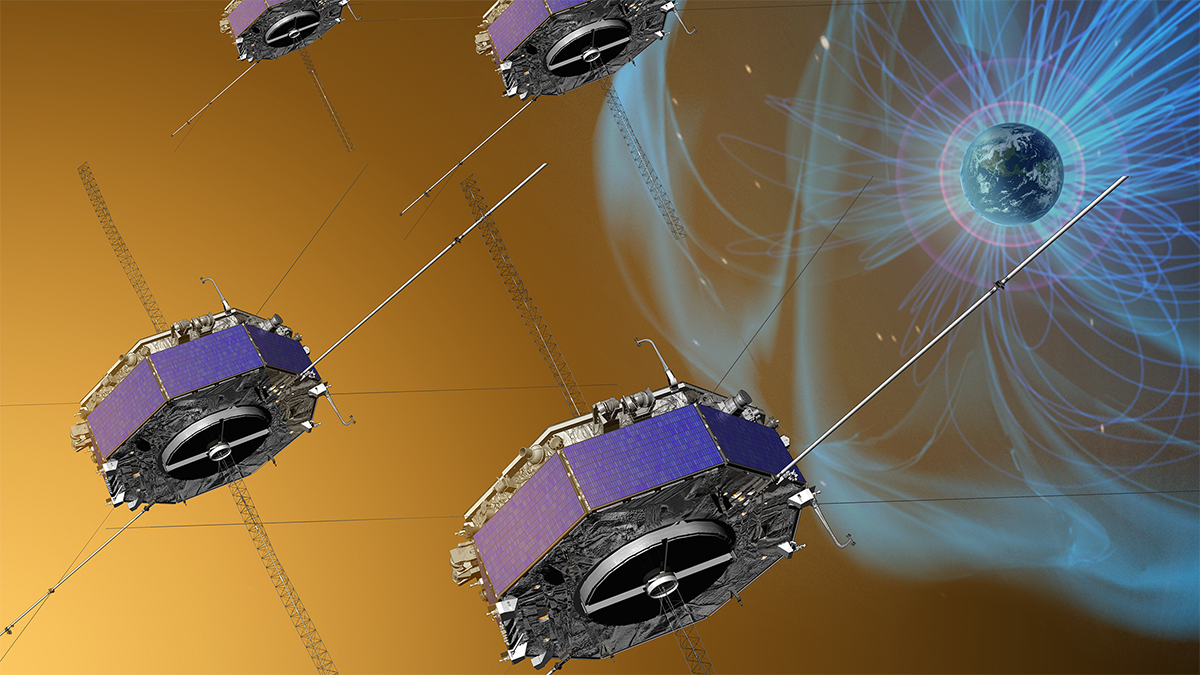
NASA’s Magnetospheric Multiscale mission, which consists of four spacecraft, is gathering information about magnetic reconnection around Earth. Credit: NASA/GSFC
NASA’s Magnetospheric Multiscale (MMS) mission recorded a sudden, twisting reversal of magnetic field direction in Earth’s outer magnetosphere. The structure, made of mixed solar wind and magnetospheric plasma, briefly rotated and then returned to its original orientation.
This motion produced a sharp kink, the same zigzag geometry known as a switchback in solar physics. Such features had, until now, been observed only in the solar corona by NASA’s Parker Solar Probe.
The new finding, published in Journal of Geophysical Research: Space Physics, shows that the same reconnection-driven twists that shape the Sun’s magnetic field also occur near Earth.
Researchers Andrew McDougall and Matthew Argall analyzed high-resolution MMS data and confirmed that the event met quantitative switchback criteria. The team measured a z-parameter greater than 0.5, a value used to define true angular reversal rather than minor field wavering.
Twisting plasma and the role of magnetic reconnection
The event was observed in the magnetosheath, a turbulent layer of space just outside Earth’s magnetic shield. Here, the solar wind, a stream of plasma expelled from the Sun at speeds exceeding 400 km/s (250 miles/s), collides with the magnetosphere.
Inside this boundary, plasma from the Sun mixed with plasma trapped by Earth’s magnetic field. The MMS instruments detected the structure slowly rotating before snapping back, leaving behind a distinct kink in the field lines.
High-energy electrons within the region were aligned along magnetic field lines, and their trajectories indicated a connection to the southern magnetic footprint of Earth. This pattern revealed that material from the magnetosphere itself was involved in the event.
The trailing edge of the structure contained a reconnecting current sheet with a guide field strength of about 1.2 relative to the background magnetic field. The sheet was split into two distinct current layers, a hallmark of complex, three-dimensional reconnection geometry.
Together, these observations confirm that the switchback formed through interchange reconnection, where open solar-wind field lines interlink with Earth’s closed magnetic loops.
Why this matters for space weather
Reconnection at the magnetopause is one of the main gateways through which energy and particles from the Sun enter Earth’s magnetic environment. When these interactions intensify, they can trigger geomagnetic storms that disrupt satellites, radio communications, and power grids.
The discovery of a magnetic switchback at this boundary suggests a new, localized pathway for solar material to cross into the magnetosphere. Small, transient reconnection events like these may inject bursts of energy that ripple through the system, influencing auroral activity and upper-atmosphere dynamics.
By studying switchbacks near Earth, scientists can probe the same physical processes that heat the solar corona to more than 1 million °C (1.8 million °F), but in a far safer, more accessible setting. The MMS measurements provide a detailed look at how energy is transferred across magnetic boundaries, a question central to both heliophysics and astrophysics.
Understanding these events improves predictive models of how solar wind conditions evolve into geomagnetic disturbances, enhancing the accuracy of space-weather forecasting critical for satellite operations and navigation systems.
Magnetic switchbacks as a universal phenomenon
Magnetic reconnection is not limited to Earth or the Sun. It occurs anywhere plasma and magnetic fields interact, from the atmospheres of stars to the magnetospheres of planets. Detecting a switchback in near-Earth space shows that these processes are scalable across vastly different environments.
Similar structures may occur at Jupiter’s or Saturn’s magnetopauses, where solar wind pressure interacts with much stronger magnetic fields. Observations from future missions such as the European Space Agency’s JUICE and NASA’s Europa Clipper could test whether planetary switchbacks are a common feature in the Solar System.
On a broader scale, understanding switchbacks provides insight into how magnetic energy converts into heat and motion throughout the Universe. The discovery establishes Earth as a natural plasma laboratory for phenomena that also power solar flares and cosmic jets.
A closer look at the data behind the twist
The MMS spacecraft fly in a precise tetrahedral formation, allowing three-dimensional measurements of electric and magnetic fields at scales smaller than a single ion’s gyration path. This configuration makes it possible to resolve the layered current sheets where reconnection occurs.
During the event, the instruments detected opposing electron flows separated by roughly 30 km (19 miles), evidence of a thin current sheet undergoing bifurcation. Particle energy spectra showed both magnetosheath and magnetospheric populations, confirming plasma mixing across the boundary.
The measured guide-field value of 1.2 indicates that the reconnecting region was dominated by a magnetic component parallel to the current sheet, providing stability during rotation. The event’s return to its original orientation demonstrated that the switchback did not detach, but oscillated like a magnetic spring before settling.
Such detailed data are possible only with MMS’s high sampling rate, up to 128 vectors per second for magnetic field measurements, providing a microsecond-by-microsecond view of plasma behavior.
Bridging solar and planetary science
The discovery closes a long-standing gap between solar observations and near-Earth measurements. For decades, researchers have suspected that interchange reconnection, responsible for creating switchbacks near the Sun, might also occur at planetary boundaries.
By confirming this mechanism at Earth, the study unites two branches of heliophysics: solar-wind dynamics and magnetospheric physics. It suggests that planetary magnetospheres are not passive shields but dynamic systems capable of generating their own switchbacks.
Future missions, including Parker Solar Probe and Solar Orbiter, will provide complementary data from near-Sun regions, while MMS continues to monitor near-Earth space. Together, these datasets will help identify how often such events occur and how they influence both local and interplanetary magnetic structures.
Scientific importance
The detection of a magnetic switchback near Earth confirms that interchange reconnection can generate solar-type structures in planetary environments. It also demonstrates the value of high-resolution, multi-spacecraft observations for understanding plasma processes that shape both space weather and cosmic energy systems.
By measuring a z-parameter above 0.5 and a normalized guide field of 1.2, the researchers provided the first quantitative proof that the physics behind solar switchbacks operates just tens of thousands of kilometers (tens of thousands of miles) from Earth.
The discovery opens a new frontier in comparative magnetospheric research, using Earth itself as a close analogue for studying the Sun’s magnetic behavior.
References:
1 A Case for a Switchback Generated by Interchange Reconnection Between the Open Solar Wind and Closed Magnetosphere Field Line – E. O. McDougall et al. – JGR Space Physics – August 29, 2025 – https://doi.org/10.1029/2025JA034180
2 Magnetic “Switchback” Detected near Earth for First Time – EOS – October 8, 2025

I’m a science journalist and researcher at The Watchers, contributing to the Epicenter edition, where I cover peer-reviewed scientific research and emerging discoveries across Earth and space sciences. With a background in astronomy and a passion for environmental science, I’ve worked in shark and coral conservation in Fiji, conducting reef and shark-behavior research, contributing to mangrove restoration, and earning PADI Open Water and Coral Reef Certifications. I bring a blend of scientific rigor and storytelling to illuminate the discoveries shaping our planet and beyond.

Commenting rules and guidelines
We value the thoughts and opinions of our readers and welcome healthy discussions on our website. In order to maintain a respectful and positive community, we ask that all commenters follow these rules.