
2025 Kamchatka earthquake rupture matched the 1952 great earthquake, study finds
A new study of the July 2025 M8.8 Kamchatka earthquake found that the rupture extended about 500 km (311 miles) southwest from its epicenter, closely matching the rupture area of the great 1952 Kamchatka earthquake. Researchers say the similarity points to long-lived structural controls along the subduction zone that may influence how the region’s largest earthquakes rupture.

Tsunami waves advancing on the Kamchatka peninsula coastline following M8.8 earthquake on July 29, 2025. Credit: Kamchatka Life
A new study has found that the rupture of the July 2025 Mw 8.8 Kamchatka earthquake extended about 500 km (311 miles) southwest from its epicenter, closely matching the rupture area of the great 1952 Kamchatka earthquake.
The finding suggests that long-lived structural features along the subduction zone may control how the largest earthquakes in the region rupture. The research was published in The Seismic Record by Guilherme W. S. de Melo of GEOMAR Helmholtz Center for Ocean Research and colleagues.
The Mw 8.8 earthquake struck the Kuril-Kamchatka subduction zone at 23:24 UTC on July 29, 2025, generating strong shaking across the Kamchatka Peninsula, along with a Pacific-wide tsunami. It was also the sixth strongest earthquake on record.
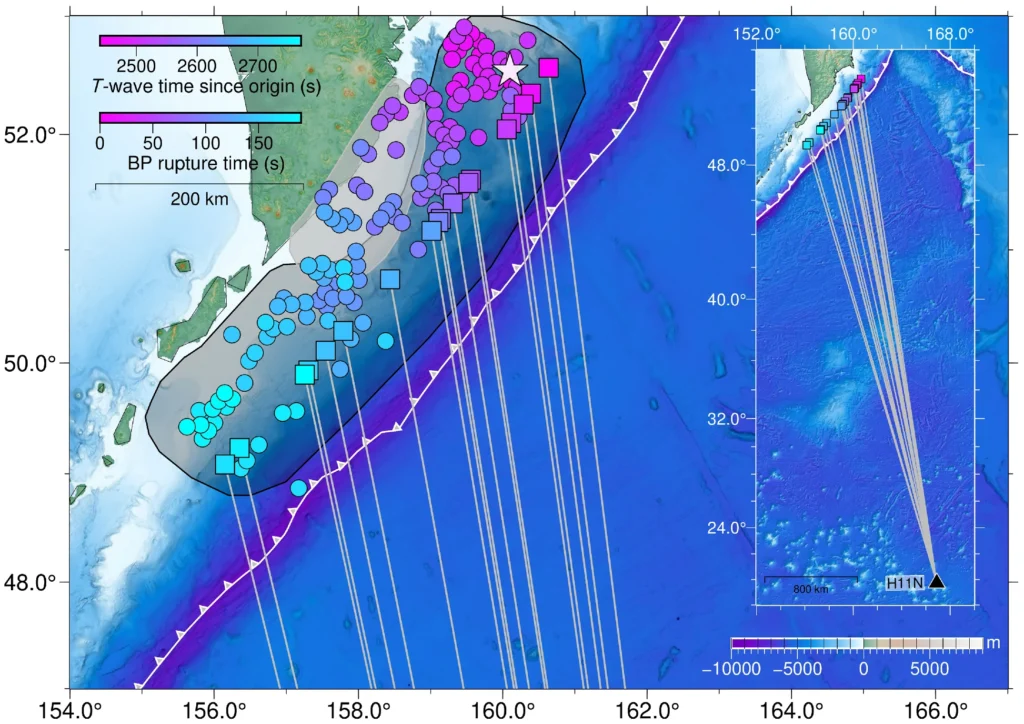
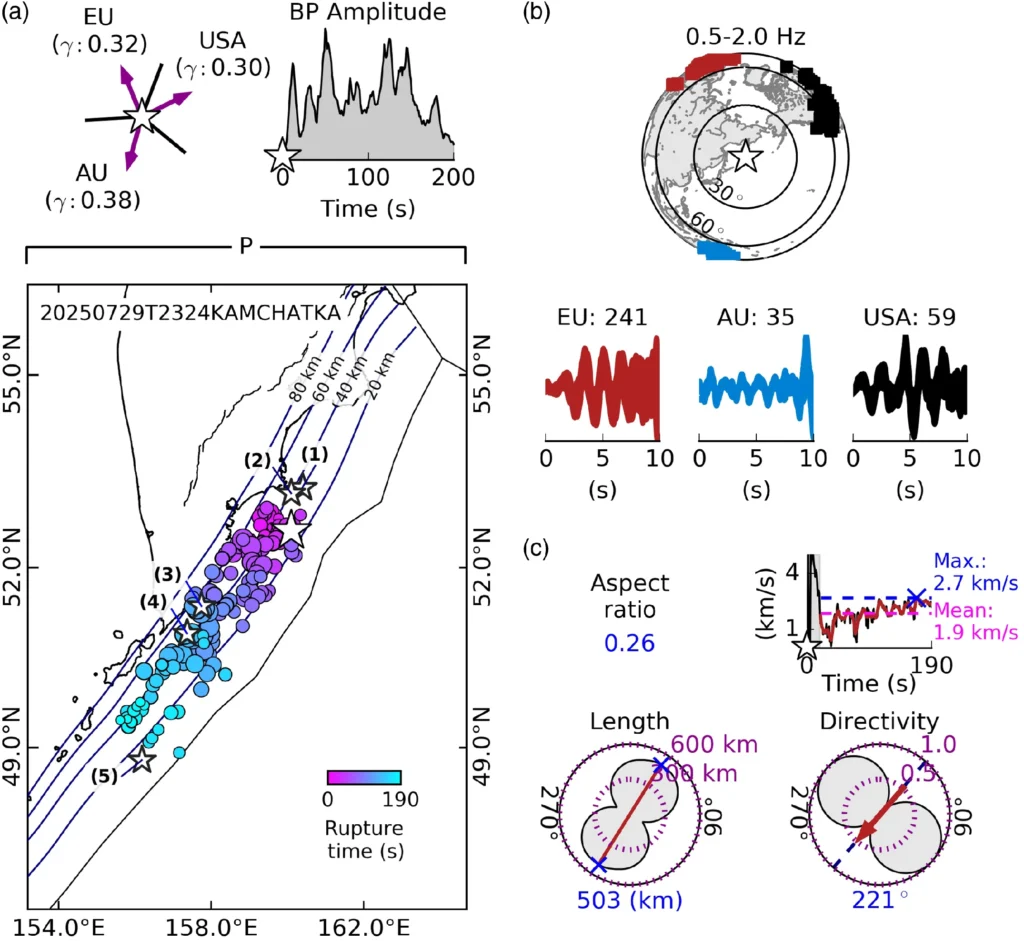
According to the study, the rupture propagated mainly southwestward for about 500 km (311 miles) and lasted about 190 seconds. The average rupture velocity was about 2.1 km/s (1.3 miles/s). Researchers used two independent methods to reconstruct the rupture.
The first method, known as teleseismic backprojection, uses seismic waves recorded by distant stations to track how an earthquake rupture evolves through space and time.
The second method relies on hydroacoustic T-waves. These acoustic signals are generated when underwater earthquake energy enters the ocean and travels through the SOFAR channel, a layer of the ocean that can guide sound across thousands of kilometers with little energy loss.
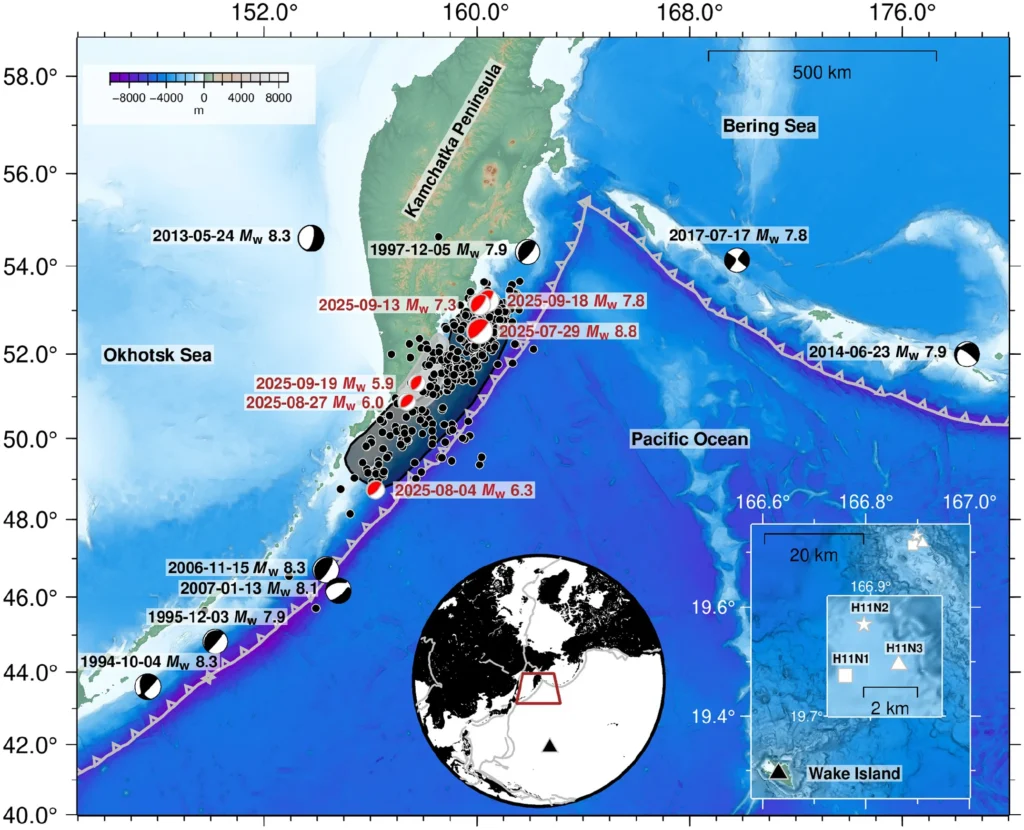
The earthquake produced strong signals that could be detected by both global seismic networks and the H11N hydrophone array in the Pacific Ocean. The hydrophone system is part of the International Monitoring System used to detect nuclear tests.
Results from both methods pointed to nearly the same rupture length and propagation direction.
“We were interested not only in characterizing the earthquake rupture itself, but also in testing whether hydroacoustic observations could provide rupture features consistent with those obtained from the teleseismic back-projection approach,” de Melo said.
“The good agreement between the two approaches was one of the most interesting outcomes of the study,” he said.
The inferred rupture length was longer than predicted by commonly used magnitude-rupture scaling relationships. Previous models estimate that an Mw 8.8 thrust-fault earthquake should rupture roughly 440 km (273 miles).
The Kamchatka rupture extended about 500 km (311 miles), exceeding those estimates by roughly 60 km (37 miles). The most notable result emerged when the researchers compared the 2025 earthquake with historical events.
The rupture extent appears indistinguishable, within uncertainties, from that of the 1952 Kamchatka earthquake, which reached Mw 8.8–9.0. The overlap is unusual because stress conditions on a fault evolve over decades between major earthquakes.
“What makes the Kamchatka case particularly interesting is that the 2025 rupture appears to overlap, within uncertainties, the area affected by the great 1952 Kamchatka earthquake,” de Melo said.
“This suggests that local structural features of the Kamchatka boundary may influence the extension of very large ruptures over many decades,” he said.
The researchers suggest that geological features along the plate boundary may play a major role in limiting or directing rupture growth.
Subduction zones are not uniform fault systems. Variations in fault geometry, stress distribution, slab structure, seafloor properties, and rock rigidity can influence how earthquake ruptures start, propagate, and stop.
“Factors such as the fault geometry, the distribution of stress on the fault, asperities along the slab structure, and variations of the seafloor material properties along the ruptured area may affect the rupture velocity and extend the rupture propagation,” de Melo said.
The study does not identify which specific structural features controlled the rupture. However, the authors conclude that the close match between the 2025 and 1952 rupture areas points to persistent geological controls that may remain stable across multiple earthquake cycles.
References:
1 Guilherme W. S. de Melo, Felipe Vera, Frederik J. Tilmann, Heidrun Kopp, Ingo Grevemeyer; The 2025
8.8 Kamchatka Megathrust Earthquake: Evidence for an Extended Rupture from Teleseismic Backprojection and Hydroacoustic Observations. The Seismic Record 2026;; 6 (2): 239–249. doi: https://doi.org/10.1785/0320260008

I am an Assistant Editor and Severe Weather & Science Journalist at The Watchers, specializing in real-time severe weather coverage, geophysical event reporting, and research-driven scientific analysis. You can reach me at rishav(at)watchers(.)news.

Commenting rules and guidelines
We value the thoughts and opinions of our readers and welcome healthy discussions on our website. In order to maintain a respectful and positive community, we ask that all commenters follow these rules.