
Typhoon Dujuan leaves 12 dead and 3 missing, record rain, floods and landslides hit Japan
Heavy rainfall from Typhoon Dujuan caused flooding and landslides across eastern Japan on September 21 and 22, 2026. Japan’s Fire and Disaster Management Agency (FDMA) reported 12 deaths and three people missing nationwide as of September 24. Seven deaths were recorded in Chiba, four in Kanagawa and one in Miyazaki, while searche and rescue operations continued in Chiba and Kanagawa.48-hour rainfall total reached 832 mm (32.76 inches) at Oshima, Tokyo setting an all time record for the station.

Rescue operatives at the landslide site in Kamogawa City, Chiba Prefecture, Japan on September 24, 2026. Credit: FDMA
The FDMA table listed seven deaths in Chiba, four in Kanagawa and one ine in Kanagawa, and the agency said the figures were preliminary.
Self-Defense Forces personnel, prefectural police and local fire authorities continued searches in Chiba and Kanagawa on September 23. The Chiba death toll had risen to seven that day after authorities confirmed the death of a man in his 70s who had been missing following a landslide in Kamogawa.
In a notice issued at 10:30 JST (01:30 UTC) on September 23, Chiba Prefecture warned that saturated ground could produce further landslides even with light rainfall. It also urged caution over flooding in low-lying areas and rising or overflowing rivers.
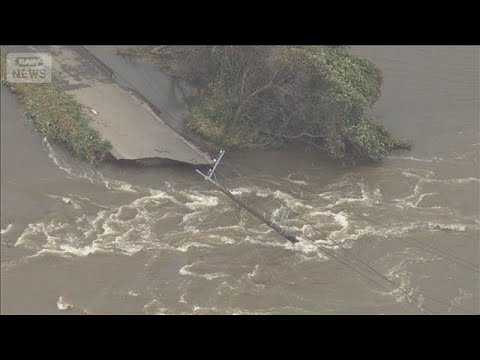
In Chiba, approximately 100 m (328 feet) of the North Inbanuma embankment failed near Funakata in Narita on September 22. An embankment along an agricultural drainage channel at Shitakata also breached, causing widespread flooding around North Inbanuma and the Nagato River.
Chiba’s September 23 update confirmed a further embankment breach on the Nagato River at Sakanao in Sakae.
Following Chiba’s request for assistance, the Ministry of Land, Infrastructure, Transport and Tourism’s (MLIT) Kanto Regional Development Bureau dispatched its Technical Emergency Control Force (TEC-FORCE) on September 23 to support emergency embankment restoration. The bureau extended its technical assistance to all three confirmed breach locations.

Kanagawa’s September 24 assessment listed three destroyed residential buildings, two in Miura and one in Yokosuka, and four partly damaged buildings in Yokohama and Yokosuka. It also recorded six slope failures in Yokohama, including two in Tsurumi Ward and one each in Hodogaya, Kohoku, Totsuka, and Tsuzuki wards.
The same assessment listed Prefectural Route 209 at Hashirimizu in Yokosuka as fully closed because of sediment. National Route 134 at Hassemachi Wada in Miura was also fully closed while the collapsed apartment building was demolished.
Sediment continued to restrict one sidewalk along Route 134 in Yokosuka’s Hayashi district.
On National Route 127 near Kitakoyasu in Kimitsu, one of the two lanes toward Tateyama reopened at 13:15 JST (04:15 UTC) on September 23 after sediment was cleared. MLIT said the other lane remained restricted while restoration continued.

At Oshima in Tokyo’s Izu Islands, the Japan Meteorological Agency (JMA) lists a 48-hour rainfall value of 832 mm (32.76 inches) dated September 22. This was the highest 48-hour rainfall total on record, which began in December 1991, breaking the previous entry of 824 mm (32.44 inches) dated October 17, 2013.
Kanagawa reported rainfall from the start of the event through 07:30 JST on September 23 (22:30 UTC on September 22) of 365.5 mm (14.39 inches) in Miura and 342 mm (13.46 inches) at Yamate in Yokohama. Totals reached 249.5 mm (9.82 inches) at Tsujido in Fujisawa and 242 mm (9.53 inches) at Hiyoshi in Yokohama.

Dujuan, known in Japan as Typhoon No. 25, approached the Izu Islands and the Kanto region on September 21 before moving northeast over the Pacific. According to MLIT, it became an extratropical cyclone far east of Japan at 21:00 JST (12:00 UTC) on September 22.
References:
1 Typhoon No. 25 damage and fire-service response, Report No. 13 – FDMA – September 24, 2026
2 Typhoon No. 25 damage report, No. 7 – MLIT – September 23, 2026
3 Kanagawa damage report, No. 16 – Kanagawa Prefectural Government – September 24, 2026
4 Emergency restoration support for Inbanuma embankments – MLIT/KTR – September 23, 2026
5 Oshima historical rainfall rankings – JMA – accessed September 24, 2026.

Rishav Kothari is Editor-in-Chief of The Watchers, where he runs the newsroom and covers earthquakes, volcanoes, severe weather and space weather.
