
Critical fire weather conditions forecast across central New Mexico into the southern High Plains
Critical fire weather conditions are forecast across central New Mexico into the southern High Plains from Thursday morning, March 26, through early Friday, March 27, 2026, as sustained west-southwesterly winds of 30–40 km/h (20–25 mph), relative humidity as low as 5–15%, and record to near-record heat support rapid fire spread and drying of fine fuels.
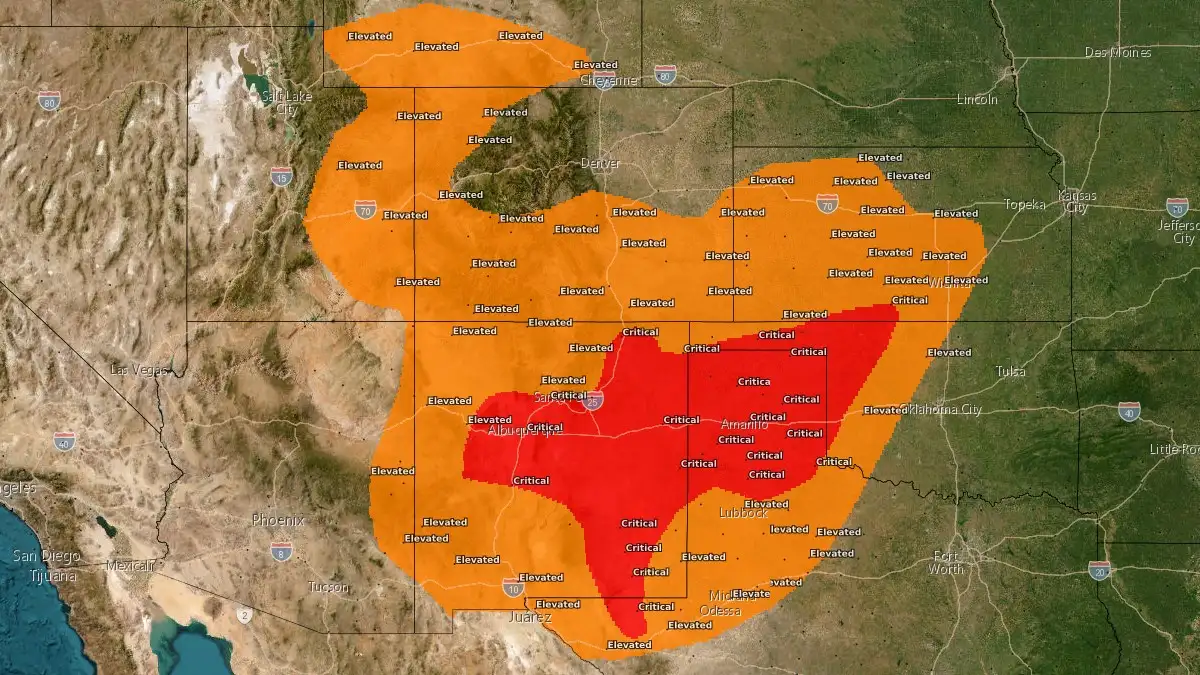
Critical fire weather map for March 26, 2026. Credit: NWS
Critical fire weather conditions are forecast across central New Mexico into the southern High Plains on Thursday, March 26, and early Friday, March 27, as a persistent upper-level ridge remains centered over northern Mexico and West Texas and a mid-level shortwave trough moves eastward across the Four Corners into the central Great Plains.
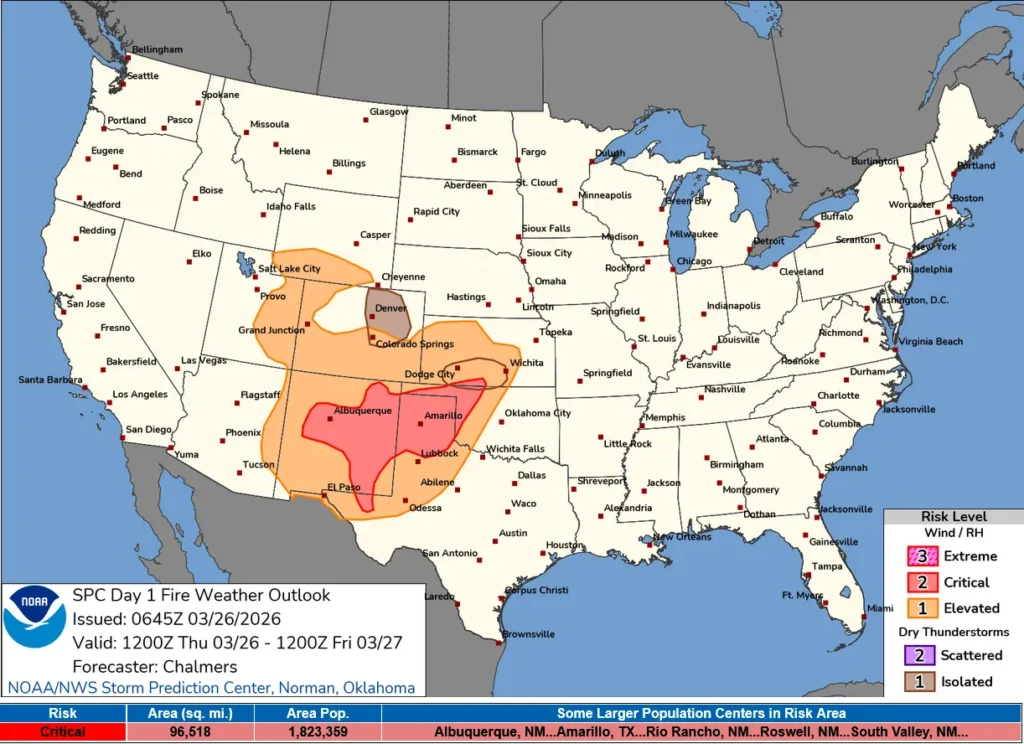
Dry downslope flow ahead of an advancing cold front is expected to dominate much of central and eastern New Mexico into the Texas and Oklahoma Panhandles, northwestern Oklahoma, and extreme southern Kansas. Sustained west-southwesterly winds of 30–40 km/h (20–25 mph) will overlap with critically low relative humidity values of 5–15%, creating an environment conducive to rapid fire spread.
Across areas in the lee of the Sacramento Mountains, relative humidity is forecast to drop to 5–10%, while westerly winds near 30 km/h (20 mph), locally higher in terrain-favored areas, enhance fire weather conditions. Afternoon temperatures are expected to reach 35–37°C (95–99°F), aiding rapid drying of fine fuels.
The advancing cold front will move southward across the southern Plains later in the period, bringing an abrupt shift to northerly winds. This transition may significantly impact ongoing wildfires or newly ignited fires by altering fire direction and spread dynamics.
Elevated fire weather conditions are forecast farther north across southeastern Colorado and western Kansas, where winds of 25–30 km/h (15–20 mph) will coincide with relative humidity values of 10–15% and receptive fuels.
Additional elevated conditions are expected across south-central Kansas, western Oklahoma, and parts of the Texas Big Country, where relative humidity will range between 20–30% but will be offset by stronger south-southwesterly winds of 30–50 km/h (20–30 mph), with gusts reaching 55–70 km/h (35–45 mph) supported by a low-level jet of 55–75 km/h (30–40 knots equivalent).
Across the eastern Great Basin and into portions of the Southwest, sustained westerly winds of 25–40 km/h (15–25 mph), locally higher, combined with relative humidity values of 10–20% and dry fuels, will support elevated fire weather conditions.
Isolated dry thunderstorms are possible across southwest and south-central Kansas as the cold front interacts with a mid-level shortwave trough and limited moisture. Minimal precipitation, very dry fuels, and temperatures near 38°C (100°F) will support high ignition efficiency from lightning.
Similar conditions are expected across northeastern and east-central Colorado, where high-based convection may develop within a deeply mixed boundary layer featuring lifted condensation levels of 3–4 km (1.9–2.5 miles) above ground level. Limited instability of 50–150 J/kg MUCAPE and minimal precipitation will favor dry lightning and additional fire starts.
The combination of critically low humidity, strong winds, anomalously high temperatures, and dry fuels across multiple regions supports a widespread environment favorable for wildfire ignition and rapid spread through the forecast period.
References:
1 Mar 26, 2026 Day 1 Fire Weather Outlook – NWS – March 26, 2026

I’m a science journalist and researcher at The Watchers, contributing to the Epicenter edition, where I cover peer-reviewed scientific research and emerging discoveries across Earth and space sciences. With a background in astronomy and a passion for environmental science, I’ve worked in shark and coral conservation in Fiji, conducting reef and shark-behavior research, contributing to mangrove restoration, and earning PADI Open Water and Coral Reef Certifications. I bring a blend of scientific rigor and storytelling to illuminate the discoveries shaping our planet and beyond.

Commenting rules and guidelines
We value the thoughts and opinions of our readers and welcome healthy discussions on our website. In order to maintain a respectful and positive community, we ask that all commenters follow these rules.