
Rapidly intensifying coastal storm brings heavy snow and Arctic cold to the Carolinas and mid-Atlantic
A powerful winter storm underwent rapid intensification along the East Coast from January 30 to February 1, 2026, bringing historic snow to the Carolinas and deep winter cold across much of the eastern United States. The nor’easter disrupted travel, caused power outages, and extended freezing conditions into Georgia and Alabama.
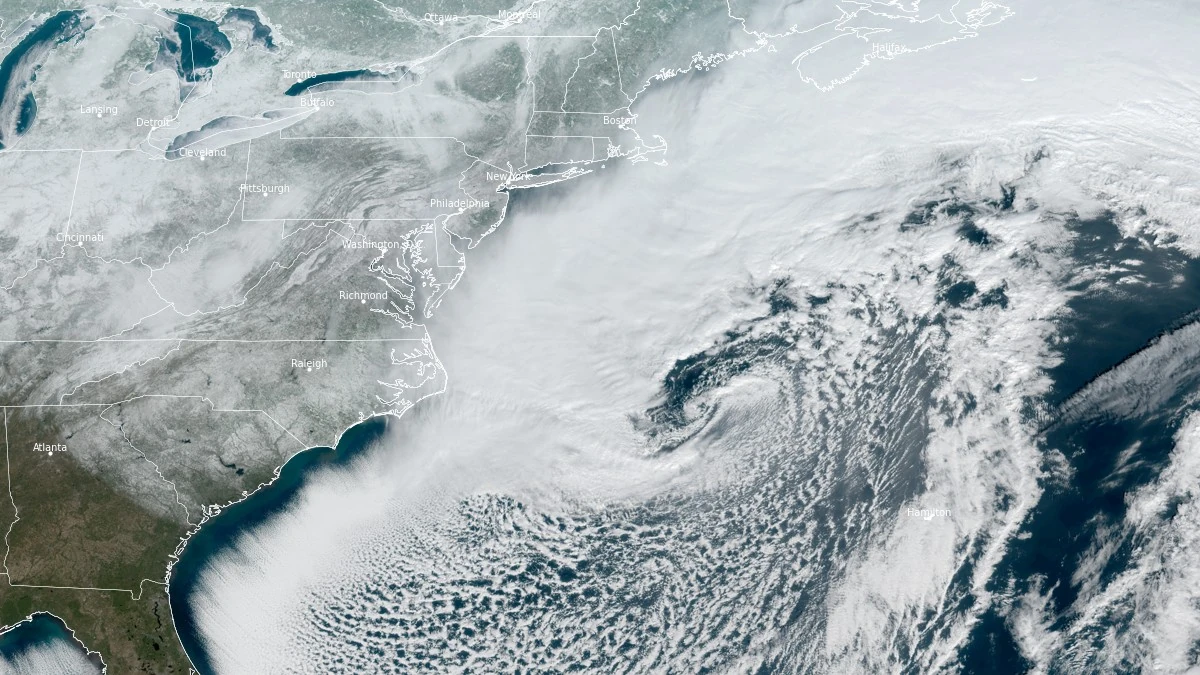
Satellite image of powerful coastal storm affecting East Coast at 16:00 UTC on February 1, 2026. Credit: NOAA/GOES-East, RAMMB/CIRA, The Watchers
A powerful winter storm that formed near the U.S. Southeast coast on January 30 rapidly intensified as it moved northeastward, producing widespread snow, strong winds, and severe cold across the Carolinas and mid-Atlantic. The system deepened offshore by more than 24 hPa within 24 hours, meeting the National Weather Service criterion for explosive cyclogenesis.
About 28 cm (11 inches) of snow accumulated in Charlotte, ranking among the city’s largest events on record, while nearby areas of North and South Carolina measured between 30 and 40 cm (12–16 inches).
Local reports described hundreds of roadway incidents and extensive transportation disruption. Near-blizzard conditions were observed in eastern North Carolina and southeastern Virginia, where sustained winds exceeded 60 km/h (37 mph), and visibility was reduced by blowing snow.
As the cyclone strengthened offshore, a strong pressure gradient generated onshore winds that drove elevated tides and coastal flooding along portions of the Outer Banks and southeastern Virginia.
Power outages affected tens of thousands of customers, and major airports, including Charlotte Douglas International Airport, experienced widespread flight cancellations.
States of emergency were declared in Georgia, North Carolina, and South Carolina as snow and ice rendered many roads impassable, while ports along the Carolinas temporarily suspended operations amid gale-force winds and high surf.
The National Weather Service advised continued caution due to cold stress hazards for residents, livestock, and unprotected infrastructure.
Behind the departing storm, a broad dome of Arctic high pressure advanced southward. The associated cold front ushered sub-freezing temperatures into southern Georgia and Alabama, conditions typical of mid-winter climatology farther north.
The same air mass extended into Florida, resulting in record lows there on February 1 and 2. Freeze warnings and wind-chill advisories were issued across multiple states as the cold wave persisted into early February.
Meteorological analyses from the National Oceanic and Atmospheric Administration identified a deep upper-level trough over the eastern United States and strong jet-stream divergence over the western Atlantic, both supporting the storm’s rapid development.
The interaction between Arctic air over the continent and anomalously warm western-Atlantic waters enhanced the baroclinic contrast that fueled the nor’easter’s intensification.
This event ranks among the strongest East Coast winter storms of the past decade. Its combination of heavy snow, coastal flooding, and deep southward Arctic air penetration recalled the February 2018 “bomb cyclone” and earlier benchmark events such as 1989.

I'm a dedicated researcher, journalist, and editor at The Watchers. With over 20 years of experience in the media industry, I specialize in hard science news, focusing on extreme weather, seismic and volcanic activity, space weather, and astronomy, including near-Earth objects and planetary defense strategies. You can reach me at teo /at/ watchers.news.

Commenting rules and guidelines
We value the thoughts and opinions of our readers and welcome healthy discussions on our website. In order to maintain a respectful and positive community, we ask that all commenters follow these rules.