
Weak La Niña supports wet north-dry south pattern across the western U.S. through March 2026
Experimental seasonal forecasts from the Center for Western Weather and Water Extremes (CW3E) suggest that a weak La Niña is reinforcing a wet–north, dry–south precipitation pattern across the western United States during January–March 2026. The outlook shows high-confidence signals for below-normal precipitation in Southern California, while model uncertainty remains higher across central and northern California.
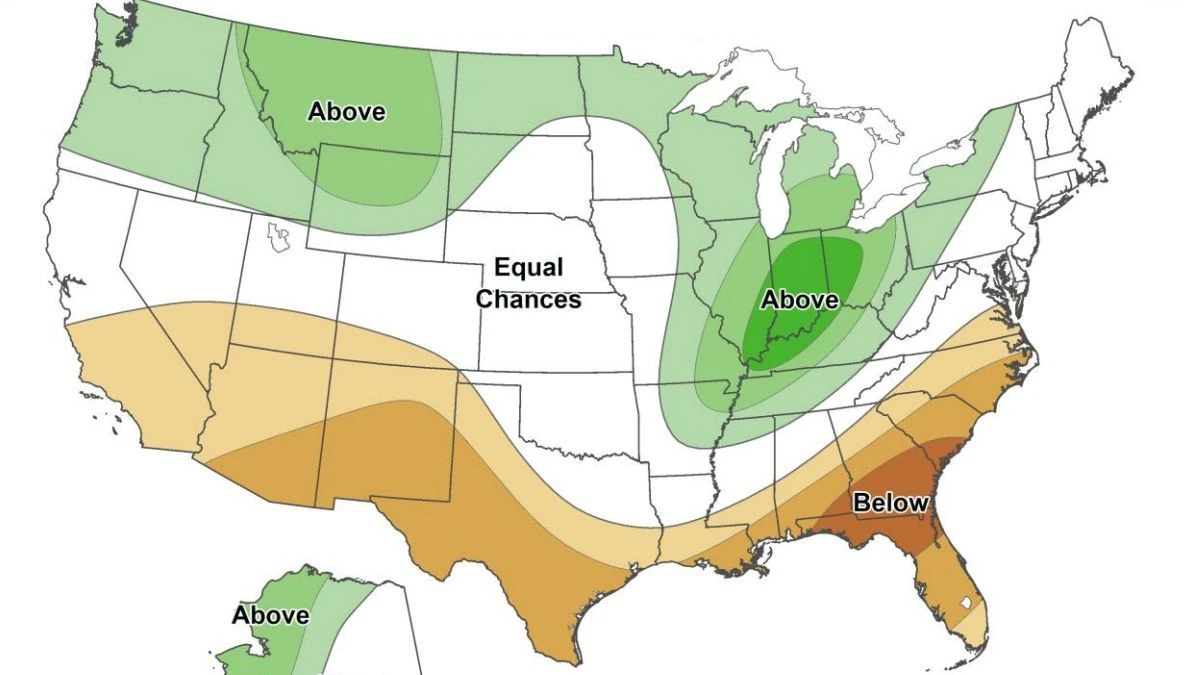
Seasonal Precipitation Outlook for January through March 2026. Credit: NOAA
Forecast models from the Center for Western Weather and Water Extremes (CW3E) show a consistent dry signal across Southern California for the January–March 2026 period. The outlook is based on both canonical correlation analysis (CCA) and machine-learning (ML) models trained on Pacific Ocean sea surface temperature (SST) patterns.
According to the analysis, CW3E’s CCA model predicts near-normal to slightly below-normal precipitation across Southern California with high confidence, while ML and the North American Multi-Model Ensemble (NMME) tilt the odds more strongly toward drier-than-normal conditions.
All external seasonal forecasts from collaborating institutions similarly show a below-normal tendency across the region.
Ensemble analysis combining CW3E’s ML models and the NMME indicates 71% agreement on a regional pattern characterized by drier-than-normal conditions across the southwestern United States and wetter-than-normal conditions in the Pacific Northwest.
This configuration reflects a weak La Niña SST state, favoring suppressed storm activity in the south and enhanced activity in the north.
For central California, model outcomes diverge, ranging from near-normal to slightly below-normal precipitation. In northern California, the CCA model suggests near-normal to slightly above-normal totals, but with low-to-moderate confidence. Ensemble spread and varying teleconnection signals add to the uncertainty across the northern sector of the state.
Despite the expected drying trend, observed conditions as of January 11 show that water-year-to-date precipitation remains much above normal across several portions of central and southern California.
According to CW3E, the odds of reaching normal annual precipitation totals have increased substantially since November 2025, suggesting that early-season storms have already provided a significant hydrologic boost.
The apparent contrast between a wet early season and a predicted dry remainder highlights the complexity of mid-latitude precipitation forecasting. CW3E links the predicted dry conditions over the southwestern deserts to a weak La Niña SST pattern, while positive anomalies over central California arise from the long-term warming trend in the Pacific Ocean.
Official outlooks from the Climate Prediction Center (CPC) align with the CW3E assessment, indicating below-normal precipitation for southern and much of central California, and uncertain outcomes for the north. CPC’s NMME-based product shows ≥50% probability of below-normal precipitation over Southern California and much of central California, and leans below-normal in the north.
The University of Arizona and International Research Institute (IRI) forecasts show similar tendencies but with generally low confidence (<50%).
Overall, model consensus suggests a continuation of the wet–north, dry–south pattern typical of weak La Niña winters, with high forecast confidence for dryness in Southern California and increasing uncertainty farther north.
References:
1 CW3E Seasonal Outlook: January-March 2026 – CW3E – January 12, 2026

I'm a dedicated researcher, journalist, and editor at The Watchers. With over 20 years of experience in the media industry, I specialize in hard science news, focusing on extreme weather, seismic and volcanic activity, space weather, and astronomy, including near-Earth objects and planetary defense strategies. You can reach me at teo /at/ watchers.news.

Commenting rules and guidelines
We value the thoughts and opinions of our readers and welcome healthy discussions on our website. In order to maintain a respectful and positive community, we ask that all commenters follow these rules.