
Orange alert in effect for Puracé volcano after renewed eruptive activity, Colombia
Volcanic activity at Puracé, Colombia, intensified on November 30, 2025, prompting authorities to raise the alert level to Orange for the Los Coconucos volcanic chain in Cauca Department on December 1. Since then, continuous tremor, long-period seismicity, and sustained gas-and-ash emissions have been recorded, with columns exceeding 700 m (2 300 feet) above the summit (4 650 m / 15 260 a.s.l.) and occasional ashfall reported in nearby communities.

Purace volcano, Colombia at 11:12 LT on December 1, 2025. Credit: SGC
Volcanic activity at Puracé volcano intensified on November 30, prompting the Colombian Geological Service (SGC) to raise the alert level to Orange for the Los Coconucos volcanic chain in Cauca Department on December 1.
Since then, continuous tremor, long-period seismicity, and sustained gas-and-ash emissions have been recorded, with columns exceeding 700 m (2 300 feet) above the summit (4 650 m / 15 260 feet above sea level) and occasional ashfall reported in nearby communities.
In its bulletin issued at 09:00 LT (14:00 UTC) on December 1, SGC confirmed persistent seismic activity beneath the crater, dominated by volcanic tremor and long-period events associated with the movement of fluids inside the volcanic conduit. The events corresponded with continuous emission of gases and occasional pulses of volcanic ash.
The height of emission columns surpassed 700 m (2 300 feet) above the summit, though unfavorable weather conditions prevented precise measurement. The agency reported four aviation warnings in 24 hours, including one at 21:23 LT on November 30 linked to a tremor episode that produced an ash-and-gas column dispersing eastward. No reports of ashfall were received from nearby communities during this period.

The following day, in its 08:30 LT (13:30 UTC) bulletin on December 2, SGC stated that seismic and surface activity persisted with similar characteristics.
Gas and ash columns reached heights of more than 500 m (1 640 feet) above the summit, spreading mainly toward the southeast. Seven aviation alerts were issued between December 1 and 2, the most significant at 23:27 LT on December 1, when a volcanic tremor generated a dense gas-and-ash column over 500 m (1 640 feet)above the crater rim.
For the first time since the onset of this activity, field observations confirmed light ashfall in San Juan de Puracé at 14:00 LT on December 1. Additionally, at 10:30 LT the same day, residents of the Pululó area reported that the San Francisco River had turned brown, likely due to rain washing volcanic ash from upper slopes into surface waters.
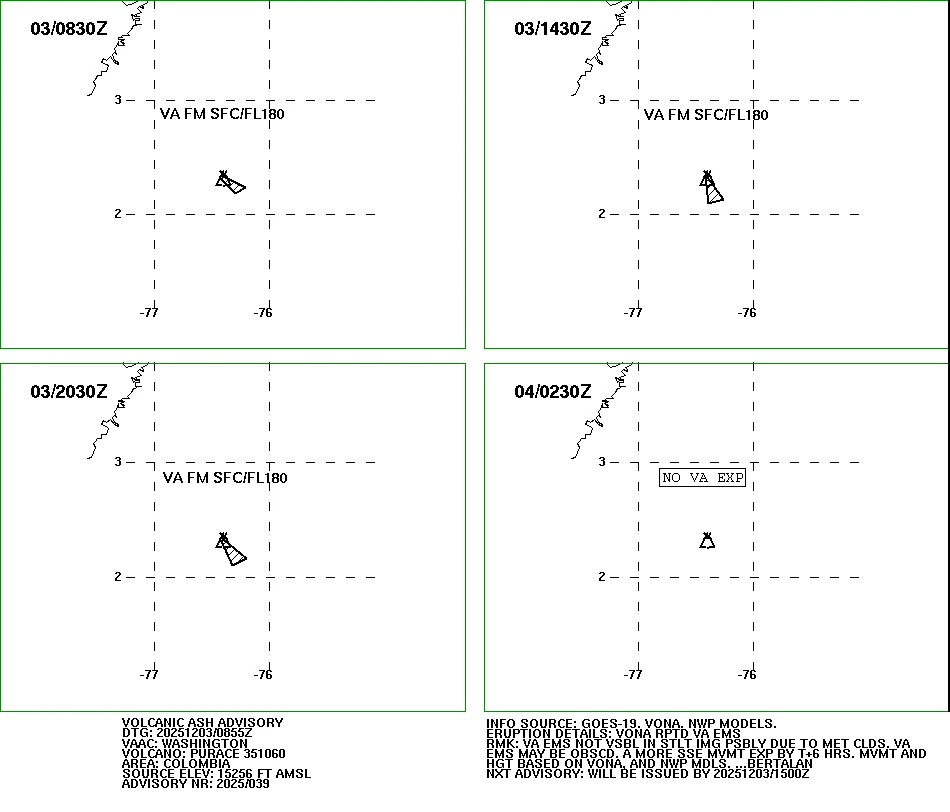
In the Volcanic Ash Advisory issued at 08:55 UTC on December 3, the Washington Volcanic Ash Advisory Center (VAAC) noted that satellite data from GOES-19, reports from SGC through its Volcano Observatory Notice for Aviation (VONA), and numerical weather prediction models indicated continuing volcanic ash emissions.
The advisory placed the observed ash cloud at altitudes up to 5.5 km (18 000 feet) above sea level. At 08:30 UTC, the ash plume was estimated to extend east and southeast of the volcano.
Forecast models suggested that ash would continue drifting toward the south-southeast during the following six hours, remaining at a similar height. The VAAC noted that ash emissions were not clearly visible in satellite imagery, likely due to dense meteorological cloud cover obscuring the signal.
This eruption follows an earlier event in early 2025. Between January 19 and February 21, 2025, Puracé experienced a confirmed explosive-effusive eruption rated VEI 2, centered at Curiquinga Crater within the same volcanic complex. Ash columns during that event rose to 5.8 km (19 000 feet) a.s.l., with ashfall reported in Coconuco and Puracé.
Several international media outlets described the November–December 2025 activity as the first eruption since 1977. However, this statement is incorrect and likely stems from a misinterpretation of Smithsonian data or reliance on outdated secondary summaries. Global Volcanism Program records confirm more recent activity, including short-lived VEI 1 eruptions on March 29, 2022, and November 16, 2023, and a VEI 2 eruption in early 2025.

Before its 21st-century reactivation, Puracé last produced moderate explosive eruptions in March 1977 (VEI 2) and July 1957 (VEI 2, uncertain), with other historical eruptions recorded throughout the 19th and 20th centuries. The current phase continues this pattern of low- to moderate-intensity explosive behavior, with continuous degassing, ash emissions, and occasional minor lava effusion.
Puracé is an andesitic stratovolcano rising 4 650 m (15 260 feet) a.s.l. in southern Colombia, about 28 km (17 miles) southeast of Popayán. It forms part of the Los Coconucos volcanic chain within the Central Andes and is one of Colombia’s most active volcanic centers.
The volcano’s eruptive behavior is usually characterized by persistent fumarolic activity, shallow seismicity, and gas-and-ash plumes of moderate height.
References:
1 Boletin Extraordinario – SGC – December 1, 2025
2 Boletin Extraordinario – SGC – December 2, 2025
3 Purace volcano – GVP – Accessed December 3, 2025
4 Eruption at Purace volcano sends ash to 5.8 km (19 000 feet) a.s.l., ashfall reported in Coconuco and Purace, Colombia – The Watchers – January 20, 2025

I'm a dedicated researcher, journalist, and editor at The Watchers. With over 20 years of experience in the media industry, I specialize in hard science news, focusing on extreme weather, seismic and volcanic activity, space weather, and astronomy, including near-Earth objects and planetary defense strategies. You can reach me at teo /at/ watchers.news.

Commenting rules and guidelines
We value the thoughts and opinions of our readers and welcome healthy discussions on our website. In order to maintain a respectful and positive community, we ask that all commenters follow these rules.