
Polar vortex expected to weaken as early season stratospheric warming develops
An early-season stratospheric warming event is forecast to weaken the polar vortex in the coming weeks, potentially influencing winter 2025–26 weather across North America and Europe.

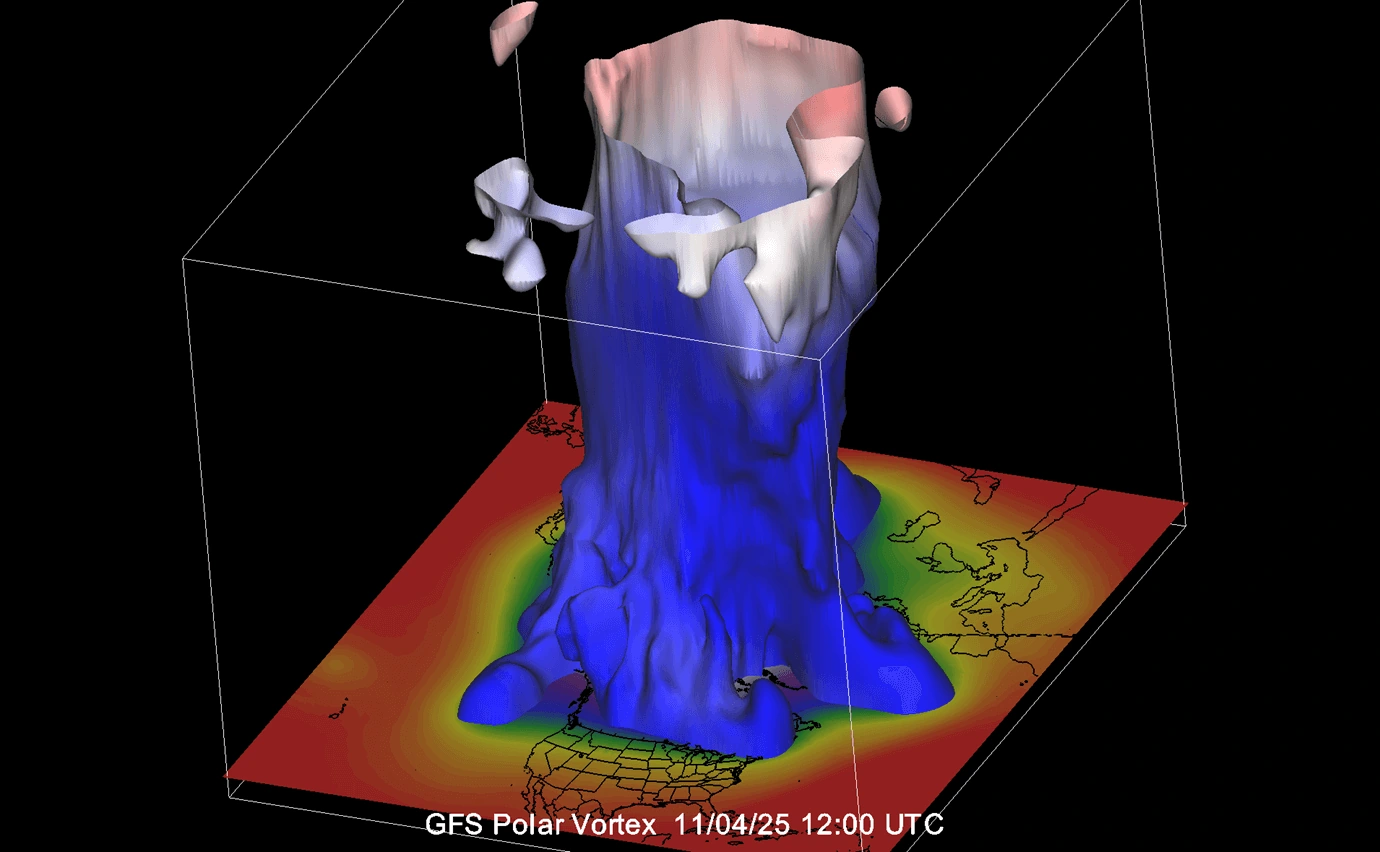
3D rendition of the Polar Vortex in Northern Hemisphere as of November 5, 2025. Image credit: Stratobserve
Forecast data show the first signs of an unusually early warming of the polar stratosphere, indicating a potential weakening of the Northern Hemisphere polar vortex.
According to an analysis by Andrej Flis from Severe Weather Europe, the warming signal is developing over the upper stratosphere, around 10 mb (approximately 30 km/ 18.5 miles altitude), and could lead to a slower or disrupted vortex during the first half of winter 2025–26.
The polar vortex is a large cyclonic circulation of cold air centered near the poles at stratospheric levels. When strong and stable, it tends to keep Arctic air confined to high latitudes.

When weakened or displaced by a stratospheric warming event, the circulation can falter, allowing cold polar air to move into mid-latitudes of North America, Europe, and Asia.
Model projections for late November and early December 2025 indicate an increasing temperature anomaly in the polar stratosphere.
This anomaly is expected to reduce wind speeds around the vortex, signaling a slowdown phase. The forecast shows a developing high-pressure anomaly over the polar region, pushing into the vortex core and displacing cold air southward.
In the troposphere, the forecast suggests a possible cold-air anomaly spreading from southern Canada into the northern and central United States during early December.
At the same time, a weakening of the jet stream pattern could enhance snowfall potential across parts of the Midwest and Great Lakes region.
For Europe, model data indicate a negative temperature anomaly over northern and central areas, including the United Kingdom, Scandinavia, and central Europe, while southern Europe remains largely unaffected. Early-season snow coverage may increase over northern Europe if the polar-air flow intensifies.
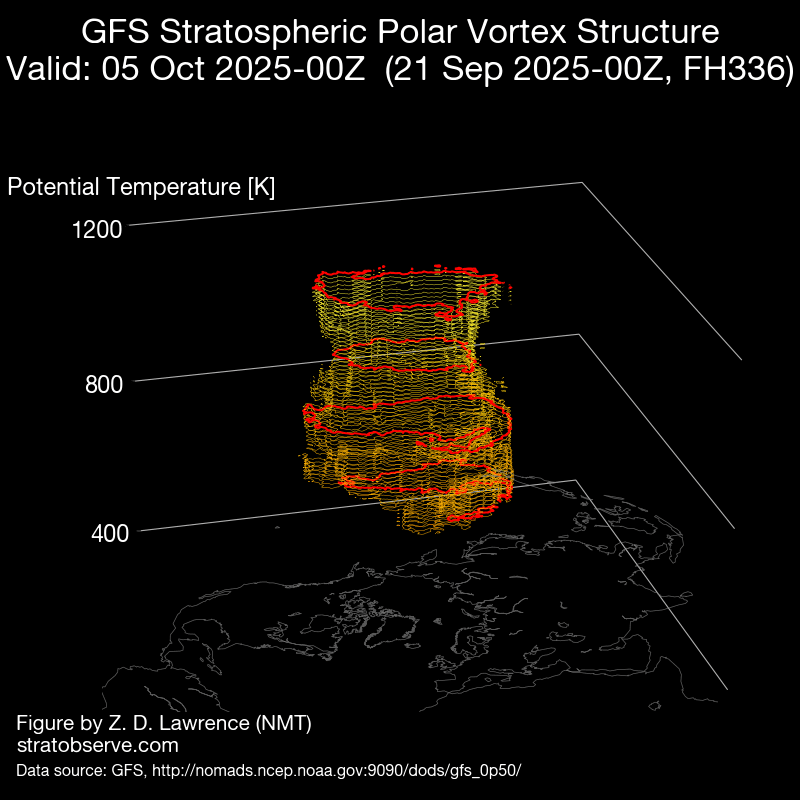
Such early-season stratospheric disturbances are uncommon. They can influence weather patterns for weeks to months, depending on the extent to which stratospheric signals propagate downward into the troposphere.
A weaker polar vortex typically favors increased meridional flow—allowing Arctic cold to reach mid-latitudes—and could lead to a more variable winter pattern across North America and Europe in the coming months.

References:
1 A significant Polar Vortex slowdown is forecast, bringing Cold Weather for Winter 2025/2026 – SWE – November 5, 2025

I am an Assistant Editor and Severe Weather & Science Journalist at The Watchers, specializing in real-time severe weather coverage, geophysical event reporting, and research-driven scientific analysis. You can reach me at rishav(at)watchers(.)news.

Commenting rules and guidelines
We value the thoughts and opinions of our readers and welcome healthy discussions on our website. In order to maintain a respectful and positive community, we ask that all commenters follow these rules.