
Earth’s electrical rings released rare energy leak during recent G2 geomagnetic storm
A G2 – Moderate geomagnetic storm on October 18, 2025, produced an extremely bright red SAR arc visible from the United States to northern Europe. The event showed an unusually efficient release of energy from Earth’s ring current system, challenging current understanding of how the planet’s magnetic field interacts with the atmosphere.
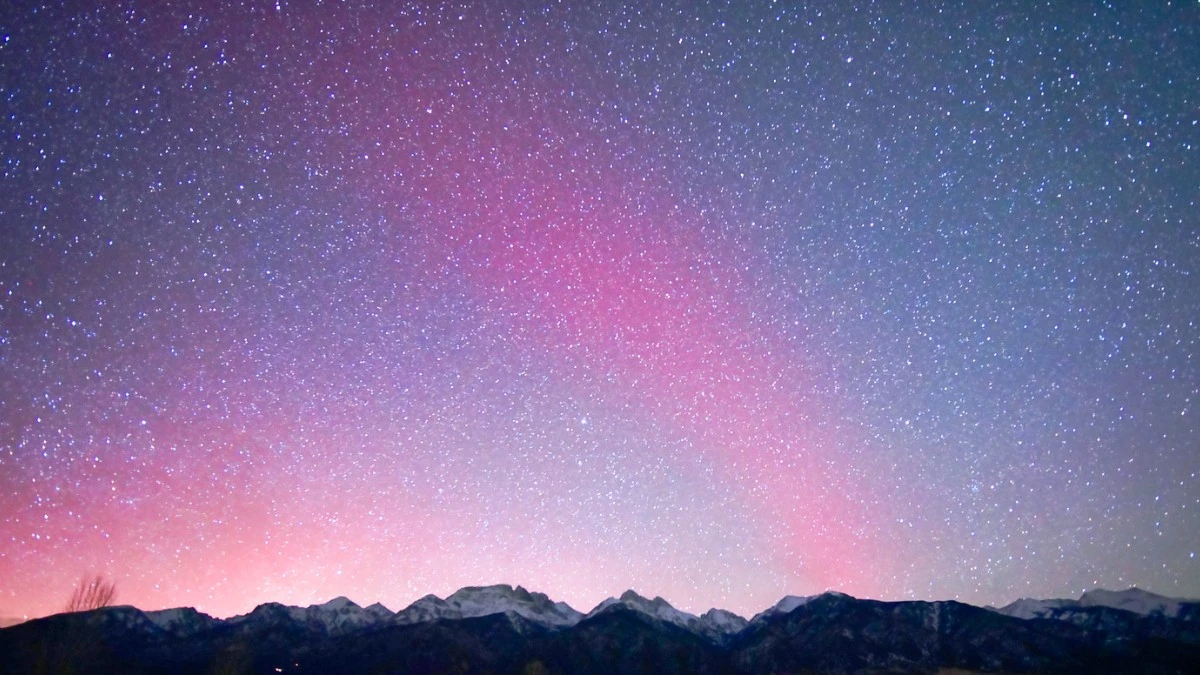
A SAR Arc from Colorado on February 27, 2023. Credit: Mike Lewinski
A deep red band of light stretched across the night sky on October 18, seen from Maine to Sweden and Finland. The phenomenon followed a moderate G2-class geomagnetic storm caused by a coronal mass ejection grazing Earth’s magnetosphere. While the storm’s strength was typical, the optical display was not.
“My son and I were surprised by this red bow in the south,” said P-M Hedén, who photographed the emission from Norrtälje, Sweden. “It was so bright, I could see its reflection in a local pond.” Observers in southern Öland, Sweden; Searsport, Maine; and southern Finland captured similar images, confirming that the arc extended across the Atlantic sector.
“Only a few times in a solar cycle do we get an SAR arc this bright,” said Jeff Baumgardner of Boston University’s Center for Space Physics, who has studied the phenomenon for decades. “It nearly saturated our detectors.” He estimated the arc was 10 to 30 times brighter than a G2 storm would normally produce, a figure still awaiting calibrated data.
SAR arcs, or Stable Auroral Red arcs, occur when thermal energy from Earth’s ring current leaks into the upper atmosphere. The ring current is a torus-shaped flow of charged particles encircling Earth between about three and eight Earth radii, carrying electrical currents of millions of amperes.
During geomagnetic storms, part of this energy escapes along magnetic field lines and heats dense plasma near the boundary of the plasmasphere. Excited atomic oxygen then emits red light at a wavelength of 630 nanometers, producing the characteristic glow.
SAR arcs were first identified in 1956, at the dawn of the Space Age. Early researchers mistook them for auroras and named them “Stable Auroral Red arcs,” a misnomer since they do not originate from charged particles streaming in from space but from heat conduction within the ring-current region.
The red emission is difficult for human eyes to see directly because night vision is relatively insensitive to red light. Nonetheless, the October 18 arc was bright enough to be visible to the naked eye at mid-latitudes, an uncommon occurrence for a storm of moderate intensity.
According to NOAA’s space-weather scale, a G2 storm represents a moderate disturbance, typically too weak to produce such bright emissions. The brightness and geographic reach, from North America across the Atlantic to northern Europe, suggest an unusually strong energy transfer between the ring current and the ionosphere.
Comparable large-scale SAR arcs have been documented only a few times in recent decades, notably during the October 29, 1991, geomagnetic storm and a global SAR event in November 2023. The 2025 occurrence joins this short list, distinguished by its brightness despite moderate storm strength.
Researchers at Boston University and collaborating institutions are compiling ground-based and satellite observations, including data from NOAA’s GOES spacecraft and ESA’s Swarm constellation, to determine why this event was so luminous.
For now, the October 18 SAR arc demonstrates that even moderate solar disturbances can produce complex and visually striking energy exchanges within Earth’s magnetic environment. The mechanism behind this unusually bright leak remains under investigation.
References:
1 Earth’s electrical rings just sprang a leak – SpaceWeather – October 22, 2025

I’m a science journalist and researcher at The Watchers, contributing to the Epicenter edition, where I cover peer-reviewed scientific research and emerging discoveries across Earth and space sciences. With a background in astronomy and a passion for environmental science, I’ve worked in shark and coral conservation in Fiji, conducting reef and shark-behavior research, contributing to mangrove restoration, and earning PADI Open Water and Coral Reef Certifications. I bring a blend of scientific rigor and storytelling to illuminate the discoveries shaping our planet and beyond.

Inversions magnétiques, aurores boréales rares et arc SAR
La chose extrêmement embarrassante que les géologues ont du faire c’est de rééditer le modèle magnétique mondial en 2024 parce que les pôles magnétiques se déplaçaient trop vite. Ils voient déjà des signes précoces de dégradation des prévisions des erreurs croissantes et donc nous pourrions nous diriger à nouveau vers cela, si cela se produit ça devrait vraiment réveiller la plupart des scientifiques. C’est important parce que nous sommes dans un déplacement des pôles magnétiques et c’est le genre de choses que nous disons depuis une décennie et quand cela se produira ce sera le signe que les choses s’accélèrent et c’est littéralement ce qui se passe. Nous avons la première identification de ce que nous avons appelé à l’origine l’événement de Noé, qui pourrait finalement être appelé l’événement de Tiani. Ils n’ont toujours pas de nom pour celui d’il y a 6 000 ans. Nous en avons la preuve au Moyen-Orient. Cela vient d’Iran. N’oubliez pas que nous avons vu des preuves de ce phénomène en Colombie, dans les Amériques et en Asie, nous l’avons vu en Sibérie, en Chine et en Corée du nord donc c’est une chose bien établie. Mais lorsque vous revenez en arrière et que vous incluez même certaines des études précédentes qui ont montré la faible intensité du paléo-champ magnétique, le point faible du champ magnétique terrestre il y a environs 6 000 ans, vous avez un total d’environ 15 études et elles utilisent toutes des méthodes de datation différentes et elles vous donnent tout d’il y a environ 5 500 ans à 7 000 ans. Maintenant ils ont 5 000 avant J-C ce qui correspondrait à 7 000 ans. De la façon dont les scientifiques font la datation isotopique dans leurs études, on peut donc dire que c’est moins de 7 000 ans. Il s’agit d’une autre preuve de l’événement qui s’est produit il y a 6 000 ans. Nous avons également l’une des premières découvertes à basse latitude confirmant l’excursion en mer du Groendand, ceci a également été appelé l’excursion Vostok et c’était il y a environ 60 000 ans. Pour ceux qui ne le savent pas
Vostok se trouve en Antarctique. Cela apparaît très fortement aux pôles Nord et Sud actuels. Nous avons eu une autre observation d’aurore rose cela s’est produit tellement de fois au cours des trois dernières années, en France aperçu au large du Cap Blanc Nez et bien d’autres pays. j’ai peur que cela devienne si courant que les gens ne comprennent pas ce que c’est et pourquoi c’est important. Juste en me basant sur les gros titres qui montrent que c’est quelque chose de cool à voir et qui n’expliquent pas. vraiment ce qui se passe c’est le genre de chose qui nous dit, d’accord, mais le plasma pénètre de plus en plus profondément dans l’atmosphère et ce n’est pas parce que le soleil nous frappe de plus en plus fort. Un autre signe que les aurores boréales deviennent folles
Notre planète est en difficulté et est bien plus proche de l’effondrement magnétique que la plupart ne le pense et tout ceci est lié au déplacement des pôles magnétiques.