
Wildfires burn 600 000 ha (1.5 million acres) in Spain and Portugal, killing six and forcing mass evacuations
Wildfires burning since August 9, 2025, have scorched about 382 600 ha (945 000 acres) in Spain and at least 216 200 ha (534 000 acres) in Portugal, killing six people and forcing tens of thousands to evacuate.
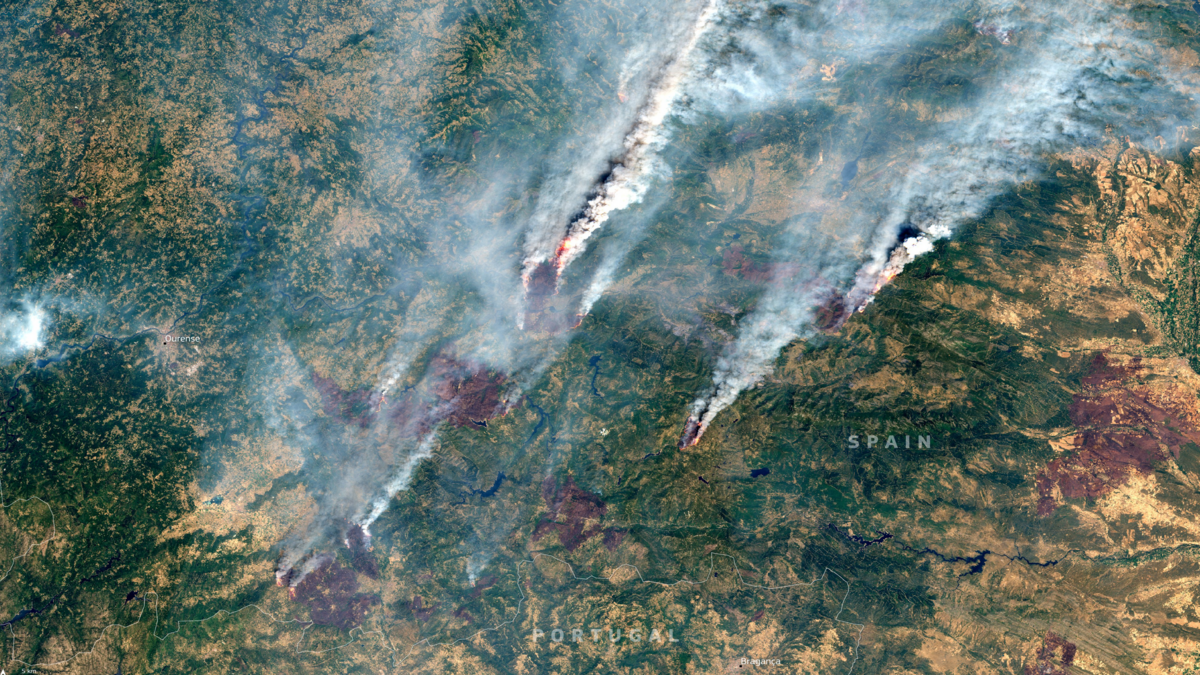
Sentinel-2 satellite image acquired on August 16, 2025 shows dense smoke plumes rising from active fires near the city of Ourense, Galicia, northwestern Spain. Credit: Copernicus EU/Sentinel-2
Wildfires fueled by prolonged drought and extreme heat have devastated vast regions of the Iberian Peninsula since August 9. The affected areas include Castile and León, Galicia, Extremadura, and Asturias in Spain, and Guarda, Castelo Branco, Coimbra, Viseu, and Bragança in Portugal.
According to the European Forest Fire Information System (EFFIS) and official reports, Spain has recorded four fatalities and evacuated more than 30 000 people. Portugal has reported two fatalities and thousands of evacuations in affected areas. The combined death toll stands at six, with tens of thousands displaced across both countries.
This year marks Spain’s most destructive wildfire season since records began in 2006, with around 382 600 ha (945 000 acres) burned by mid-August. In Portugal, wildfires have consumed approximately 216 200 ha (534 000 acres) so far in 2025.
Spanish military emergency unit firefighters battled different blazes in various regions of the country. Southern Europe is experiencing one of its worst wildfire seasons in two decades, with Spain and Portugal among the hardest-hit countries https://t.co/MD9deLnvuZ pic.twitter.com/WsFX6V68Zn
— Reuters (@Reuters) August 20, 2025
Spain has deployed approximately 3 400 troops to support firefighting efforts and has received assistance from EU partners, including firefighting aircraft from several countries. In Galicia, multiple fires were reportedly sparked by dry lightning during high-temperature conditions.
In Portugal, around 3 700 firefighters have been mobilized, and the government has requested EU support, including water-bombing aircraft. The situation has been described as a “disproportionate war against nature,” as large parts of the forested interior remain vulnerable. According to Copernicus Atmosphere Monitoring Service (CAMS) data, the country’s estimated emissions have nearly reached the highest annual totals of 2003 and 2005.
Authorities are investigating suspected arson, with Spain’s Interior Ministry reporting 32 arrests and 93 people under investigation. Spanish Prime Minister Pedro Sánchez has called for a cross-party “state pact” to improve preparedness for future climate-related emergencies.
Forecasts of cooler temperatures and increased humidity in the coming days may aid containment efforts, though officials warn that the underlying conditions of parched soils and dry vegetation leave the region vulnerable to further outbreaks.

I’m a science journalist and researcher at The Watchers, contributing to the Epicenter edition, where I cover peer-reviewed scientific research and emerging discoveries across Earth and space sciences. With a background in astronomy and a passion for environmental science, I’ve worked in shark and coral conservation in Fiji, conducting reef and shark-behavior research, contributing to mangrove restoration, and earning PADI Open Water and Coral Reef Certifications. I bring a blend of scientific rigor and storytelling to illuminate the discoveries shaping our planet and beyond.

Commenting rules and guidelines
We value the thoughts and opinions of our readers and welcome healthy discussions on our website. In order to maintain a respectful and positive community, we ask that all commenters follow these rules.