
Iceland’s historic May heatwave sets new temperature records
A record-breaking heatwave affected Iceland from May 6 to 15, 2025, with temperatures reaching 26.6°C (79.9°F) at Egilsstaðir Airport and setting a new national May temperature record. The 10-day event was described by the Icelandic Meteorological Office as the most significant May heatwave in the country’s meteorological history.
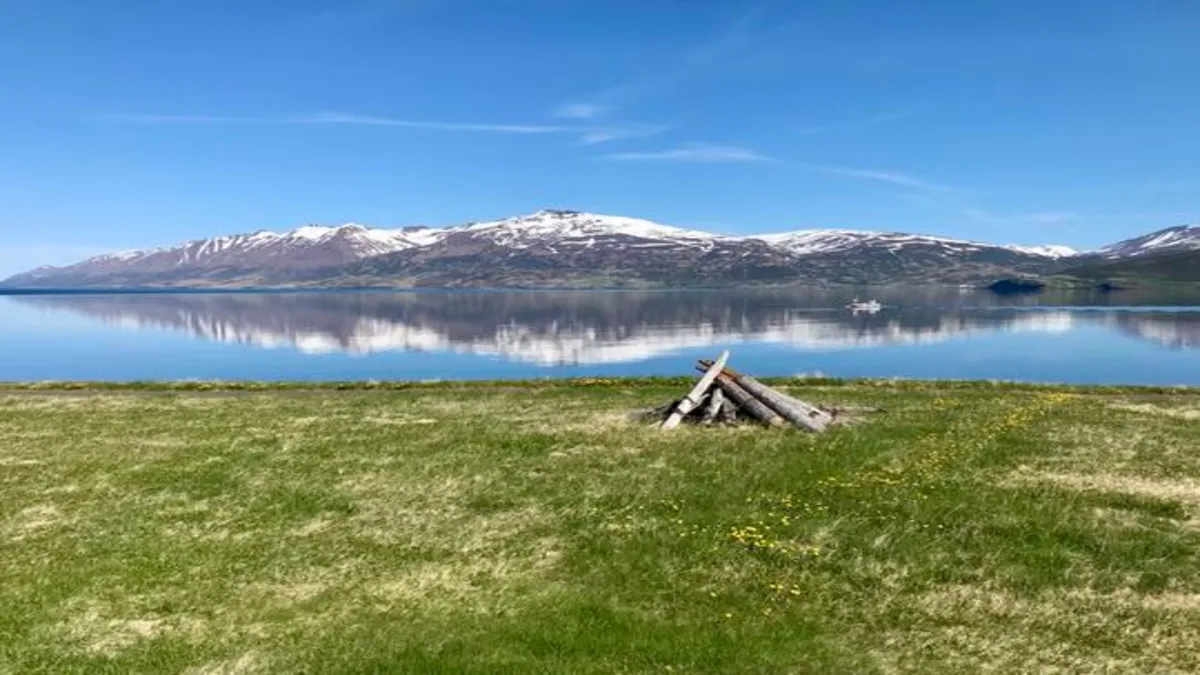
Calm seas in Eyjafjörður near the town of Akureyri on May 17, 2025. In the town of Akureyri which has more than 100 years of temperature measurements the average for the first 22 days of May 2025 is 10.9°C (51.6°F) - by far the warmest on record for this period. Credit: IMO/Haukur Haraldsson
Iceland experienced a historic heatwave from May 13 to 22, with temperatures reaching or exceeding 20°C (68°F) at multiple weather stations for 10 consecutive days. According to the Icelandic Meteorological Office (IMO), this was the first such occurrence in May and the most significant May heatwave ever recorded in the country.
“The entire country experienced very warm and bright weather during these days, with temperatures far above the seasonal average,” IMO said.
The temperature anomalies were highest in the northeastern and eastern highlands of Iceland, where the average temperature anomaly exceeded 10°C (18°F). It wasn’t quite as warm along the southern and southeastern coasts, but even there, the temperature anomalies were about 3°C (5.4°F) or higher.
On May 15, Egilsstaðir Airport in eastern Iceland recorded a temperature of 26.6°C (79.9°F), setting a new national temperature record for May. This surpassed the previous record of 25.6°C (78.1°F) set in Vopnafjörður in 1992. Satellite data from the Copernicus program recorded a similar temperature of 26.3°C (79.3°F) at Egilsstaðir on the same day.
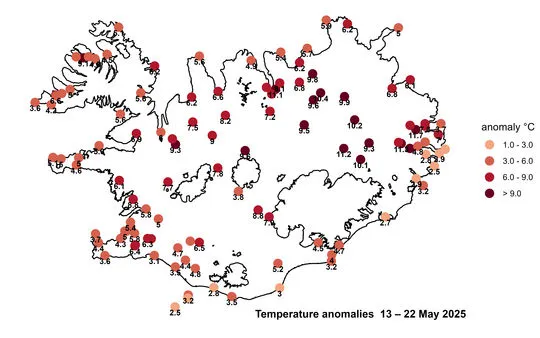
The heatwave impacted multiple regions, with May temperature records broken at 94% of automatic weather stations that have been operational for at least 20 years. Both inland and coastal areas, including eastern and western Iceland, recorded extreme temperatures simultaneously, showing a large-scale atmospheric pattern.
Temperatures peaked over the weekend of May 17–18, with temperatures reaching 20°C (68°F) or more at about half of all weather stations in Iceland.
At many weather stations across the country, the average temperature for the first 22 days of May has never been this high, IMO said.
This includes decades-old stations such as Stykkishólmur (reliable daily maximum temperature data since 1846), Reykjavík (since 1881), Dalatangi (since 1939), and Vatnsskarðshólar (since 1951).
In the town of Akureyri, which has over 100 years of temperature records, the average for the first 22 days of May 2025 was 10.9°C (51.6°F), by far the warmest on record for this period. The same applies to the highland station at Grímsstaðir á Fjöllum, where the average temperature for the first 22 days of May was just under 10°C (50°F), the highest recorded in 119 years of continuous measurements.
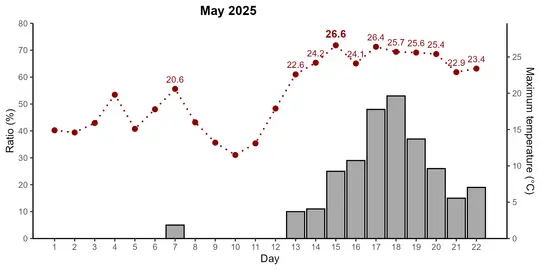
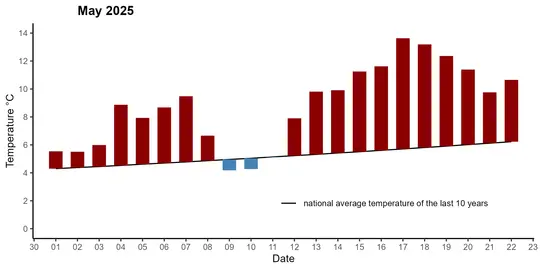
While heatwaves are not unknown in Iceland, the May 13–22 event is the most intense ever recorded during the month of May.
The only comparable May heatwave occurred in 1987 under similar weather conditions. In terms of duration and geographic extent, major heatwaves also occurred in late July to early August 2008 and August 2004, with widespread record-breaking temperatures exceeding 20°C (68°F), although those events reached higher temperatures as they took place in late summer.
Other notable events include July 1976, July 1991, and the summer of 2021, which mainly affected the northeast and east. The highest temperature ever recorded in Iceland, 30.5°C (86.9°F)—was registered at Teigarhorn on June 22, 1939.
References:
1 The most significant May heatwave ever recorded in Iceland – Icelandic Meteorological Office – May 26, 2025

I’m a science journalist and researcher at The Watchers, contributing to the Epicenter edition, where I cover peer-reviewed scientific research and emerging discoveries across Earth and space sciences. With a background in astronomy and a passion for environmental science, I’ve worked in shark and coral conservation in Fiji, conducting reef and shark-behavior research, contributing to mangrove restoration, and earning PADI Open Water and Coral Reef Certifications. I bring a blend of scientific rigor and storytelling to illuminate the discoveries shaping our planet and beyond.

Commenting rules and guidelines
We value the thoughts and opinions of our readers and welcome healthy discussions on our website. In order to maintain a respectful and positive community, we ask that all commenters follow these rules.