
Kanlaon eruption leads to lahars and forced evacuations, Philippines
The eruption at Kanlaon volcano on Thursday, February 6, 2025, occurred amid heavy rainfall, triggering lahars that swept through river channels in Negros Occidental. The event prompted authorities to enforce evacuations within a 6 km (3.7 miles) radius.
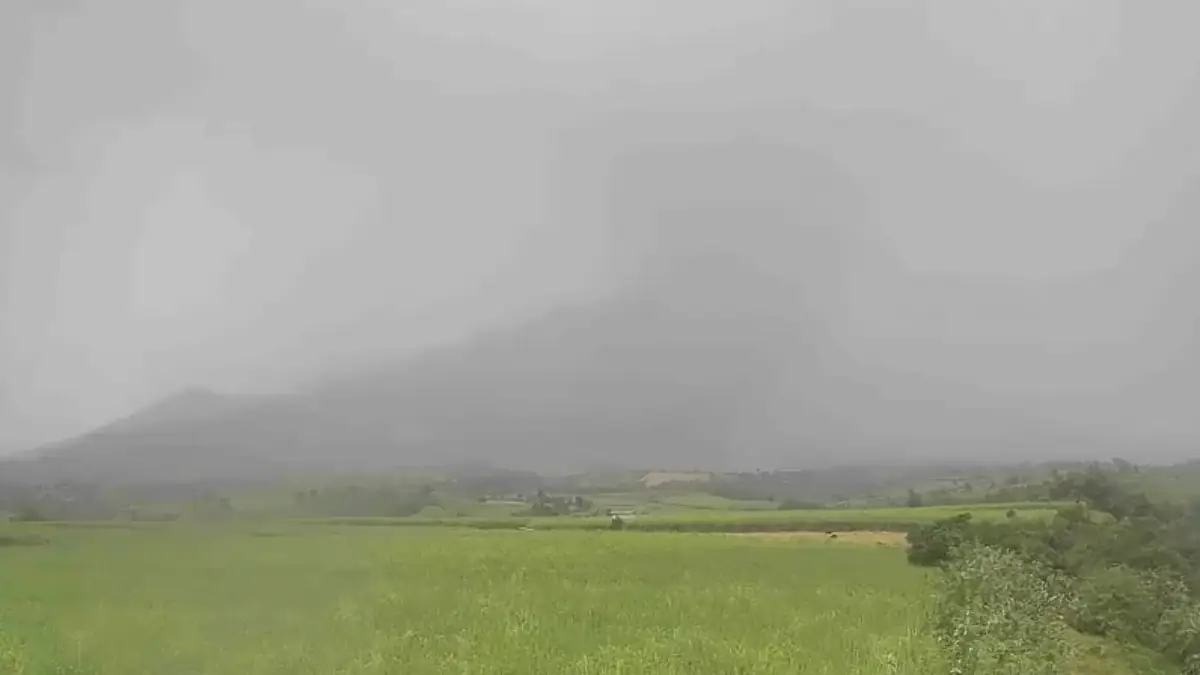
Kanlaon volcano on February 6, 2025. Credit: PHIVOLCS
- Various parameters, not just the eruption on Thursday, suggest Kanlaon is showing signs of preparing for a major eruption
Heavy rainfall during the February 6, 2025, eruption of Kanlaon volcano triggered lahars, forcing evacuations in Negros Occidental. Evacuations have been ordered within a 6 km (3.7 miles) radius from the summit due to risks of sudden explosive eruptions, lava flows, pyroclastic density currents (PDCs), rockfalls, and lahars.
Lahar flows were recorded in the Buhangin River and Binalbagan River and posed serious risks to nearby communities. Authorities have urged increased vigilance as the volcano remains at Alert Level 3 (magmatic unrest).
The minor explosive eruption which occurred at 15:11 LT (07:11 UTC) on February 6, lasted two minutes and produced a 600 m (1 968 feet) ash plume drifting southwest. Thin ashfall was reported in Sto. Mercedes and San Luis, Barangay Sag-ang, Negros Occidental.
The explosion also generated an airwave recorded at 70 Pascals (Pa), heard in Barangay Yubo, La Carlota City, and Barangay Sag-ang, La Castellana. Sulfurous fumes were also reported in the areas.
The eruption coincided with rainy weather and led to channel-confined lahars flowing through La Castellana and Moises Padilla through the Buhangin River. The Binalbagan River also recorded lahar flow on February 7.
Philippine Institute of Volcanology and Seismology (PHIVOLCS) has strongly advised increased caution in river drainages around the volcano, warning that intense rainfall could worsen sediment-laden flows.
Residents in affected areas have been advised to wear face masks because of sulfurous gas emissions and avoid fishing in lahar-affected rivers.
23 volcanic earthquakes were recorded on February 8. The sulfur dioxide (SO2) flux was measured at 4 186 tonnes per day on February 7, increasing from 2 249 tonnes per day on February 6. A 75 m (246 feet) high moderate plume was observed drifting southwest. The volcano remains inflated which signals ongoing magma intrusion.
PHIVOLCS noted a drop in SO2 emissions before the February 6 eruption from an average of 4 484 tonnes per day since June 3, 2024, to 2 249 tonnes per day. Weak degassing and inflation of the upper and middle slopes have been detected since January 10.
The agency attributed the eruption to pressure buildup in the volcanic conduit because of plugging and weakened degassing.
“All parameters, not just the event Thursday, are indicating Kanlaon is preparing for a major eruption,” Ma. Antonia V. Bornas, PHIVOLCS Volcano Monitoring and Eruption Prediction Division chief, said.
The Negros Occidental provincial government is using local funds to support evacuees in 15 evacuation centers in La Castellana, La Carlota City, and Bago City.
Eugenio Jose Lacson, the Governor, stated that the ₱50 million ($861 500) emergency fund from the Office of the President remains inaccessible because of pending documentation.
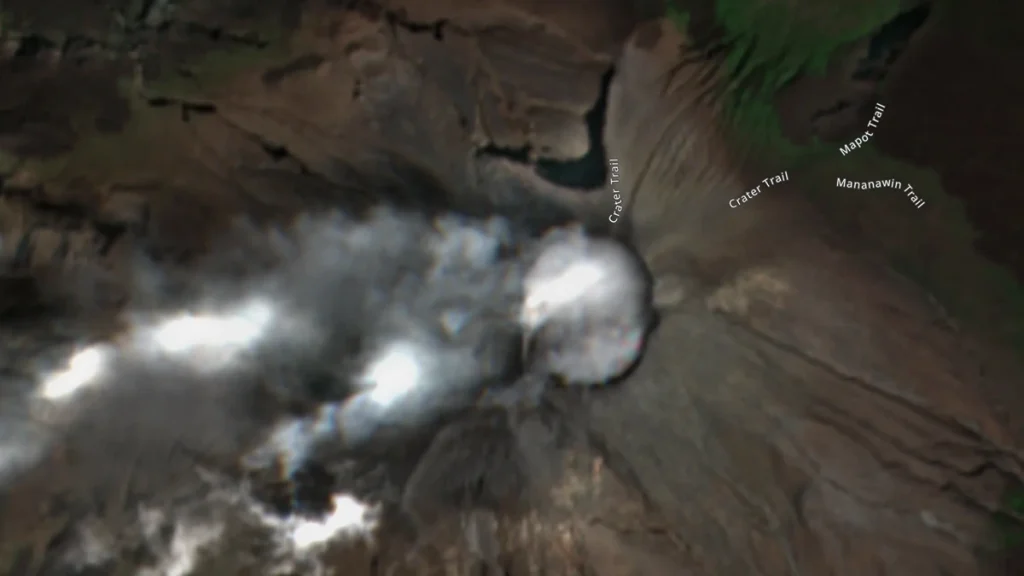
Kanlaon, a stratovolcano on the island of Negros in the Philippines, stands at an elevation of 2 422 m (7 946 feet) and forms part of the Negros-Sulu Volcanic Arc. Its structure comprises fissure-controlled pyroclastic cones, craters, and a northern caldera measuring approximately 2 km (6 561 feet) in width.
The active Lugud crater, located to the south of the main caldera, has been the site of multiple historical eruptions. Kanlaon has experienced both phreatic and magmatic activity, with recorded eruptions dating back to 1866. Its geological composition includes andesite and basaltic andesite, with evidence of subduction-related volcanism because of its position above a tectonic subduction zone.
The volcano’s most notable geological event was a large debris avalanche that traveled 33 km (108 267 feet) southwest, the longest such event recorded in the Philippines.
Kanlaon has exhibited consistent eruptive activity, with over 30 confirmed Holocene eruptions. Recent activity has been marked by an ongoing eruption that began in October 2024, following a June 2024 eruption that reached a Volcanic Explosivity Index (VEI) of 3.
Eruptions were recorded in 2017, 2015-2016, and several times throughout the 20th century, with most events classified as small-to-moderate phreatic explosions causing local ashfall. The volcano’s active degassing phase includes SO2 emissions, reaching thousands of tonnes per day.
References:
1 Kanlaon volcano summary – PHIVOLCS – February 8, 2025
2 Kanlaon volcano summary – PHIVOLCS – February 7, 2025
3 Kanlaon – GVP – Accessed on February 8, 2025
4 Kanlaon volcano eruption update – PHIVOLCS – February 6, 2025
5 Phivolcs calls for increased vigilance against potential syn-eruption lahars – DIGICAST NEGROS – February 7, 2025

Rishika holds a Master’s in International Studies from Stella Maris College, Chennai, India, where she earned a gold medal, and an MCA from the University of Mysore, Karnataka, India. Previously, she served as a Research Assistant at the National Institute of Advanced Studies, Indian Institute of Science, Bengaluru, India. During her tenure, she contributed as a Junior Writer for Europe Monitor on the Global Politics website and as an Assistant Editor for The World This Week. Her work has also been published in The Hindu newspaper, showing her expertise in global affairs. Rishika is also a recipient of the Women Empowerment Award at the district level in Haryana, India, in 2022.

Commenting rules and guidelines
We value the thoughts and opinions of our readers and welcome healthy discussions on our website. In order to maintain a respectful and positive community, we ask that all commenters follow these rules.