
Category G2 – Moderate geomagnetic storm predicted for November 29
A coronal mass ejection (CME) associated with filament eruption near Region 3901 at around 20:24 UTC on November 25, 2024, is forecast to reach Earth late November 28 (UTC).
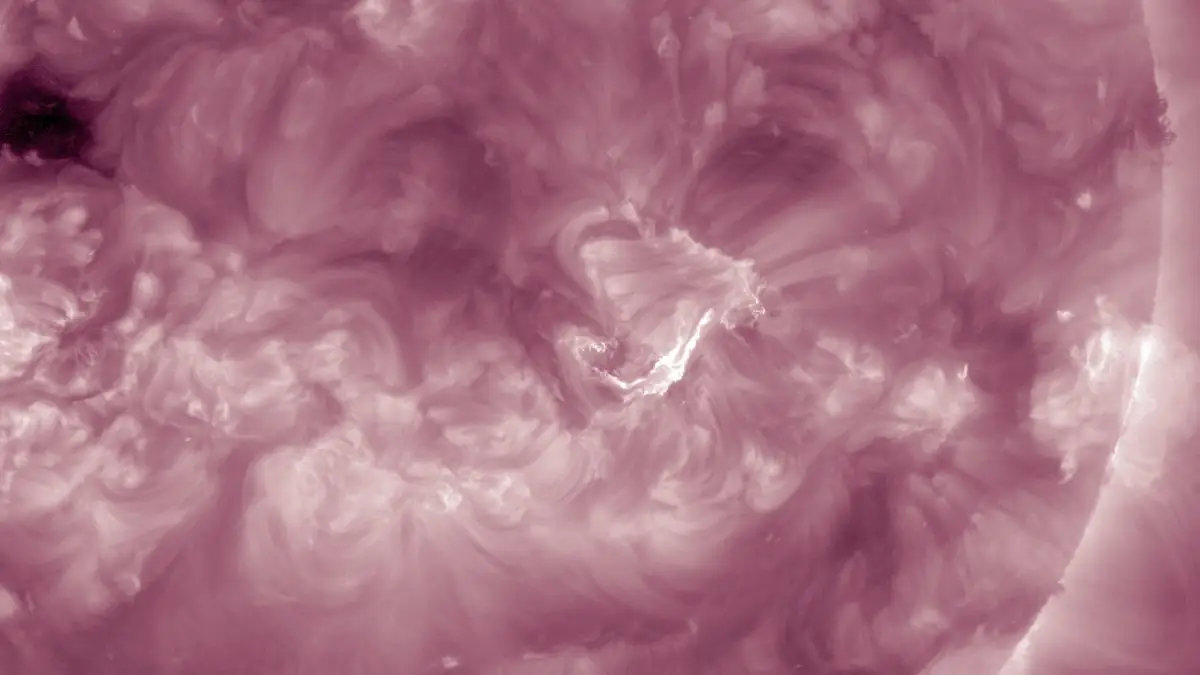
Image credit: NASA SDO/AIA 211. Acquired at 20:44 UTC on November 25, 2024
CME associated with a filament eruption near Region 3901 on November 25, 2024, is forecast to reach Earth late November 28 (UTC).
As a result, the NOAA Space Weather Prediction Center (SWPC) is forecasting a G1 – Minor geomagnetic storm for November 28 and a G2 – Moderate for November 29.

G2 – Moderate geomagnetic storms can produce a range of effects primarily affecting areas poleward of 55 degrees geomagnetic latitude.
Storms of this intensity may cause power grid fluctuations and voltage alarms in high-latitude power systems. Satellites could also experience irregularities in their orientation, along with increased atmospheric drag on those in low Earth orbit. Additionally, high-frequency (HF) radio communications may experience fading at higher latitudes, potentially disrupting communication.
Aurora displays may extend as far south as regions like New York, Wisconsin, and Washington state.

Solar wind parameters over the past 24 hours continued to reflect weak, negative polarity coronal hole high speed stream (CH HSS) influence. The total field was between 6 – 9 nT with the Bz component oscillating between +/- 7 nT.
Solar wind speeds averaged around 415 km/s while the phi angle remained in the negative orientation through much of the period.
References:
1 Forecast Discussion – NOAA/SWPC – Issued at 12:30 UTC on November 26, 2024

Teo Blašković founded The Watchers in 2011 and edited it until 2026, covering seismic and volcanic activity, extreme weather, space weather and near-Earth objects. Articles on this page are his archive.
Earlier reporting
Nothing on Watchers was published in the last 24 hours. These are older articles.
- On October 22, 2017, a single flash of lightning stretched 515 miles from eastern Texas to near Kansas City, a distance that takes eight hours to drive, and nobody realized how far it had gone until scientists went back through the satellite data years later Epicenter
- CPC posts a slight risk of heavy rain from the Gulf Coast to the Northeast urban corridor November 25-29, and a moderate risk of West Coast wind and Sierra snow on November 25
- Florida's east coast faces a moderate flash flood risk Wednesday through Friday, with 4 to 8 inches of rain forecast and the St. Johns River near Cocoa already in major flood at 17.13 feet
- Cyclone Akvan to make landfall between Nellore and Visakhapatnam around noon on November 20, IMD forecasts 120-130 km/h winds gusting to 145
