
M9.4 solar flare erupts beyond northeastern limb
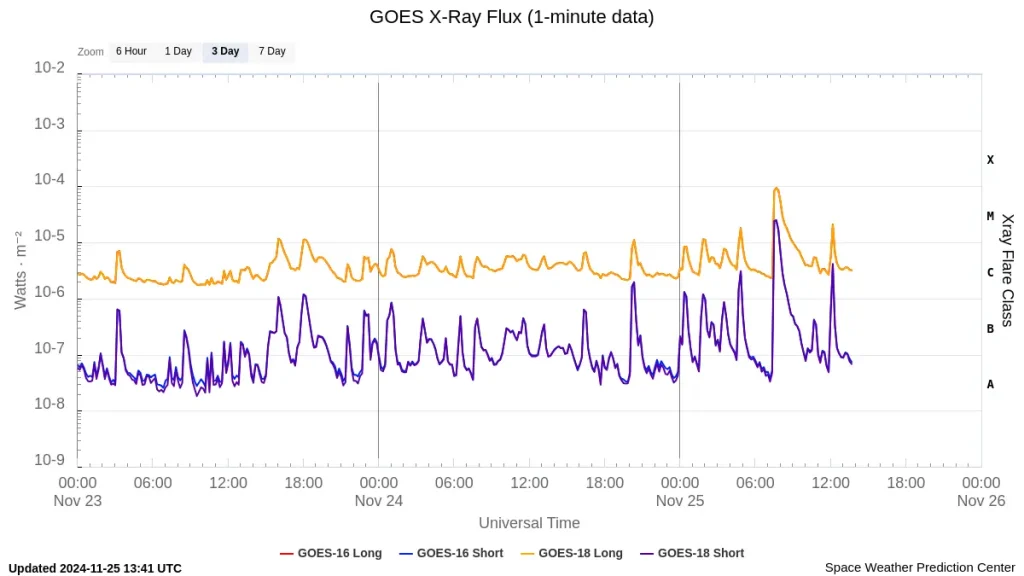
A strong solar flare measuring M9.4 erupted beyond the Sun’s northeastern limb at 07:42 UTC on November 25, 2024. The event started at 07:24 and ended at 08:03 UTC.

M9.4 solar flare on November 25, 2024. Credit: NASA SDO/AIA 131, Helioviewer, The Watchers
A strong solar flare measuring M9.4 erupted beyond the Sun’s northeastern limb on November 25, peaking at 07:42 UTC.
A 10cm Radio Burts (Tenflare), lasting 3 minutes and with a peak flux of 210 sfu, was registered from 07:33 to 07:36 UTC.
A 10cm radio burst indicates that the electromagnetic burst associated with a solar flare at the 10cm wavelength was double or greater than the initial 10cm radio background. This can be indicative of significant radio noise in association with a solar flare. This noise is generally short-lived but can cause interference for sensitive receivers including radar, GPS, and satellite communications.
This region also produced M1.1 at 20:22 UTC on November 24.
The location of this region does not favor Earth-directed coronal mass ejections (CMEs). However, this will change in the days ahead as the region moves toward the center of the solar disk.


Additionally, beginning at approximately 01:48 UTC on November 25, a filament eruption, centered near S45E18, was observed in GOES-16 304 angstroms imagery. This event was modeled and returned as a miss below Earth’s orbit.
“Any glancing influence would likely materialize on November 29, but confidence is low in this outcome. No Earth-directed CMEs were observed in available imagery,” NOAA SWPC forecasters said at 12:30 UTC today.

Solar activity will likely continue at high levels due to R1 – R2 (Minor – Moderate) radio blackout activity, with a slight chance for R3 – Strong radio blackouts, through November 27.
The greater than 2 MeV electron flux was at normal to moderate levels in 24 hours to 12:30 UTC on November 25, while the greater than 10 MeV proton flux returned to background levels.
The greater than 2 MeV electron flux is expected to continue at normal to moderate levels. There’s a slight chance for the greater than 10 MeV proton flux to reach S1 – Minor solar radiation storm levels through November 27 primarily due to the flare and subsequent CME potential currently exhibited by AR 3906.
Solar wind parameters reflected weak, negative polarity coronal hole high speed stream (CH HSS) influence over the past 24 hours. The total field was primarily 6 – 9 nT, and the Bz component underwent several southward deflections reaching -5 to -7 nT. Solar wind speeds ranged ~400 km/s to brief peaks near 450 km/s. Phi was predominantly in a negative orientation.
Solar wind parameters are expected to begin to trend towards a more ambient-like state over the remainder of November 25 and remain in a nominal state through November 27 thereafter.
The geomagnetic field was at quiet to unsettled levels with an isolated active period at the end of November 24.
The geomagnetic field is expected to be at quiet to unsettled levels for the remainder of November 25. Predominantly quiet levels are expected to prevail through November 27.
References:
1 Forecast Discussion – NOAA/SWPC – Issued at 12:30 UTC on November 25, 2024Center.

Teo Blašković founded The Watchers in 2011 and edited it until 2026, covering seismic and volcanic activity, extreme weather, space weather and near-Earth objects. Articles on this page are his archive.
Published in the last 24 hours
- Male toads abandoned a pond in Italy five days before a deadly 2009 earthquake, while a scientist was counting them Epicenter
- An asteroid was spotted 19 hours before it exploded over Sudan in 2008, and students picked its pieces off the desert Epicenter
- A wave up to 3 m (10 feet) high rose out of Lake Michigan on a sunny June morning in 1954 and swept fishermen off Chicago’s piers, and when a second came 10 days later, warnings had cleared the shore Epicenter
- Just 12 inches of rushing water can carry away most cars, and more than half of US flood drownings happen to people who drive into flood water Epicenter
