
Black Sea storm stalls off Turkish coast, floods parts of Trabzon
A low pressure area forming over the eastern Black Sea brought heavy rains of up to 165 mm (6.5 inches) to the eastern districts of Trabzon Province, Turkey on September 20, 2024, causing floods and landslides.
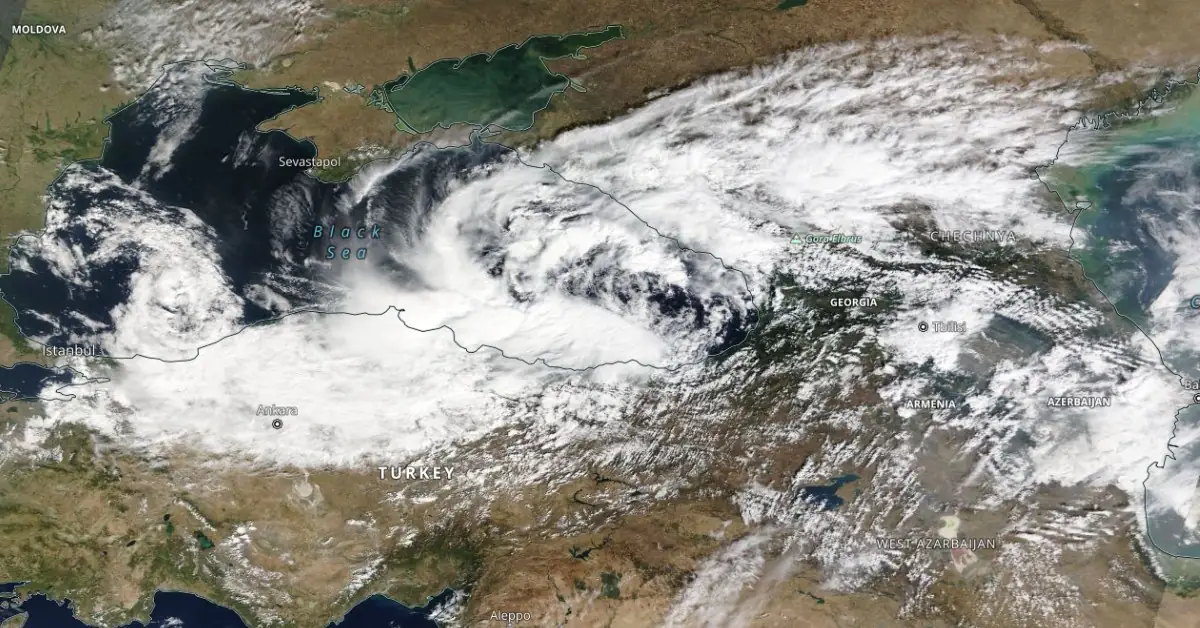
Image credit: NASA Terra/MODIS. Acquired on September 23, 2024
- The rains were brought by an area of low pressure over the Black Sea that developed a well-defined surface circulation on Monday, September 23.
- Conditions are currently favorable for subtropical development, and there is a high chance of medistorm formation in the next day or so.
- Trabzon, known for its mountainous terrain and densely forested areas, is particularly vulnerable to such weather events.
- Interests along the central Turkish coast and the Russian and Georgian coasts should prepare for periods of high wind and heavy rain.
Turkish province of Trabzon experienced heavy rainfall across the districts of Araklı, Arsin, and Sürmene, on September 20, resulting in severe flooding and landslides.
According to reports, the 112 Emergency Call Center and the district Disaster and Emergency Management Authority (AFAD) received approximately 320 reports of flood-related incidents.
Around 664 personnel, 228 vehicles, and five boats were deployed for search and rescue operations, as well as for clearing blocked roads and debris from rivers.
Official reports indicate that flood-related issues have been resolved in 93 workplaces and seven residences, and three vehicles have been recovered. Visuals shared online show flood waters racing through the regions carrying away houses and vehicles causing widespread damage.

A total of 12 ha (30 acres) of agricultural land was damaged in four neighborhoods, and assessments of crop losses are ongoing.
Damage control efforts are ongoing, blocked roads have been cleared, and no neighborhoods are currently facing power outages, water shortages, or communication problems, although some localized issues remain.
The Turkish Red Crescent has been distributing hot soup, food packages, drinks, and water using three service vehicles in the affected areas, while several governorates and municipalities have assisted in damage control efforts.
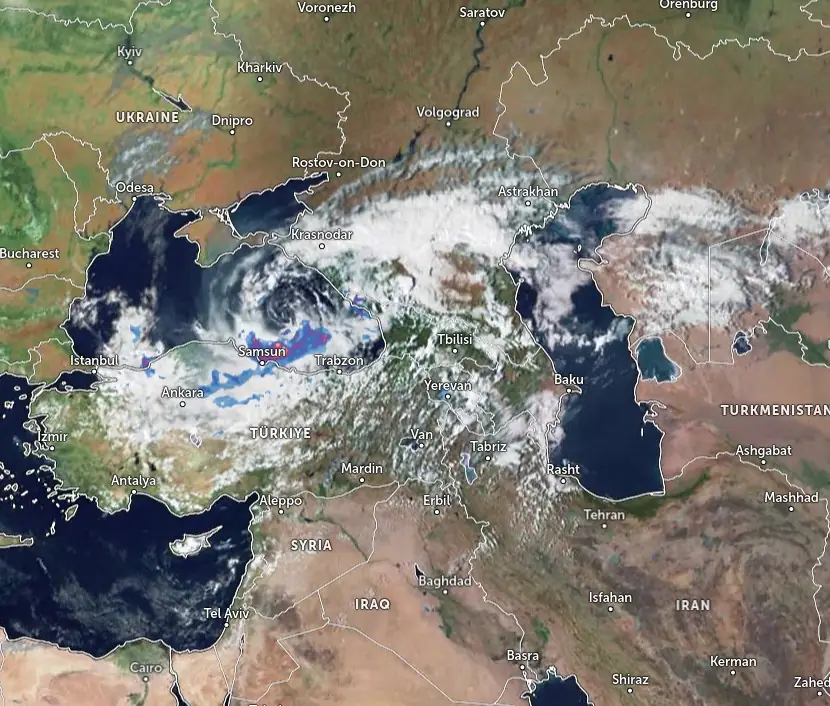
The rains were brought by an area of low pressure over the Black Sea that developed a well-defined surface circulation overnight on Monday, September 23.
According to the Mediterranean Cyclone Center (MCC), a group of amateur meteorologists studying medicanes and eurocanes, the center of this storm is now located in the central Black Sea.
“If trends continue, advisories on a subtropical medistorm will begin later today or early tomorrow. Conditions are currently favorable for subtropical development, and there is a high chance of medistorm formation in the next day or so.”
Conditions are expected to begin deteriorating late Tuesday, September 24, and this system will not survive as a named storm beyond Wednesday, MCC said.
The low is currently stalled off the Turkish coast and is expected to move slowly to the northeast.
Interests along the central Turkish coast and the Russian and Georgian coasts should prepare for periods of high wind and heavy rain. The low is producing sustained winds of 65 km/h (40 mph) according to a recent ASCAT pass.
References:
1 Flooding affects 12 neighborhoods across Trabzon, NE Türkiye – DailySabah – September 22, 2024
2 Special Outlook – MCC – Issued at 12:00 UTC on September 23, 2024

Rishav Kothari is Editor-in-Chief of The Watchers, where he runs the newsroom and covers earthquakes, volcanoes, severe weather and space weather.
Published in the last 24 hours
- A 19-year-old Nebraska teacher reportedly tied her pupils together with twine and led them to safety through a blizzard in January 1888 Epicenter
- NASA built the Opportunity rover to last 90 days on Mars, and Martian winds helped keep it alive for nearly 15 years by blowing dust off its solar panels, until a planet-wide dust storm in 2018 blocked sunlight and silenced the rover Epicenter
- In the winter of 1811–12, earthquakes near New Madrid, Missouri, shook so hard that witnesses saw the Mississippi River flow backward, and the shaking left a brand-new lake in Tennessee Epicenter
- On 28 August 1859 a solar storm shocked telegraph operators and threw sparks on other lines, and on 2 September Boston to Portland clerks unhooked their batteries and kept sending for more than two hours on the aurora's current alone. Epicenter
