
Galaxies in denser regions up to 25% larger than those in less crowded locations
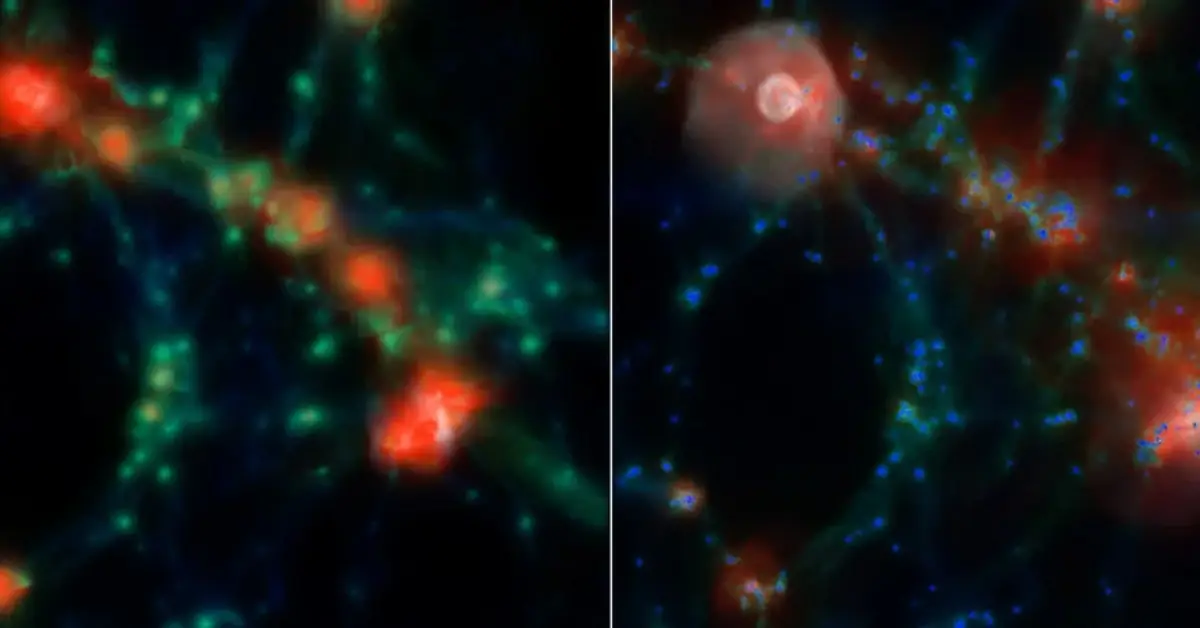
Image credit: Shy Genel and the Illustris collaboration
A new study discovered that galaxies in denser astronomical surroundings are up to 25% larger than those in less crowded locations. This study, published on August 14, 2024, in The Astrophysical Journal, stressed the importance of ambient density in galaxy size, refuting prior theories that focused solely on internal processes.
- The study was led by Aritra Ghosh, with contributions from Meg Urry and Frank van den Bosch, and international teams from ESO and NAOJ.
- The researchers used the Galaxy Morphology Posterior Estimation Network (GaMPEN), a cutting-edge machine-learning technology, to handle and evaluate large amounts of astronomical data. High-resolution imagery from the Very Large Telescope (VLT) and the Subaru Telescope, as well as data from the Hyper Suprime-Cam Subaru Strategic Program, enabled them to conduct a thorough examination of 8 million galaxies.
The new study was led by Aritra Ghosh, a former Yale doctoral student and current LSST-DA Catalyst postdoctoral fellow at the University of Washington, and included contributions from international researchers at the European Southern Observatory (ESO) and the National Astronomical Observatory of Japan (NAOJ). The research also benefited from Meg Urry, the Israel Munson Professor of Physics and Astronomy at Yale University, and Frank van den Bosch, associate professor of Astronomy at Yale University. Their combined efforts provided new light on galaxy structure and evolution.
“This comprehensive study represents an important step in resolving decades of contradictory results on the correlation between galaxy size and environmental density beyond z ≥ 0.2. Our findings emphasize that earlier works were limited in their scope, examining a narrow segment of all galaxies rather than a comprehensive overview,” the researchers stated.
The study, published on August 14, 2024, in The Astrophysical Journal, shows that galaxies in denser cosmic environments, such as galaxy clusters, are up to 25% larger than those in less crowded locations. This observation challenges previous models that relied heavily on internal processes such as star formation and black hole activity. Instead, the study directs the importance towards ambient density on galaxy size, employing a novel machine-learning tool known as the Galaxy Morphology Posterior Estimation Network (GaMPEN), which processes massive amounts of astronomical imaging data with unparalleled precision.
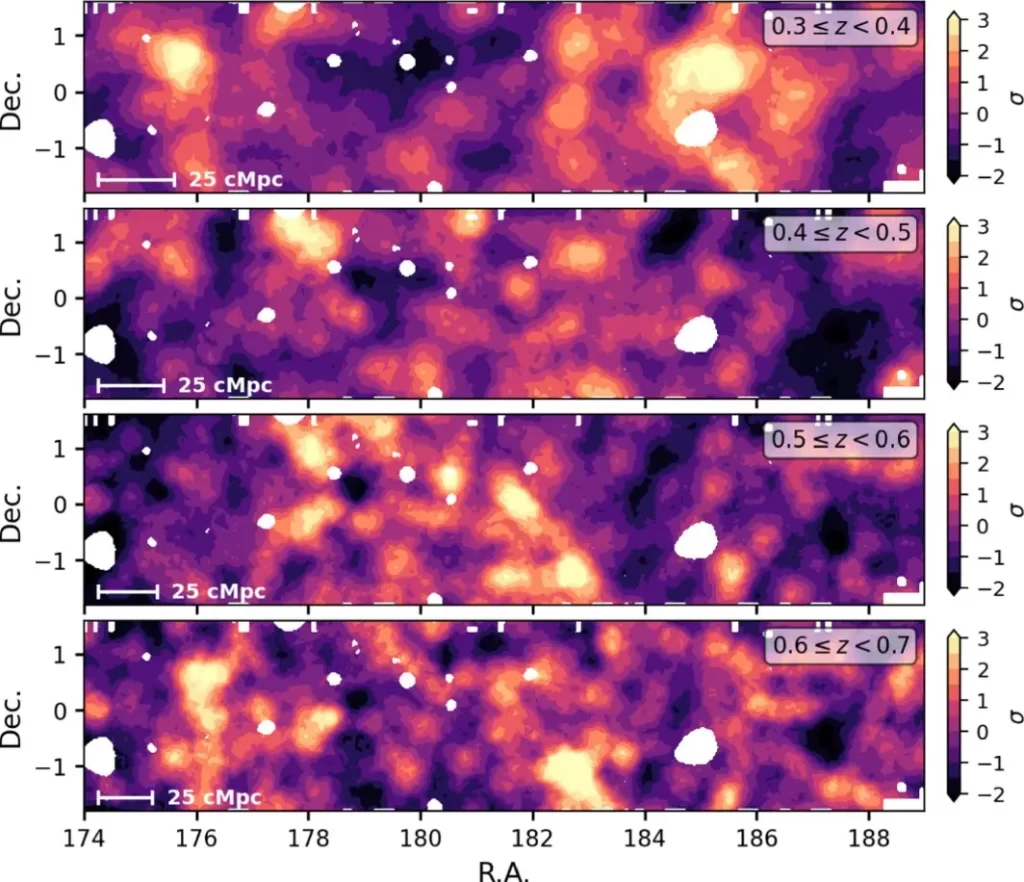
The study utilized high-resolution imaging data from the Very Large Telescope (VLT) at the Paranal Observatory in Chile and the Subaru Telescope at the Mauna Kea Observatory in Hawaii. Additionally, the study observed and analyzed data from the Hyper Suprime-Cam Subaru Strategic Program, which covered 1,400 square degrees of the sky. This rich dataset allowed for detailed comparisons of galaxies in various astronomical conditions.
The research provides new evidence on how environmental factors influence the growth of the galaxy. While internal phenomena like gravitational collapse and gas accretion were previously assumed to be responsible for galaxy size, the study shows that external factors such as the density of the surrounding cosmic environment play an important impact. The bigger size of galaxies in denser places indicates that they have more substantial gravitational interactions, which contribute to their increased size.
The animation below, from Shy Genel & the Illustris collaboration, shows the wide range of physics at play in a typical dense region of the universe. Studying the structural parameters of millions of galaxies and correlating them with the density of their environments allows astronomers to develop a better understanding of how galaxies form and evolve.
The researchers used GaMPEN, a machine-learning program that can process and analyze huge astronomical datasets with great precision. GaMPEN’s improved algorithms enabled the quick analysis of galaxy images and the calculation of structural characteristics, with around 60% more accuracy than earlier methods. Using this approach, the team generated a catalog of 8 million galaxies and discovered that galaxies in denser regions were up to 25% larger than those in less dense places.
The study’s thorough analysis, which included galaxies from the Hyper Suprime-Cam dataset, revealed that, while some links with existing theoretical frameworks were found, a coherent framework to explain all results was missing.
“Comparative theoretical follow-up work using N-body and cosmological simulations is needed to expand on the theoretical framework we presented above and conclusively establish the reason for the observed correlations,” the researchers concluded.
References:
¹ Denser Environments Cultivate Larger Galaxies: A Comprehensive Study beyond the Local Universe with 3 Million Hyper Suprime-Cam Galaxies – Aritra Ghosh et al. – The Astrophysical Journal, Volume 971, Number 2 – August 14, 2024 – DOI: 10.3847/1538-4357/ad596f – OPEN ACCESS

Harsha Borah is an experienced content writer with a proven track record in the industry. Harsha has worked with LitSpark Solutions and Whateveryourdose, honing skills in creating engaging content across various platforms. A gold medalist in a state-level writing competition organized by Assam Tourism, Harsha’s travelogue on Tezpur was widely appreciated. Harsha’s article, "The Dark Tale of the Only Judge in India to Be Hanged," ranks second on Google and has garnered over 11 000 views and 8 900 reads on Medium. Outside of writing, Harsha enjoys reading books and solving jigsaw puzzles.

Commenting rules and guidelines
We value the thoughts and opinions of our readers and welcome healthy discussions on our website. In order to maintain a respectful and positive community, we ask that all commenters follow these rules.