
X3.4+ solar flare erupts from Region 3664, solar radiation storm continues
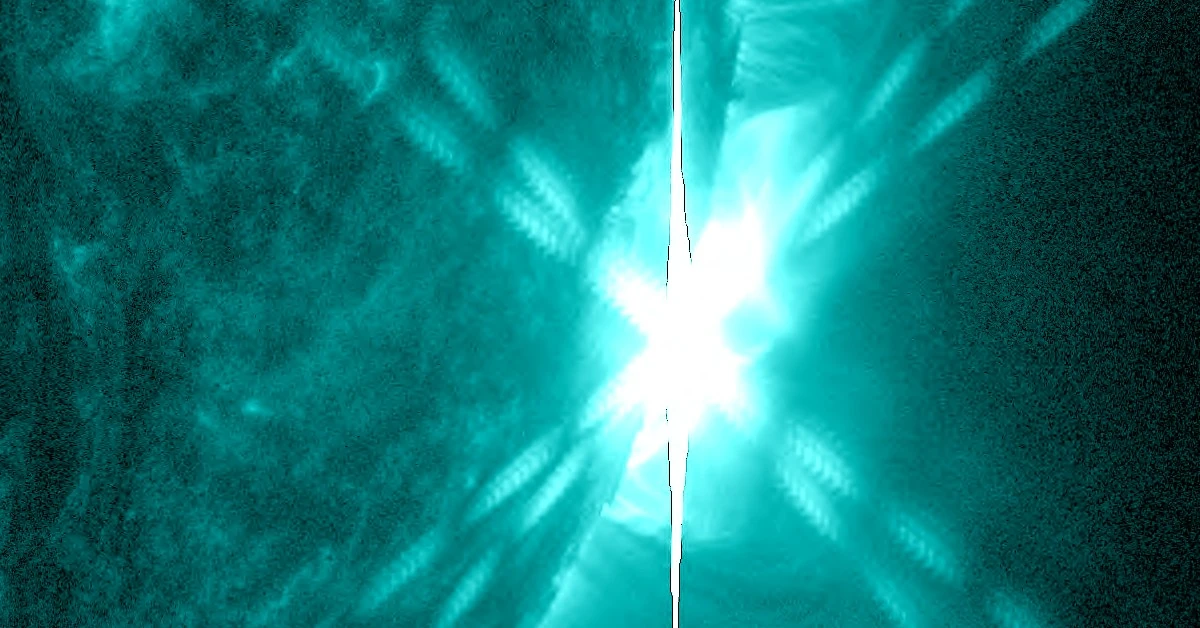
Featured image: X3.4+ solar flare on May 15, 2024. credit: NASA SDO/AIA 131
A powerful solar flare registered as X3.4 erupted from Active Region 3664 — now located beyond the west limb — at 08:37 UTC on May 15, 2024. The event started at 08:18 and ended at 08:52 UTC. A solar radiation storm continues at S1 – Minor to S2 – Moderate levels since May 13.
This event follows three X-class flares from the same region on May 14, including X8.7 — the strongest solar flare of the current solar cycle (Solar Cycle 25). This was also the strongest flare since X9.3 on September 10, 2017 — the strongest solar flare of Solar Cycle 24.
While today’s X-class flare was registered as X3.4, due to the location of this region behind the edge of the disk, it was probably much stronger than that.
A Type IV Radio Emission was associated with this event, suggesting a strong coronal mass ejection (CME) was produced.
In addition, a 10cm Radio Burst (tenflare) with a peak flux of 450 sfu was detected from 08:30 to 08:35 UTC. A 10cm radio burst indicates that the electromagnetic burst associated with a solar flare at the 10cm wavelength was double or greater than the initial 10cm radio background. This can be indicative of significant radio noise in association with a solar flare. The noise is generally short-lived but can cause interference for sensitive receivers including radar, GPS, and satellite communications.
Radio frequencies were forecast to be most degraded over Europe, Africa, Asia, and the Indian Ocean at the time of the flare.


The location of Region 3664, now beyond the west limb, no longer favors Earth-directed CMEs. The region will traverse the farside of the Sun and reemerge into Earth’s view in about two weeks if it survives.

3667 – Alpha
3670 – Beta-Gamma
3671 – Beta
3672 – Beta
3673 – Alpha
3674 – Beta
3675 – Beta-Gamma
3676 – Beta-Gamma
3678 – Alpha
3679 – Beta-Gamma
3680 – Beta
3682 – Beta-Gamma
Powerful flaring from this region over the past couple of days is still reflected on Earth in the form of solar radiation storming, with periods of S1 – Minor to S2 – Moderate storming observed since 13:50 UTC on May 13.

During S1 – Minor solar radiation storms, satellites may encounter operational issues and communication disruptions, while the International Space Station (ISS) and its crew face elevated radiation risks. Additionally, High-Frequency (HF) communication in polar regions can be affected.
S2 radiation storms exacerbate these effects, presenting higher radiation risks to passengers and crew on high-altitude aircraft, potentially causing satellite malfunctions, radio blackouts, and disruptions in radio communication due to ionospheric disturbances.

Solar activity is expected to be at high levels due to M-class flare activity (75%) with a chance for X-class
flares (40%) on May 15. The odds drop to 40%/15% on May 16 and to 35%/10% on May 17.

I'm a dedicated researcher, journalist, and editor at The Watchers. With over 20 years of experience in the media industry, I specialize in hard science news, focusing on extreme weather, seismic and volcanic activity, space weather, and astronomy, including near-Earth objects and planetary defense strategies. You can reach me at teo /at/ watchers.news.

Commenting rules and guidelines
We value the thoughts and opinions of our readers and welcome healthy discussions on our website. In order to maintain a respectful and positive community, we ask that all commenters follow these rules.