
Deep magma reservoirs’ role in predicting large-scale volcanic eruptions
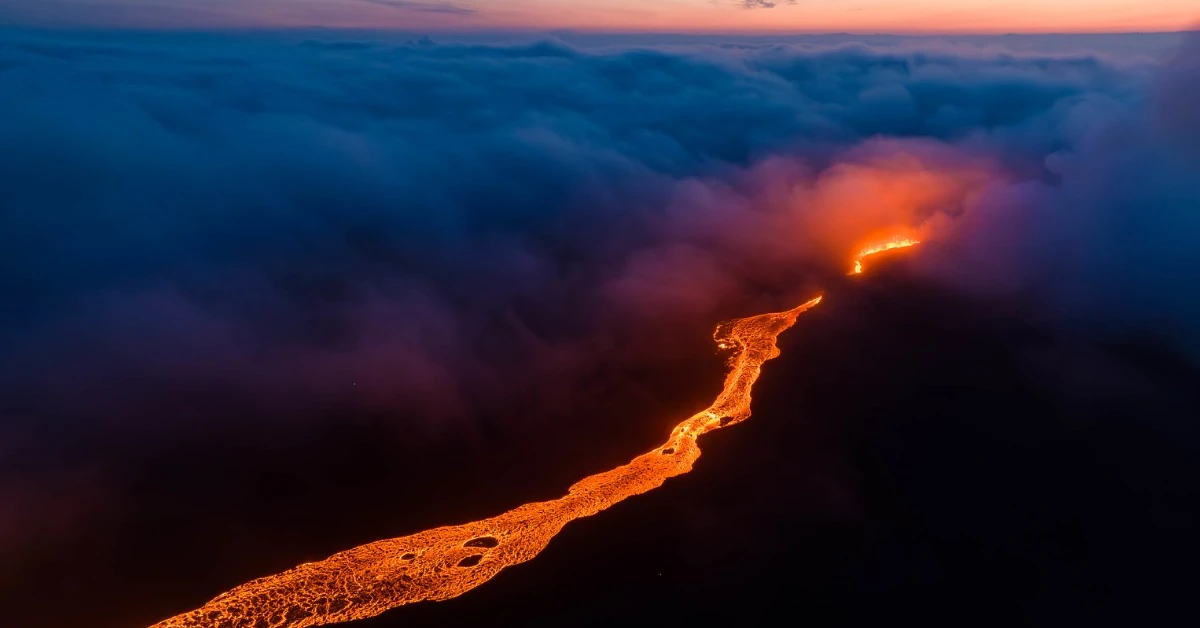
Image credit: Anthony Quitano
New research reveals that deep magma buoyancy, rather than the proportion of solid and molten rock, drives volcanic eruptions. The study, conducted by researchers at Imperial College London and the University of Bristol, highlights the importance of searching for clues much deeper in the Earth’s crust, where rocks are first melted into magma before rising to chambers closer to the surface.
Volcanic eruptions pose significant hazards, causing devastating impacts on nearby populations and the environment. Current eruption predictions rely on monitoring the volcano itself and the upper few kilometers of crust containing potentially eruptive molten rock.
However, new research emphasizes the importance of investigating deeper in the Earth’s crust, where magma forms before rising to shallower chambers.
Researchers from Imperial College London and the University of Bristol have identified that the buoyancy of magma, rather than the proportion of solid and molten rock, drives eruptions. This discovery challenges previous beliefs and could enhance the accuracy of volcanic eruption forecasts.
The study, published in Science Advances a few days ago, suggests that the time required for extremely hot, molten rock, known as magma, to form in deep reservoirs at depths up to 20 km (12.4 miles) beneath the Earth’s crust is crucial.
The size of these reservoirs also plays a significant role in determining the size and frequency of eruptions. By understanding these deep processes, researchers aim to predict volcanic activity more accurately, ultimately safeguarding communities and mitigating environmental risks.

A long-lived, high crystallinity mush reservoir is created by intrusion of parental magma sourced from the deep crust or upper mantle. Low-crystallinity magma formed in the reservoir can evacuate and supply a shallow chamber via (A) dikes or (B) diapirs; alternatively, the reservoir can span the crust, and melt can be supplied direct to a shallow chamber (C). Reactive, percolative flow of melt through the source reservoir accumulates a layer of evolved magma near the top of the reservoir (D). Credit: SciAdv, Authors
The research team reviewed data from 60 explosive volcanic eruptions across nine countries: the United States, New Zealand, Japan, Russia, Argentina, Chile, Nicaragua, El Salvador, and Indonesia. Led by Dr. Catherine Booth, Research Associate in the Department of Earth Science and Engineering at Imperial College London, the team focused on deep magma source reservoirs, where extreme heat melts solid rocks into magma at depths of around 10 to 20 km (6.2 – 12.4 miles).
Combining real-world data with advanced computer models, the researchers analyzed the composition, structure, and history of rocks beneath the Earth’s crust. They aimed to understand how magma builds up and behaves deep underground before rising to volcanoes.
The team created computer simulations to mimic the complex processes of magma flow and storage, gaining new insights into the factors driving volcanic eruptions.
Dr. Booth explained that magma buoyancy, controlled by its temperature and chemical composition, is crucial for eruptions. As magma accumulates, its composition changes, making it less dense and more buoyant. Once buoyant enough, magma rises, creating fractures in the overlying solid rock and flowing rapidly through these fractures, causing an eruption.
The study also found that the duration of magma storage in shallow underground chambers affects eruption size, with longer storage periods leading to smaller eruptions. Contrary to expectations, larger reservoirs disperse heat, slowing the melting process and reducing eruption size.
The researchers concluded that reservoir size is a key factor in predicting eruption sizes accurately, with an optimal size existing for the most explosive eruptions.
Additionally, the findings highlight that eruptions are rarely isolated events but part of a repetitive cycle. The high silica content in the studied magma, a compound influencing viscosity and explosiveness, further links the research to more explosive eruptions.
“By improving our understanding of the processes behind volcanic activity and providing models that shed light on the factors controlling eruptions, our study is a crucial step towards better monitoring and forecasting of these powerful geological events,” co-author Professor Matt Jackson said.
Despite limitations in the current model, such as focusing on upward magma flow and excluding other fluids like water and carbon dioxide, the researchers aim to refine their models.
By incorporating three-dimensional flow and various fluid compositions, they hope to continue unraveling the Earth’s processes responsible for volcanic eruptions, aiding in natural disaster preparedness.
References:
1 Clues from deep magma reservoirs could improve volcanic eruption forecasts – Imperial College London – May 10, 2024
2 Source reservoir controls on the size, frequency, and composition of large-scale volcanic eruptions – Catherine A. Booth et al. – Sci. Adv.10,eadd1595(2024).- DOI:10.1126/sciadv.add1595

The Watchers team and our contributors bring the latest on extreme weather, earthquakes, volcanic eruptions, space weather, and all things science. We're all about making sense of the natural world and keeping you informed on what’s happening. Got a tip or a question? Hit us up using the form at newstips!

In the ultimate analysis volcanic eruption is the result of a varaition in the magnetic buoyancy force and the varaition is caused by external factor, namely, by solar-cosmic radiation