
Antarctica hit by 30 000 earthquakes in 3 months
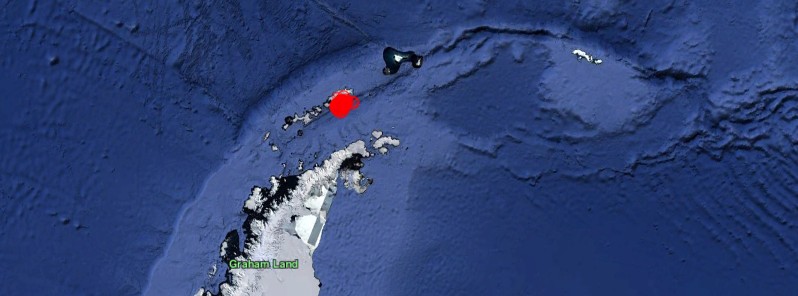
Image credit: TW
More than 30 000 earthquakes have been registered in the Bransfield Strait, an ocean channel between the South Shetland Islands and the Antarctic Peninsula, since the end of August 2020, according to the University of Chile. The strait is now expanding 15 cm (6 inches) per year from the Antarctic Peninsula, nearly 20 times faster than before.
The strongest earthquake in the sequence was M6.0 at a depth of 15 km (9 miles) at 23:49 UTC on November 6.

According to the National Seismological Center at the University of Chile, the swarm is centered in the Bransfield Strait, a 96 km (60 miles) ocean channel between the South Shetland Islands and the Antarctic Peninsula.
The center said several tectonic plates and microplates meet in this area, leading to frequent rumbling, but the past three months have been unusual.
Most of the seismicity is concentrated at the beginning of the sequence, mainly during the month of September, with more than a thousand earthquakes a day, the center said, as reported by Reuters.
Due to these frequent earthquakes, the strait is now expanding from the Antarctic Peninsula about 15 cm (6 inches) per year, nearly 20 times faster than before (7 to 8 mm (0.30 inch) per year).

Image credit: Berricoso et al. (2008)
Featured image: Location of earthquakes in Bransfield Strait, 2020. Credit: EMSC

Teo Blašković founded The Watchers in 2011 and edited it until 2026, covering seismic and volcanic activity, extreme weather, space weather and near-Earth objects. Articles on this page are his archive.
Earlier reporting
Nothing on Watchers was published in the last 24 hours. These are older articles.
- M6.6 earthquake hits the Banda Sea 148 km west-southwest of Tual, Indonesia, at 68 km depth, USGS issues Green alert
- Winds high above the Arctic broke a 68-year record by collapsing in early November, and while the eastern US has already had a taste of the cold it shook loose, forecasters say a second wave could arrive around Thanksgiving weekend
- On October 22, 2017, a single flash of lightning stretched 515 miles from eastern Texas to near Kansas City, a distance that takes eight hours to drive, and nobody realized how far it had gone until scientists went back through the satellite data years later Epicenter
- CPC posts a slight risk of heavy rain from the Gulf Coast to the Northeast urban corridor November 25-29, and a moderate risk of West Coast wind and Sierra snow on November 25

The Antarctic continent is used to be the largest earthquake-free area on the Earth, only a few earthquakes are registered by the Worldwide Standardized Seismograph Network (WWSSN). Now, look at the massive increase of seismic activity in Antarctica. This is of course has to do with the rapid pole shift and the colossal energy build up at the core of the Earth that will be released mainly, through hotspot locations and major earthquake zones worldwide