
Severe dust storm hits Crete, Greece

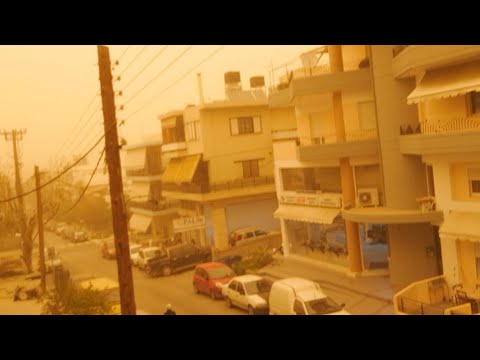
Featured image: Saharan dust hits Crete, Greece on March 22, 2018. Credit: athanasiothegr8
A cutoff low in the central Mediterranean pushed huge amounts of Saharan dust from Libya toward the eastern Mediterranean on March 22, 2018, heavily impacting the region, especially the island of Crete.
A thick layer of Saharan sand reached Crete around 16:00 local time, dropping the visibility at Heraklion airport to 600 m (2 000 feet). In some parts of the island, like Chania, it mixed with the smoke from local wildfires, making the air unbreathable.

This is how this awesome dust storm looked like from space.

The thickness becomes really apparent once we remove the coastline layer. A rare sight indeed:

Satellite images courtesy NASA/NOAA Aqua/MODIS
The animation below shows Eumetsat's Dust Product for entire March 22, 2018. The pink color shows the highest concentration of the atmospheric dust.
The dust cloud has already left Greece it mainly affects Egypt, Cyprus and Turkey early March 23.
A new irruption from Libya to Greece is expected for next Sunday, March 25 but it's probably going to be less severe than the present one, the Barcelona Dust Forecast Center said.
Dust model provided by Barcelona Dust Forecast Center

Teo Blašković founded The Watchers in 2011 and edited it until 2026, covering seismic and volcanic activity, extreme weather, space weather and near-Earth objects. Articles on this page are his archive.
Published in the last 24 hours
- Strong El Niño reinforces above-normal winter precipitation outlook across southern and eastern U.S.
- Scientists directly observe how submarine landslides unfold in western Canada Epicenter
- Odisha evacuated 983,642 people before Phailin crossed near Gopalpur on 12 October 2013 with winds of 200-210 km/h gusting to 220, and 44 died, against 9,885 in the 1999 super cyclone. Cyclone Akvan crossed the same coast on 20 November 2026. Epicenter
- Lava fountains reached 1,900 feet (580 m) at Kīlauea Iki in 1959, the highest ever recorded at Kīlauea, as USGS forecasts episode 57 fountaining at Halemaʻumaʻu for November 22-26. Epicenter
