
States of emergency as rivers reach record levels, Croatia

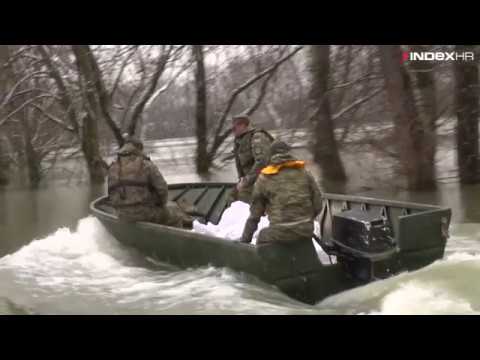
Featured image: Croatian army called in to help battling floods - March 2018. Credit: Sanja Padjen/Index.hr
Croatia is still battling major river levels after warm weather followed by heavy rains caused rapid melt of record-breaking snow that fell during Arctic cold outbreak at the end of February.
States of emergency were declared over the weekend in several areas, including Kosinja in Lika-Senj County, where army, firefighters and mountain rescue service are called in to help battle floods.
The declaration will allow extra resources for the communities of Donji Kosinj, Gornji Kosinj, Mlakva, Kosinjski Bakovac, Lipovo polje and Rudinka, threatened by River Lika which measured 494.26 cm (16.21 feet) at 11:00 UTC, March 18 and was still rising today, some 5 – 8 cm (2 – 3.1 inches) per hour. These communities are preventively disconnected from the power grid. About 50 houses in this region are flooded and some 500 people isolated.
State of emergency was also declared in Jasenovac where River Sava reached 921 cm (362.6 inches) on March 19, breaking the previous record of 907 cm (357.1 inches) set in 1970.
Rivers in this region are expected to continue rising over the next 24 hours and reach their peaks in the days ahead. With no further rain expected, this should be the end of this flood wave in Croatia.

It is worth noting that while the region is experiencing exceptional river levels, flood-defense is working extremely well this year and no major damage has been reported.

Teo Blašković founded The Watchers in 2011 and edited it until 2026, covering seismic and volcanic activity, extreme weather, space weather and near-Earth objects. Articles on this page are his archive.
