
Asteroid 2017 UL6 to flyby Earth at 0.16 LD
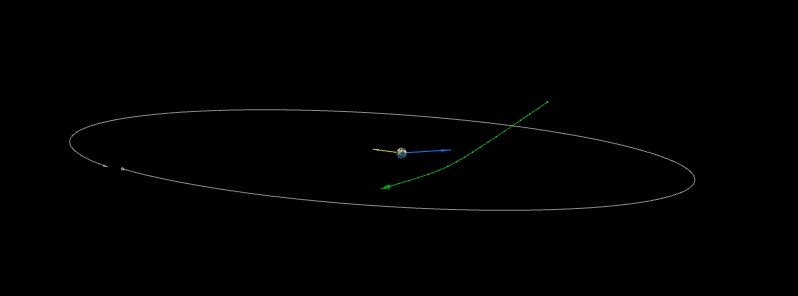
Featured image: The green line indicates the object's apparent motion relative to the Earth, and the bright green marks are the object's location at approximately one-hour intervals. The Moon's orbit is grey. The blue arrow points in the direction of Earth's motion and the yellow arrow points toward the Sun. Credit: Minor Planet Center
A newly discovered, very small asteroid designated 2017 UL6 will flyby Earth at 0.16 LD or 0.00040 AU (~ 59 839 km / 37 182 miles) at 11:24 UTC on October 28, 2017. This is the 45th known asteroid to flyby Earth within 1 lunar distance since the start of the year and the 6th closest.
2017 UL6 belongs to the Apollo group of asteroids and was first observed at Mt. Lemmon Survey on October 27, one day before its close approach.
This asteroid has an estimated diameter between 1 and 2.3 m (3 – 7 feet). It will fly past our planet at 11:24 UTC on October 28 at a speed (relative to the Earth) of 8.03 km/s.
[ Ephemeris | Orbit Diagram | Orbital Elements | Physical Parameters | Close-Approach Data ]
This is the 9th known asteroid to flyby Earth within 1 lunar distance this month, 45th since the start of the year and the 6th closest. It is also one of the smallest this year (within 1 LD).
Reference:
2017 UL6 at Minor Planet Center; CNEOS

Teo Blašković founded The Watchers in 2011 and edited it until 2026, covering seismic and volcanic activity, extreme weather, space weather and near-Earth objects. Articles on this page are his archive.
