
Partial lunar eclipse of August 7, 2017
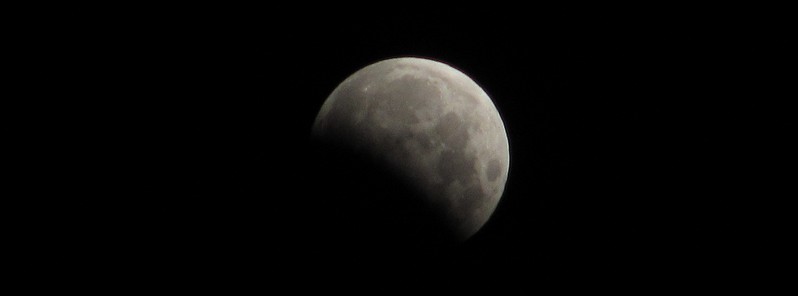
Image credit: Partial lunar eclipse by Jeremy Michael
A partial lunar eclipse will take place on August 7, 2017, with the greatest eclipse occurring at 18:20 UTC. It will be visible from eastern Europe, throughout most of eastern Africa, central Asia, the Indian Ocean, and Australia.
This lunar eclipse will begin at 15:50 UTC on August 7 and peak at 18:20 UTC. This is 5 days after the Moon reaches apogee, the farthest point from the Earth. During today's eclipse, the Moon is in the constellation Capricornus.
The synodic month in which this eclipse takes place has a Brown Lunation Number of 1170. It belongs to Saros 119 and is number 61 of 82 eclipses in the series. All eclipses in this series occur at the Moon’s descending node. The Moon moves northward with respect to the node with each succeeding eclipse in the series and gamma increases.

By Fred Espenak, NASA's GSFC. Find PDF version, here.
Today's partial lunar eclipse is followed two weeks later by a total solar eclipse on August 21, 2017. Both of them take place during a single eclipse season.

Teo Blašković founded The Watchers in 2011 and edited it until 2026, covering seismic and volcanic activity, extreme weather, space weather and near-Earth objects. Articles on this page are his archive.
Published in the last 24 hours
- High Risk of excessive rainfall covers Florida’s Space Coast as St. Johns River near Cocoa reaches 5.67 m
- Asteroid 2026 WJ to pass Earth at 1.7 lunar distances at 04:20 UTC on November 22, with 2026 WD following at 4.4 lunar distances on November 23
- Cyclone Akvan crossed the north Andhra Pradesh and south Odisha coasts close to Gopalpur on November 20 with 70-80 km/h winds gusting to 90, and has weakened into a deep depression
- A broad low over southeastern Florida and the northwestern Bahamas has a 30 percent chance of subtropical or tropical development within 48 hours and a 50 percent chance within 7 days, the National Hurricane Center says
