
Earthquake swarm shaking Taupo Volcanic Zone, New Zealand
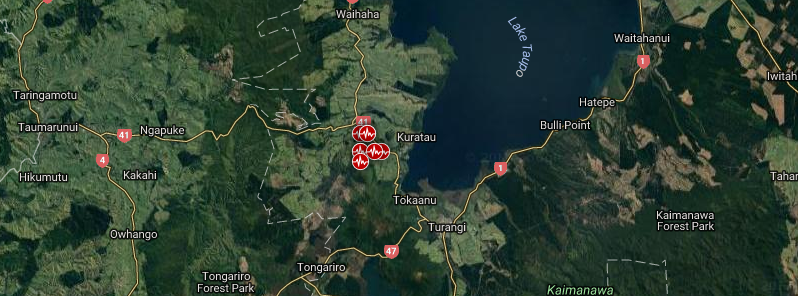
Featured image: Earthquake swarm, New Zealand - February 2017. Credit: Google, The Watchers
GeoNet's seismometer network between Taupo and the Tongariro National Park has been recording a swarm of small earthquakes since February 13, 2017. The swarm, a very common characteristic of the greater Rotorua-Taupo area, known as the Taupo Volcanic Zone, continues to date.
The quakes are located about 10 km (6.2 miles) north-west of Tokaanu. Since the swarm started, GeoNet has located over 290 events, the largest being a M3.8 at 21.35 NZST on Tuesday, February 21.
Earthquake swarms are defined as a sequence of many earthquakes striking in a relatively short period of time in a localized area. They are differentiated from ‘normal’ earthquakes followed by aftershocks by the fact that no single earthquake in the sequence is obviously the main shock. The larger or largest event can come early in the sequence towards the middle or at the end. The rate that earthquakes occur can also vary through the sequence.

Seismogram showing the earthquakes recorded in last 24 hours. Credit: GeoNet
"The current swarm west of Tokaanu (Turangi) has comprised three phases," GeoNet's duty volcanologist Brad Scott explains. The third phase has included the four largest events (M3.0, 3.4, 3.6 and 3.8) and started Tuesday around 17:00 NZST, continuing overnight.
"We have located about 200 events so far in this phase of the swarm. In total, we have located 291 events so far (09:30 NZST, February 22). Their magnitudes have ranged from about M0.6 to M3.8, while the depths ranged between 1 and 11 kilometers [0.62 – 6.8 miles], with most being 5 -7 km [3.1 – 4.3 miles] deep. As the earthquakes are quite shallow they will feel stronger than the magnitudes indicate."
Earthquake swarms are very common in the Taupo Volcanic Zone. In 2008 there was a larger swarm in the same area, while in March 2015 there was one about 9 km to the north and another in October 2015 to the south.
The Taupo Volcanic Zone is a rifting area, growing wider each year by 6 – 9 mm [0.23 – 0.35 inches]. These earthquakes are likely to be related to the long-term ‘tectonic’ stretching of the Zone. Currently, there are no indications that the earthquakes are related to volcanic activity, being located well away from the active volcanoes. As usual, we continue to closely monitor the activity, Scott concluded.

The Watchers team and our contributors bring the latest on extreme weather, earthquakes, volcanic eruptions, space weather, and all things science. We're all about making sense of the natural world and keeping you informed on what’s happening. Got a tip or a question? Hit us up using the form at newstips!

Commenting rules and guidelines
We value the thoughts and opinions of our readers and welcome healthy discussions on our website. In order to maintain a respectful and positive community, we ask that all commenters follow these rules.