
Lake Maracaibo in Venezuela, the place of highest lightning activity on Earth
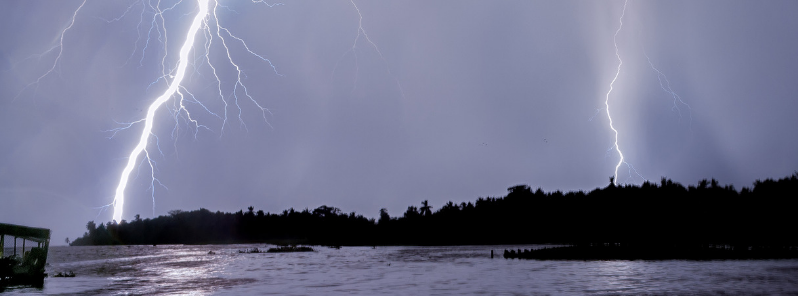
Featured image: Lightning over the mouth of Catatumbo River, where the river empties into Lake Maracaibo, Venezuela, October 31, 2015. Image credit: Fernando Flores (Flickr-CC)
Researchers have utilized the observations from the Lightning Imaging Sensor onboard NASA's Tropical Rainfall Measurement Mission to investigate which location has a maximum lightning activity on Earth. According to data analysis, Lake Maracaibo in Venezuela is a new lightning capital with a rate of about 233 flashes per square kilometer in one year. The first place was previously held by the Congo Basin in Africa.
A high-resolution data set used to investigate the areas of top lightning activity was obtained from 16 years of space-based LIS observations. Researchers from the University of São Paolo, the University of Maryland, the National Oceanic Atmospheric Administration (NOAA), and the University of Alabama in Huntsville have conducted a joint investigation on the matter, to improve our understanding of a lightning phenomenon and help in predicting its occurrence.
"We can now observe lightning flash rate density in very fine detail on a global scale. A better understanding of lightning activity around the world enables policy makers, government agencies and other stakeholders to make more informed decisions related to weather and climate," said Richard Blakeslee, LIS project scientist at NASA's Marshall Space Flight Center.

Daytime and nighttime lightning flash rate density at Lake Maracaibo (top) and Lake Victoria (bottom). White lines represent elevation, and gray lines are country physical boundaries. Image credit: University of São Paulo
According to Dennis Buechler from the University of Alabama, Lake Maracaibo location is ideal for thunderstorms development due to its unique geography and climatology. The lake is the largest in South America and a part of the Andes Mountain chain. With night breezes constantly developing and converging over the layer of the warm, moist air above the lake's surface, the site has unique conditions necessary to allow the development of persistent deep convection. The conditions at the site are capable of generating on average 297 nocturnal thunderstorms per year with a maximum in September.
Six of the world's top ten locations of lightning activity are still in Africa. Most of them are situated by Lake Victoria and the lakes along the East African Rift Valley in environmental conditions similar to those of Lake Maracaibo.

Video credit: whatevvervideos
In general, lightning activity is concentrated over land with lightning peaks in the afternoon, and reduced over oceans, as confirmed by this research.
LIS is capable of detecting the distribution and variability of total lightning, including cloud-to-cloud, intracloud, and cloud-to-ground, that happens across the tropics, by using a high speed imaging system to search for changes occurring in the optical output caused by lightning in the cloud tops. After analyzing a wavelength band in the near-infrared spectrum, around 777 nanometers, the instrument's sensors can spot brief flashes of lightning, even under bright daylight
"Our research using LIS observations in new ways is a prime example of how NASA partners with scientists all over the world to better understand and appreciate our home planet," said Blakeslee.
LIS was build in the 1990s, and the same research team at Marshall has now created another unit, waiting to be launched on a Space Exploration Technologies rocket to the International Space Station in August 2016.
Reference:
- "Where are the lightning hotspots on Earth" – Rachel I. Albrecht, Steven J. Goodman, Dennis E. Buechler, Richard J. Blakeslee, Hugh J. Christian – Journal of the American Meteorological Society (2016) – DOI: http://dx.doi.org/10.1175/BAMS-D-14-00193.1

Earlier reporting
Nothing on Watchers was published in the last 24 hours. These are older articles.
- Winds high above the Arctic broke a 68-year record by collapsing in early November, and while the eastern US has already had a taste of the cold it shook loose, forecasters say a second wave could arrive around Thanksgiving weekend
- On October 22, 2017, a single flash of lightning stretched 515 miles from eastern Texas to near Kansas City, a distance that takes eight hours to drive, and nobody realized how far it had gone until scientists went back through the satellite data years later Epicenter
- CPC posts a slight risk of heavy rain from the Gulf Coast to the Northeast urban corridor November 25-29, and a moderate risk of West Coast wind and Sierra snow on November 25
- Florida's east coast faces a moderate flash flood risk Wednesday through Friday, with 4 to 8 inches of rain forecast and the St. Johns River near Cocoa already in major flood at 17.13 feet
