
Close view of the world’s largest lava lake at Nyiragongo volcano, Congo
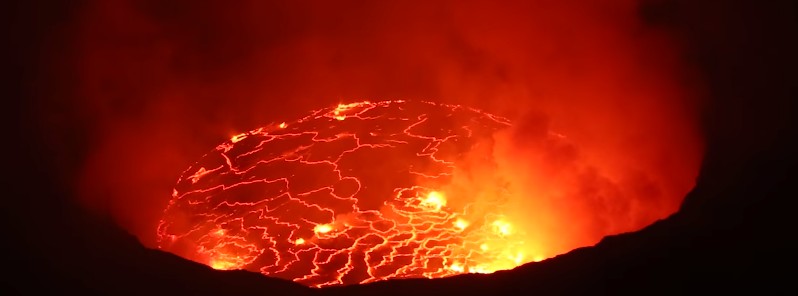
Image credit: TW
Award winning photographer and self-proclaimed adventure seeker Bradley Ambrose from Auckland, New Zealand recently ventured into treacherous Nyiragongo volcano in the Democratic Republic of Congo to help assist a team of Japanese scientists.
Nyiragongo volcano has the largest lava lake in the world. It is located in a Virunga Mountains, few kilometers from the border with Rwanda.
Nyiragongo is considered one of the most dangerous volcanoes in Africa because of its intense activity. Its last eruption occurred on May 17, 2012.
Video courtesy of Bradley Ambrose
Geological summary
One of Africa's most notable volcanoes, Nyiragongo contained a lava lake in its deep summit crater that was active for half a century before draining catastrophically through its outer flanks in 1977. In contrast to the low profile of its neighboring shield volcano, Nyamuragira, 3470-m-high Nyiragongo displays the steep slopes of a stratovolcano. Benches in the steep-walled, 1.2-km-wide summit crater mark levels of former lava lakes, which have been observed since the late-19th century. Two older stratovolcanoes, Baruta and Shaheru, are partially overlapped by Nyiragongo on the north and south.
About 100 parasitic cones are located primarily along radial fissures south of Shaheru, east of the summit, and along a NE-SW zone extending as far as Lake Kivu. Many cones are buried by voluminous lava flows that extend long distances down the flanks, which is characterized by the eruption of foiditic rocks. The extremely fluid 1977 lava flows caused many fatalities, as did lava flows that inundated portions of the major city of Goma in January 2002.

The Watchers team and our contributors bring the latest on extreme weather, earthquakes, volcanic eruptions, space weather, and all things science. We're all about making sense of the natural world and keeping you informed on what’s happening. Got a tip or a question? Hit us up using the form at newstips!

Commenting rules and guidelines
We value the thoughts and opinions of our readers and welcome healthy discussions on our website. In order to maintain a respectful and positive community, we ask that all commenters follow these rules.