
Etna erupting on the evening of May 13, new lava flow
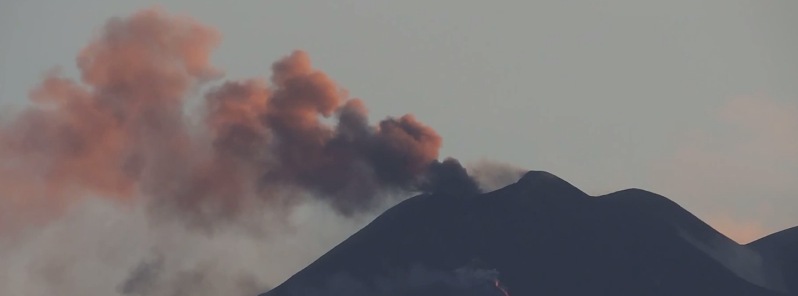
Featured image: Etna erupting on May 13, 2015. Credit: Boris Behncke.
Following almost three-and-a-half months of total quiescence Etna's New Southeast Crater is again in business.
Following mild Strombolian activity that started early on May 12, 2015, the activity diminished on the afternoon of the 13th and then became again more vigorous in the evening of the same day, Boris Behncke writes.
This phase is seen on the video below, recorded by Behncke from near the village of Fiumefreddo on Etna's lower northeast flank.
Ash emissions from a vent at the summit of the New Southeast Crater are accompanied by lava emission and minor explosions from a short fissure at the northeast base of its cone.

Video courtesy of Boris Behncke
INGV reported weak Strombolian activity inside Etna’s New Southeast Crater (NSEC) during May 11 – 12, mainly from a depression on the E part of the crater and sometimes from a second vent in the middle of the crater.
This activity was preceded by a sudden increase in tremor amplitude and intense degassing during May 2 -3. Visible activity did not accompany the episode at the time.
After a few days tremor returned to normal levels only to increase again on May 12:

Infrared imagery on May 14 shows new lava flow:

Image credit: INGV.
Geologic summary
Mount Etna, towering above Catania, Sicily's second largest city, has one of the world's longest documented records of historical volcanism, dating back to 1500 BCE. Historical lava flows of basaltic composition cover much of the surface of this massive volcano, whose edifice is the highest and most voluminous in Italy. The Mongibello stratovolcano, truncated by several small calderas, was constructed during the late Pleistocene and Holocene over an older shield volcano. The most prominent morphological feature of Etna is the Valle del Bove, a 5 x 10 km horseshoe-shaped caldera open to the east.
Two styles of eruptive activity typically occur at Etna. Persistent explosive eruptions, sometimes with minor lava emissions, take place from one or more of the three prominent summit craters, the Central Crater, NE Crater, and SE Crater (the latter formed in 1978). Flank vents, typically with higher effusion rates, are less frequently active and originate from fissures that open progressively downward from near the summit (usually accompanied by strombolian eruptions at the upper end). Cinder cones are commonly constructed over the vents of lower-flank lava flows. Lava flows extend to the foot of the volcano on all sides and have reached the sea over a broad area on the SE flank. (GVP)

Teo Blašković founded The Watchers in 2011 and edited it until 2026, covering seismic and volcanic activity, extreme weather, space weather and near-Earth objects. Articles on this page are his archive.
Published in the last 24 hours
- An asteroid was spotted 19 hours before it exploded over Sudan in 2008, and students picked its pieces off the desert Epicenter
- A wave up to 3 m (10 feet) high rose out of Lake Michigan on a sunny June morning in 1954 and swept fishermen off Chicago’s piers, and when a second came 10 days later, warnings had cleared the shore Epicenter
- Just 12 inches of rushing water can carry away most cars, and more than half of US flood drownings happen to people who drive into flood water Epicenter
- People who hid under an Oklahoma highway overpass from a 1999 tornado lost fingers, ears and noses, and three people died near or under overpasses that day Epicenter
