
Comet Lovejoy (C/2014 Q2) makes closest approach to Earth
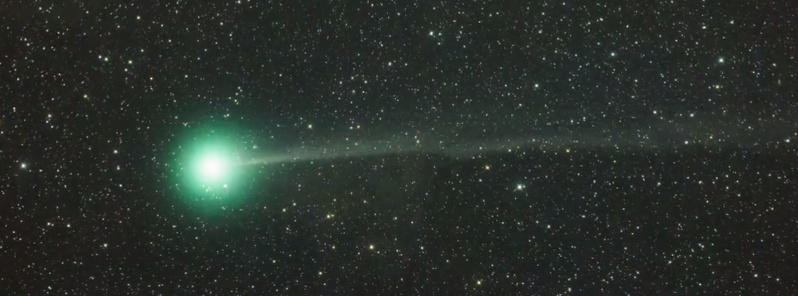
Image credit: Screenshot from Vimeo video by Phil Hart
Comet C/2014 Q2 (Lovejoy), a long-period comet discovered by Australian astronomer Terry Lovejoy on August 17, 2014, is making closest approach to our planet today, at some 70 million kilometers (43.5 million miles / 0.469 AU) away.
This comet is now a naked eye object and predictions call for it to continue brightening from 5th to 4th magnitude for the next couple of weeks. This makes it an easy target for both binoculars and even naked-eye observations for those who know where to look (finder chart during January 2015 by Sky&Telescope).
This is a once in a lifetime opportunity to observe this comet so close as its next scheduled appearance through our neighborhood is due around the year 10 000.
Q2 will be in excellent place for viewing from the Northern Hemisphere through much of January, 2015.
It can be seen near the constellation Orion about an hour after sunset, although it is even easier to see it a few hours later in the evening and until moonrise. Luckily, the moon is now waning, rising an hour later each evening.
| C/2014 Q2 (Lovejoy) |
| [ Ephemeris | Orbit Diagram | Orbital Elements | Physical Parameters | Close-Approach Data ] |

C/2014 Q2 (Lovejoy) orbit diagram by JPL
Q2 is forecast to reach its brightest, at around magnitude 4.2 on January 10, 2015. It will lie at a distance of about 197 million km (122 million miles / 1.32 AU) from the Sun and 71 million km (44 million miles / 0.48 AU) from the Earth.
Video courtesy of Phil Hart
For astrophotographers, however, the real photo op will be on Sunday, January 18, when Q2 brushes past the famous Pleiades star cluster in the constellation Taurus.
The comet will make its closest approach to the Sun on January 30 at a distance of 192 million km (119 million miles / 1.29 AU).
#Comet #Lovejoy glows green, makes closest approach to Earth in 8,000 years http://t.co/6zDYqKzQXn pic.twitter.com/kyGqRkdvff
— Weather Network UK (@TheWeatherNetUK) January 7, 2015
#Space: #comet C/2014 Q2 #Lovejoy & its incredible glowing #tail http://t.co/SEzSkMQdrz by Gerald Rhemann pic.twitter.com/xchow1VJO1
— Maxime Duprez (@maximaxoo) January 6, 2015
3 brilliant images of #Comet #Lovejoy. 3rd image by Velimir Popov, Emil Ivanov. It will be at it's brightest 7th Jan pic.twitter.com/2jiX1qDCPF
— Blackpool Astronomy (@badas_tweets) January 5, 2015
#Space: #comet Q2 #Lovejoy flies past the globular #StarCluster M79 ► http://t.co/McIgWE7tve via @UniverseToday pic.twitter.com/6u9zkR1w8C
— Maxime Duprez (@maximaxoo) January 4, 2015
An image of Comet C/2014Q2 #Lovejoy and globular cluster M79,taken by @astrostew.Stunning piece of #astrophotography! pic.twitter.com/MHNtJt6YNH
— Sophia Nasr (@Pharaoness) December 30, 2014
Perhaps comet #LoveJoy sent out feelers, or arrived early. Lets ask #NBC & @nellyNECN at 9 http://t.co/AL4xJpsR76 pic.twitter.com/vyDn2uuAwP
— Tim Kelley NECN (@SurfSkiWxMan) December 30, 2014
RT @JamesWillinghan: #Comet #Lovejoy passing M79 and small galaxy NGC1886 @SPACEdotcom @EpicCosmos @fcain pic.twitter.com/qXCsBFKcN9
— David Dickinson (@Astroguyz) December 30, 2014
#Comet #Lovejoy #C2014Q2 on 29 Dec – http://t.co/ujBaL8lbGT @SPACEdotcom @earthskyscience @universetoday pic.twitter.com/dlRVgcaYL4
— Justin Ng (@justinngphoto) December 30, 2014
- See more images of this comet here.

Teo Blašković founded The Watchers in 2011 and edited it until 2026, covering seismic and volcanic activity, extreme weather, space weather and near-Earth objects. Articles on this page are his archive.
Published in the last 24 hours
- Asteroid 2026 WJ to pass Earth at 1.7 lunar distances at 04:20 UTC on November 22, with 2026 WD following at 4.4 lunar distances on November 23
- High Risk of excessive rainfall covers Florida’s Space Coast as St. Johns River near Cocoa reaches 5.67 m
- Cyclone Akvan crossed the north Andhra Pradesh and south Odisha coasts close to Gopalpur on November 20 with 70-80 km/h winds gusting to 90, and has weakened into a deep depression
- A broad low over southeastern Florida and the northwestern Bahamas has a 30 percent chance of subtropical or tropical development within 48 hours and a 50 percent chance within 7 days, the National Hurricane Center says

amazing that this comet is following a sacred journey that has been pointed out to us in star maps from all across our planet from every culture throughout human history check out the website dedicated to this
http://www.thehiddenrecords.com/index.htm