
Meteorite hits Nicaragua’s capital, leaves 12-meter wide crater
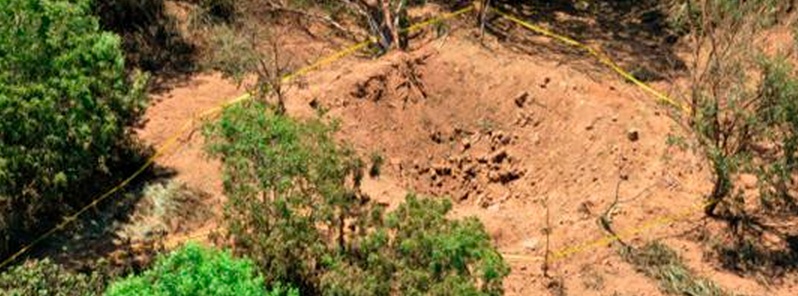
Image credit: Crater left by meteorite that hit Nicaragua's capital Managua on September 6, 2014.
A meteorite hit Nicaragua's capital Managua around 05:00 UTC on Sunday, September 7, and left a 12-meter wide crater in a wooded area near the city's airport. The meteorite impact was accompanied by a loud boom and a burning smell. There are no reports of injuries.
The crater has a radius of 12 meters (39 feet) and a depth of 5 meters (16 feet), according to Humberto Saballos, a volcanologist with the Nicaraguan Institute of Territorial Studies.
Authorities said they are pretty sure it was a piece of the 20-meter wide asteroid 2014 RC which flew by Earth on September 7th at a distance of about 40 000 km. The closest approach of asteroid 2014 RC to our planet was around 18:18 UTC over New Zealand.
Government spokeswoman Rosario Murillo said a committee formed by the government to study the event confirmed it was a "relatively small" meteorite that "appears to have come off an asteroid that was passing close to Earth."(BBC)
She added Nicaragua will ask international experts to help local scientists in understanding what happened.
Residents reported a loud boom but none of them reported seeing a streak of light.
Ron Baalke, a software engineer at the Jet Propulsion Laboratory has posted an update to the close pass by asteroid 2014 RC on the NASA’s Near Earth Object website, saying, “Since the explosion in Nicaragua occurred a full 13 hours before the close passage of asteroid 2014 RC, these two events are unrelated… No eyewitness accounts or imagery have come to light of the fireball flash or debris trail that is typically associated with a meteor of the size required to produce such a crater.” (UniverseToday)
Meteorito causa explosión en #Nicaragua y creen es fragmento asteroide. http://t.co/BkBFX31IZa pic.twitter.com/WzL7FhgC4V
— Noticias SIN (@SIN24Horas) September 8, 2014
#asteroide del tamaño de una casa habría impactado en #Nicaragua . http://t.co/Co9mwxiTFH pic.twitter.com/86USBq4yBW
— Sophimania (@sophimania) September 8, 2014

Maps shows approximate location of the impact crater.

Teo Blašković founded The Watchers in 2011 and edited it until 2026, covering seismic and volcanic activity, extreme weather, space weather and near-Earth objects. Articles on this page are his archive.
Published in the last 24 hours
- Asteroid 2026 WJ to pass Earth at 1.7 lunar distances at 04:20 UTC on November 22, with 2026 WD following at 4.4 lunar distances on November 23
- High Risk of excessive rainfall covers Florida’s Space Coast as St. Johns River near Cocoa reaches 5.67 m
- Cyclone Akvan crossed the north Andhra Pradesh and south Odisha coasts close to Gopalpur on November 20 with 70-80 km/h winds gusting to 90, and has weakened into a deep depression
- A broad low over southeastern Florida and the northwestern Bahamas has a 30 percent chance of subtropical or tropical development within 48 hours and a 50 percent chance within 7 days, the National Hurricane Center says

It seems odd to me, the crater looks just like a marker. A drop more than a collision with the earth. Maybe the asteroid stopped and dropped like a tear from the sky instead of real trajectory?