
Indonesian Mount Merapi erupts, thick-pyroclastic surge up to 1500 m
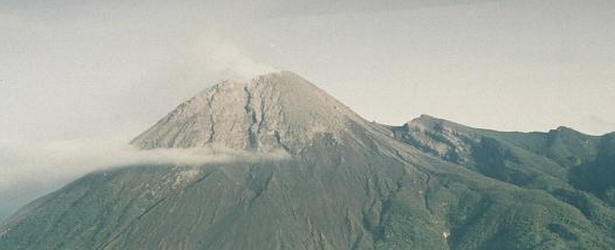
Featured image: Mount Merapi. Credit: Global Volcanism Program
According to local media Indonesian Mount Merapi erupted early Monday, March 10, 2014 causing a thick-pyroclastic surge to shoot 1 500 meters up in the air.
"The eruption took place at around 6:54 a.m. [local time] and the ash spread up to 7 kilometers from the volcano’s crater," Subandriyo, the head of the Geological Disaster Technology Research and Development Center (BPPTKG) in Yogyakarta.
He explained that the eruption may have been sparked by M 5.4 tectonic earthquake which occurred around 115 kilometers southeast of Malang Regency, East Java, on Sunday evening.
The most severely-affected areas were in Kemalang and Balerante Klaten regency, scores of villages in Magelang, all in Central Java; as well Yogyakarta. (JP)
"Merapi, one of Indonesia's most active volcanoes, lies in one of the world's most densely populated areas and dominates the landscape immediately north of the major city of Yogyakarta. Merapi is the youngest and southernmost of a volcanic chain extending NNW to Ungaran volcano. Growth of Old Merapi volcano beginning during the Pleistocene ended with major edifice collapse perhaps about 2000 years ago, leaving a large arcuate scarp cutting the eroded older Batulawang volcano.
Subsequently growth of the steep-sided Young Merapi edifice, its upper part unvegetated due to frequent eruptive activity, began SW of the earlier collapse scarp. Pyroclastic flows and lahars accompanying growth and collapse of the steep-sided active summit lava dome have devastated cultivated lands on the volcano's western-to-southern flanks and caused many fatalities during historical time. The volcano is the object of extensive monitoring efforts by the Merapi Volcano Observatory." (GVP)

I'm a dedicated researcher, journalist, and editor at The Watchers. With over 20 years of experience in the media industry, I specialize in hard science news, focusing on extreme weather, seismic and volcanic activity, space weather, and astronomy, including near-Earth objects and planetary defense strategies. You can reach me at teo /at/ watchers.news.

Is there any other information I could use to sound smart for my project?
Ring of Fire