
Etna erupting again – 13th paroxysm in 2013

Image credit: Lava fountains from the New SE crater (Etna Trekking webcam)
Strong strombolian activity and frequent ash emissions that continued throughout the whole night on April 27, 2013, were a prelude to the 13th paroxysm (lava fountaining) of this year at Etna’s New Southeast Crater. The strombolian activity had begun already on April 21, just one day after the April 2′ paroxysm.
On the evening of April 26, 2013 a gradual increase in both the eruptive activity and in the volcanic tremor amplitude had started.

Shortly after the sunset on April 27, 2013, the paroxysmal phase began with lava fountains 300-500 m high.
Emission of lava flows from the southeastern and northeastern flanks of the New Southeast Crater cone and from the “saddle” between the two Southeast Crater cones, formed small lava flows toward south and north.
A pyroclastic flow, which advanced about 1 km toward the Valle del Bove, was generated when a portion of the eastern flank of the cone collapsed.
Furthermore, a tephra cloud formed, and was blown by the wind to the northeast, producing ash and lapilli falls in the area of Linguaglossa, and also in Taormina and Messina.
Here is an amazing video of this Saturday’s eruption:
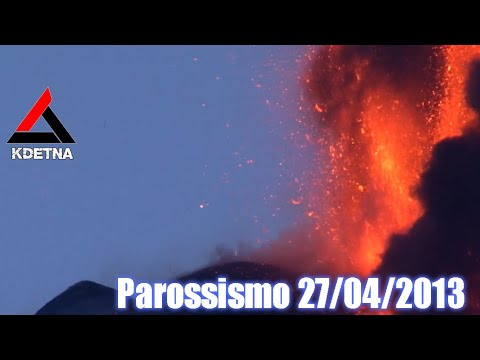
The entire paroxysmal episode lasted about 2 hours, but lava emission toward southeast continued for many hours and stopped during the forenoon of April 28, 2013.
Sources: INGV Catania, VolcanoDiscovery

Published in the last 24 hours
- Male toads abandoned a pond in Italy five days before a deadly 2009 earthquake, while a scientist was counting them Epicenter
- An asteroid was spotted 19 hours before it exploded over Sudan in 2008, and students picked its pieces off the desert Epicenter
- A wave up to 3 m (10 feet) high rose out of Lake Michigan on a sunny June morning in 1954 and swept fishermen off Chicago’s piers, and when a second came 10 days later, warnings had cleared the shore Epicenter
- Just 12 inches of rushing water can carry away most cars, and more than half of US flood drownings happen to people who drive into flood water Epicenter
