
Dust storm over China’s Taklimakan Desert
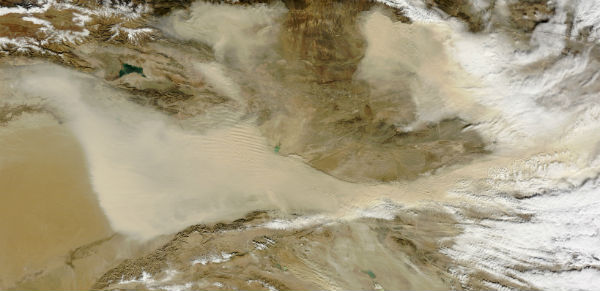
Image credit: TW
The Taklimakan Desert is China’s largest, hottest, and driest desert located far in the western part of the country. Shifting sand dunes cover About 85 percent of the desert floor is covered by shifting sand dunes, with some rising to a height of 200 meters (650 feet). It is cut off from the impacts of the Asian monsoon and Arctic storms that bring moisture to other parts of the region. Winds can easily loft the sand into the air, producing sand storms usually blowing eastward.
The Moderate Resolution Imaging Spectroradiometer (MODIS) on NASA’s Terra satellite captured image of dust blew out of the Taklimakan Desert in November 2,2012. Dust plumes—thick enough in places to completely hide the land surface below—blow away from the basin’s eastern margin.


Published in the last 24 hours
- High Risk of excessive rainfall covers Florida’s Space Coast as St. Johns River near Cocoa reaches 5.67 m
- Four small asteroids will pass close to Earth from November 21 to 23
- Cyclone Akvan weakens after landfall near Gopalpur; more than 300 000 evacuated in Odisha, India
- A broad low over southeastern Florida and the northwestern Bahamas has a 30 percent chance of subtropical or tropical development within 48 hours and a 50 percent chance within 7 days, the National Hurricane Center says
