
Subsiding geomagnetic storm with beautifull auroras
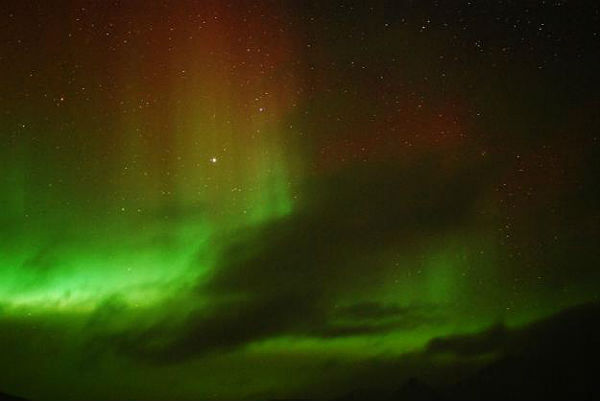
Featured image: Aurora display seen above Kjell Henriksen Observatory (KHO) outside of Longyearbyen in Svalbard on February 14th (Credit: Ashton Seth Reimer)
The expected CME impact sparked aurora lights around the Arctic Circle on Feb. 14th. The display was probably caused by a CME, launched from the sun on Feb. 10th. Solar wind poured in and fueled a G1-class geomagnetic storm (Kp index was at level 5). Our geomagnetic field has since returned to more quieter levels (Kp=4 right now).


Today on Feb. 15th, the interplanetary magnetic field (IMF) near Earth tilted south, opening a crack in Earth’s magnetic field as we wrote in our earlier post.

NOAA/SWPC in the latest alert report about potential impacts in areas primarily poleward of 65 degrees
geomagnetic latitude with possible weak power grid fluctuations. Aurora may be visible at high latitudes such as Canada and Alaska.

All current sunspot regions remain stable and there is no chance for strong solar flares at this time. The next region expected to return onto the eastern limb, will be old region 1408 within the next couple of days.
For more updates please visit: SpaceWeather, SolarHam, NOAA/SWPC

Published in the last 24 hours
- A fog linked to about 12 000 excess deaths in London in 1952 puzzled scientists for decades, until researchers reconstructed how coal smoke formed acidic haze Epicenter
- In 2012, cameras filming a thunderstorm in western China caught ball lightning by accident, and its 1.64-second glow carried iron, silicon, and calcium from the soil it rose out of Epicenter
- Strong El Niño reinforces above-normal winter precipitation outlook across southern and eastern U.S.
- Strong M6.8 earthquake hits Kepulauan Barat Daya, Indonesia, near Timor-Leste
