
Subsiding solar activity, small chances for M-class flares
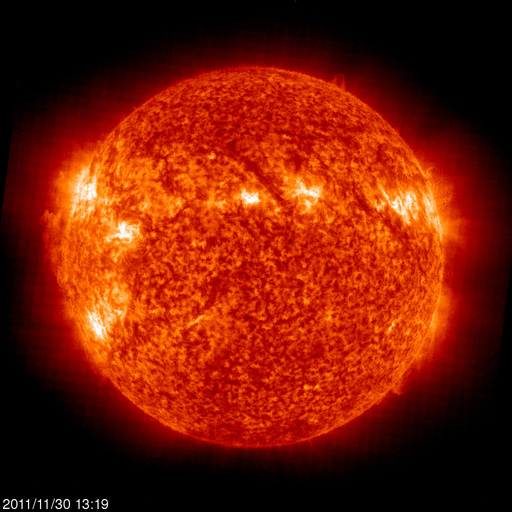
Image credit: TW
Two new regions rotated into view on the eastern limb and were numbered 1363 and 1364 on Tuesday. Numerous low level C-Class flares have been detected within the past 24 hours around Sunspot 1362 and new Sunspot 1363.
Region 1361 in the northern hemisphere is now listed as having a Beta-Gamma magnetic configuration and is directly facing Earth. There will remain the risk for an isolated M-Class flares on Wednesday. NOAA forecast gives 10% chance of M-class solar flares.

Solar wind
speed: 456.1 km/sec
density: 0.5 protons/cm3
The Radio Sun
10.7 cm flux: 141 sfu
Planetary K-index
Now: Kp= 3 quiet
24-hr max: Kp= 3 quiet
Interplanetary Mag. Field
Btotal: 7.5 nT
Bz: 5.5 nT south
A non-geoeffective CME was seen off the east limb in SOHO/LASCO C2 imagery on November 28. This CME was likely associated with an eruption near Region 1362 seen in SDO/AIA 171 imagery.

The geomagnetic field was quiet to active with an isolated minor storm period observed at middle latitudes. On November 28 increases in solar wind speed (380 – 515 km/s) and total magnetic field (5.8 – 13.5 nT) was observed at the ACE spacecraft. A 45 nT Sudden Impulse subsequently was observed in the Boulder magnetometer on November 28. Activity was due to the CME effects from the November 26.

And interesting error occured at EIT304 image from SOHO recorded on November 30 at 01:19. Take a look below:

Solar activity is expected to continue at low levels with a slight chance for an isolated M-flare. NOAA/SWPC forecast quiet to unsettled geomagnetic field on days 1-2 (30 November – 01 December) and mostly quiet conditions are expected on day 3 (02 December).

Published in the last 24 hours
- A Virginia park ranger was struck by lightning seven times and lived, even though three of the strikes set his hair on fire Epicenter
- The hole in the ozone layer over Antarctica was about twice the size of the US this year, and scientists say it would have been bigger still if ozone-eating chemicals were at their 2000 levels Epicenter
