
Earth-directed M5.3 solar flare took place
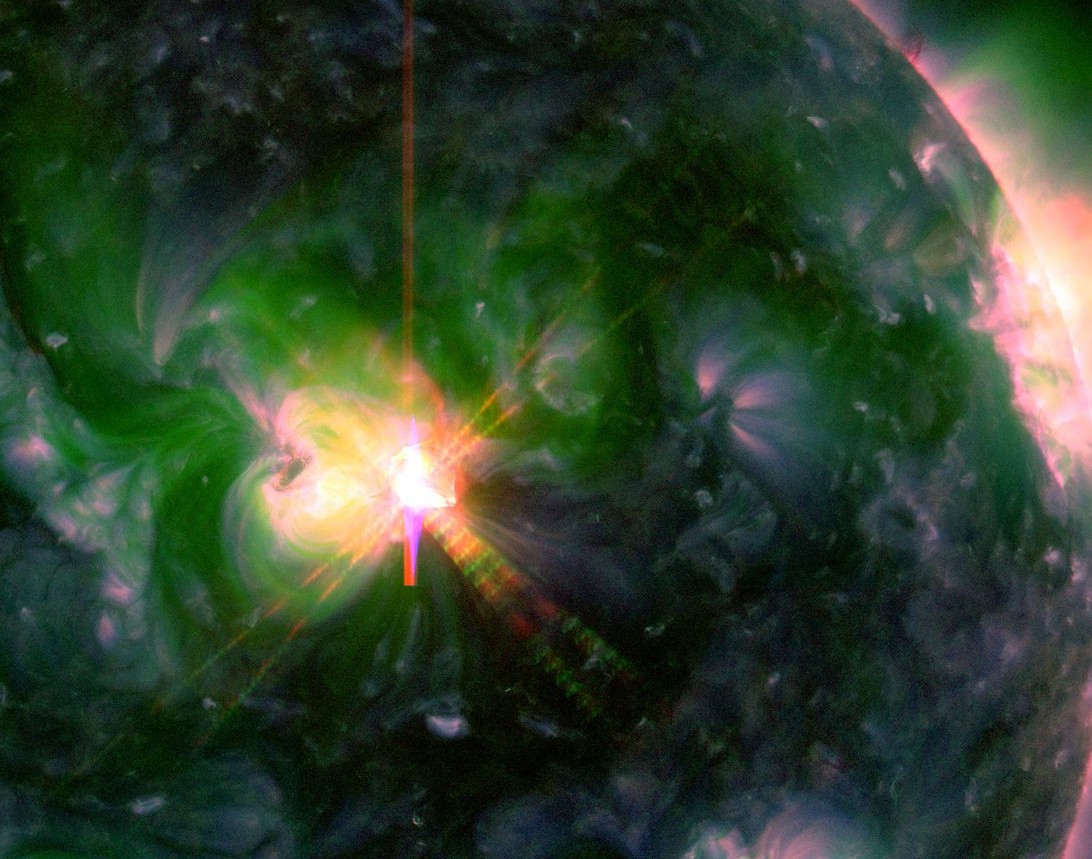
Image credit: TW
This morning at 0150 UT, sunspot 1283 produced an M5.3-class solar flare. A movie from NASA’s Solar Dynamics Observatory shows the flash of extreme UV radiation. Because of the sunspot’s central location on the solar disk, the eruption was Earth-directed and a CME might be heading our way. Stay tuned for updates. (SpaceWeather)
Solar wind
speed: 428.6 km/sec
density: 0.1 protons/cm3
The Radio Sun
10.7 cm flux: 119 sfu
Planetary K-index
Now: Kp= 2 quiet
24-hr max: Kp= 2 quiet

A moderate sized Solar Flare took place at 01:50 UTC Tuesday morning. An R2 Level radio blackout resulted. The solar flare was centered around Sunspot 1283 which is located in the center of the visible solar disk. While looking at the latest STEREO Ahead COR2 images, there appears to be a CME. More images will be needed to determine just how big. It does appear that a portion of this explosion may be earth directed.
Just as active Sunspot 1286 is rotating out of view on the western limb, a large new Sunspot is now rotating into view on the northeast limb. We will get a better view within the next 24 hours. The solar X-Rays remain in C-Class territory due to the departing Sunspot cluster and there will be a chance for another M-Class event.

Sunspot 1283 remains a large Sunspot group and now has a Beta-Gamma magnetic configuration and also may produce an M-Class event. (SolarHam)

Published in the last 24 hours
- High Risk of excessive rainfall covers Florida’s Space Coast as St. Johns River near Cocoa reaches 5.67 m
- Asteroid 2026 WJ to pass Earth at 1.7 lunar distances at 04:20 UTC on November 22, with 2026 WD following at 4.4 lunar distances on November 23
- Cyclone Akvan crossed the north Andhra Pradesh and south Odisha coasts close to Gopalpur on November 20 with 70-80 km/h winds gusting to 90, and has weakened into a deep depression
- A broad low over southeastern Florida and the northwestern Bahamas has a 30 percent chance of subtropical or tropical development within 48 hours and a 50 percent chance within 7 days, the National Hurricane Center says
