
NASA tests communication scenarios for Near-Earth Asteroids
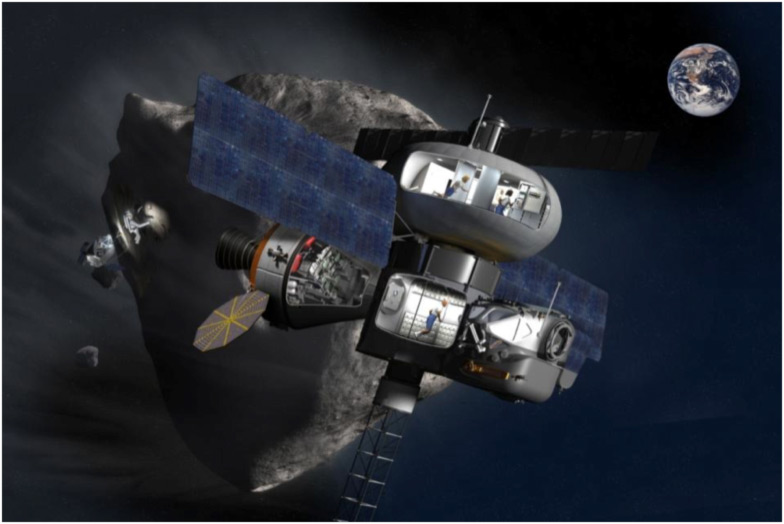
Image credit: NASA
NASA’s Desert Research and Technology Studies (RATS) team has commenced testing communication scenarios for near-Earth asteroids. The RATS team also evaluates technology, human-robotic systems and extravehicular equipment in the high desert near Flagstaff, Arizona from August 27 through September 12.
Field testing provides a knowledge base that helps scientists and engineers design, build and operate better equipment, and establish requirements for operations and procedures. The Arizona desert has a rough, dusty terrain and extreme temperature swings that simulate conditions that may be encountered on other surfaces in space.
Some of the elements that will be tested at Desert RATS during the next fortnight are prototypes of the transportation elements needed to explore a near-Earth asteroid:
– Deep Space Habitat (Habitat Demonstration Unit-Deep Space Habitat – X-Hab incorporating inflatable structures)
– “Free-Flyer” – Space Exploration Vehicle (SEV) Crew Cabin module
– Robotic assistant vehicle system – Centaur
– Deep Space Network- communications and data network link
RATS team will conduct integrated mission simulations in the Arizona desert near Black Point Lava Flow to evaluate different conditions that will enable multiple destinations for future human exploration including high earth orbit, Lagrange points, the Moon, near-Earth asteroids (NEAs), Mars moons, and ultimately the surface of Mars. (NASA)
This year's focus on asteroids is consistent with NASA's exploration goals going forward. Last year, President Obama directed the space agency to concentrate on getting astronauts to an asteroid by 2025, then on to Mars by the mid-2030s.
NASA also has an asteroid sample-return mission in the works. This effort, known as Osiris-Rex, should bring pieces of the asteroid 1999 RQ36 back to Earth in 2023. (Space.com)

Published in the last 24 hours
- Asteroid 2026 WJ to pass Earth at 1.7 lunar distances at 04:20 UTC on November 22, with 2026 WD following at 4.4 lunar distances on November 23
- High Risk of excessive rainfall covers Florida’s Space Coast as St. Johns River near Cocoa reaches 5.67 m
- Cyclone Akvan crossed the north Andhra Pradesh and south Odisha coasts close to Gopalpur on November 20 with 70-80 km/h winds gusting to 90, and has weakened into a deep depression
- A broad low over southeastern Florida and the northwestern Bahamas has a 30 percent chance of subtropical or tropical development within 48 hours and a 50 percent chance within 7 days, the National Hurricane Center says

Jack Ho commented on The Watchers:
What’s the point by sending human to an asteroid? Why not simply sending human to moon then to Mars? b4 somebody else do, u know?