
Scientists discover deep-Earth structures influencing the planet’s magnetic field
Scientists from the University of Liverpool and the University of Leeds discovered that two massive hot rock structures located about 2 900 km (1 800 miles) beneath Africa and the Pacific Ocean have been influencing Earth’s magnetic field for millions of years. Published in Nature Geoscience on February 5 2026, the study combines palaeomagnetic records and numerical geodynamo models to reveal that uneven heat flow at the core–mantle boundary controls long-term magnetic stability.
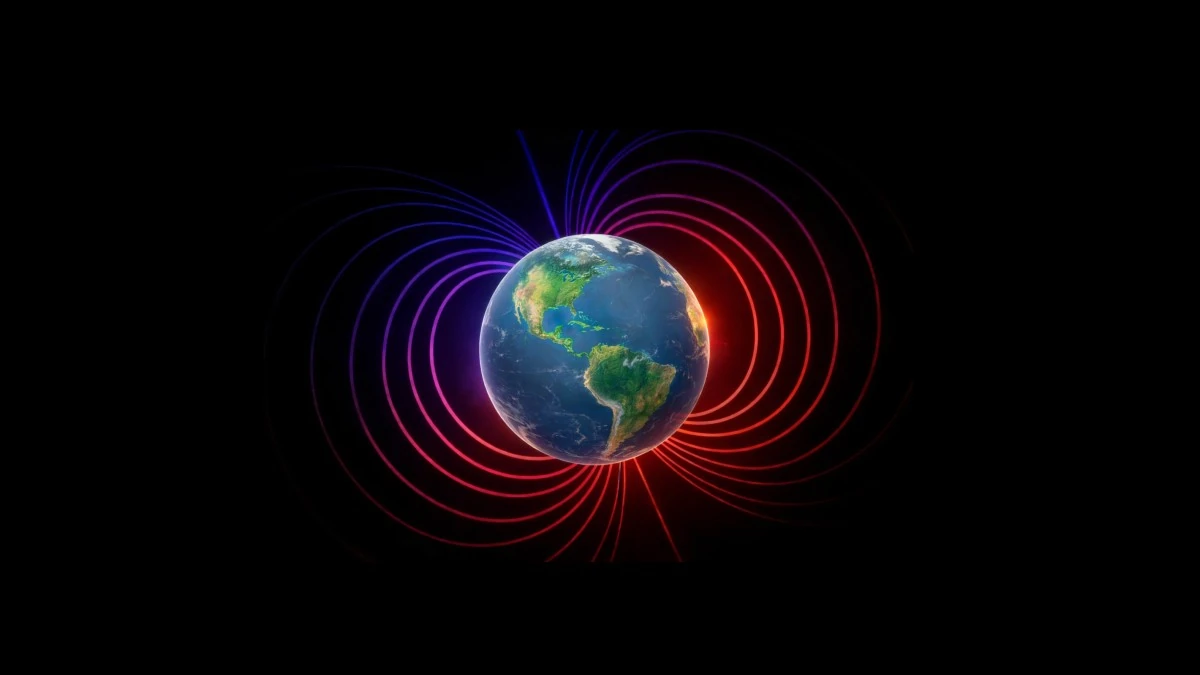
Earth's magnetic field. Credit: The Watchers
Two massive rock formations deep inside Earth are quietly controlling the planet’s magnetic field, according to a new study published on February 5, 2026, in Nature Geoscience. Located about 2 900 km (1 800 miles) below Africa and the Pacific Ocean, the formations are immense bodies of solid, superheated rock at the base of the mantle — a region known as the core–mantle boundary.
The research team from the University of Liverpool and the University of Leeds combined records of ancient magnetism preserved in rocks with advanced geodynamo simulations to reconstruct magnetic-field behaviour over the past 265 million years. By linking field reversals and stability intervals to regions of variable heat flow at the core–mantle boundary, the study provides direct evidence that mantle heterogeneity affects core dynamics.
The numerical models show that the outer core’s upper boundary is far from uniform in temperature, with sharp thermal contrasts producing zones of sluggish iron motion beneath hotter mantle regions and vigorous flow beneath cooler ones. The differences in temperature govern how the magnetic field is generated and sustained, explaining why some aspects of the field remain stable for hundreds of millions of years while others change rapidly.
Professor Andy Biggin, lead author from the University of Liverpool’s School of Environmental Sciences, said the results demonstrate strong temperature contrasts in the mantle above the core. Beneath hotter zones, the liquid iron may stagnate rather than join the vigorous flow seen beneath cooler areas, changing how magnetic energy is distributed within the core.
The team reports that deep-mantle features correspond closely to large low-shear-velocity provinces (LLSVPs—vast regions of anomalously hot, dense material) detected by seismic tomography. Each extends thousands of kilometres laterally and is enclosed by a ring of cooler material encircling the core. Their persistence over geological time suggests they are stable thermochemical domains rather than short-lived plumes.
By integrating magnetic-field records from rocks on all continents, the researchers verified that magnetic flux concentrations align with these deep-mantle provinces.
The finding supports the view that Earth’s average magnetic field is not a perfect bar magnet aligned with its rotation axis, as previously assumed. Such deviations can affect how scientists reconstruct ancient continental positions and the timing of supercontinent assemblies.
Long-term magnetic variability also influences Earth’s radiation shield and upper-atmospheric chemistry. Understanding how the core and mantle interact over hundreds of millions of years may improve models of palaeoclimate stability and the evolution of surface conditions.
According to the authors, refining the couplings is essential for interpreting ancient climate signals and resource formation linked to magnetic-field behaviour.
The study was conducted within the DEEP project (Determining Earth Evolution using Palaeomagnetism) at the University of Liverpool with support from the Leverhulme Trust and the Natural Environment Research Council (NERC). Collaborators from the University of Leeds contributed to model development and numerical analysis using high-performance computing resources.
References:
1 Mantle heterogeneity influenced Earth’s ancient magnetic field – A. J. Biggins et al. – Nature Geoscience – February 2026 – DOI: https://doi.org/10.1038/s41561-025-01910-1 – OPEN ACCESS

I'm a dedicated researcher, journalist, and editor at The Watchers. With over 20 years of experience in the media industry, I specialize in hard science news, focusing on extreme weather, seismic and volcanic activity, space weather, and astronomy, including near-Earth objects and planetary defense strategies. You can reach me at teo /at/ watchers.news.

What are the implications for the mechanism of magnetic-polarity?
Are we suggesting that it’s based-on the flow of material across the notional lower-mantle boundary? Charge-mass-density flow, in a spinning environment. See how important the external-field is in that context? Mr Faraday’s observations, with Cooper-pairs likely in our driving seat.
Even if the flow-direction never changed, if its charge-carrying ability varied more or less than cosmic-input, that might swing our field direction; I could imagine oscillation in this scenario, which, may also enhance energy-storage.
‘Geodynamo’ and geoid, both off-axis. Imagine a shoddy electric drill with motor and mechanism both differently off-axis out-of balance. Picture the energy kick-back when coming off and on the power? Earth may be a partly-stable planet.
I would have appreciated in the summary a diagram of the suggested ring-toroids, how pertains to the anisotropy, correlation visually with the posited structures and in the paper perhaps some quantitative-findings to reveal constraints, the model inputs, I would expect further points raised to leverage into seismic implications. Any plasma-physics considered?
Any suggestions of unrecorded brief reversals or excursions?
I’ll need to read the paper, satisfy my suspicions of bias, including gradualism.
A monthly editorial page where Teo is unleashed on what has come across his desk? Even a 30 min video format. This paper really needs dissecting for Watchers.