
NASA rover finds strongest hints of life on Mars
NASA’s Perseverance rover may have found the strongest evidence of past life on Mars. In a new study, scientists report that samples from Jezero Crater contain compounds with potential organic origins, a discovery that could reshape our understanding of the Red Planet’s habitability.

Leopard spots on Cheyava Falls in Mars' Jazero Crater, discovered by NASAs Perseverance Rover in July 2024. Credit: NASA JPL-Caltech MSSS
NASA’s Perseverance rover has collected a rock sample on Mars that may contain potential biosignatures — chemical traces that could point to an organic origin. The find comes from Jezero Crater and represents the most promising evidence yet in the decades-long search for life beyond Earth.
While further analysis is needed to confirm its biological nature, scientists say the discovery marks a major step forward in understanding whether the Red Planet was once habitable.
This is the closest we have ever been to discovering life on the Red Planet, according to acting NASA Administrator Sean Duffy. “The identification of a potential biosignature on the Red Planet is a groundbreaking discovery, and one that will advance our understanding of Mars,” he said.
The study behind the discovery was led by Joel A. Hurowitz from the Department of Geosciences at Stony Brook University, New York, and was published in the journal Nature on September 10.
Cheyava Falls rock sample
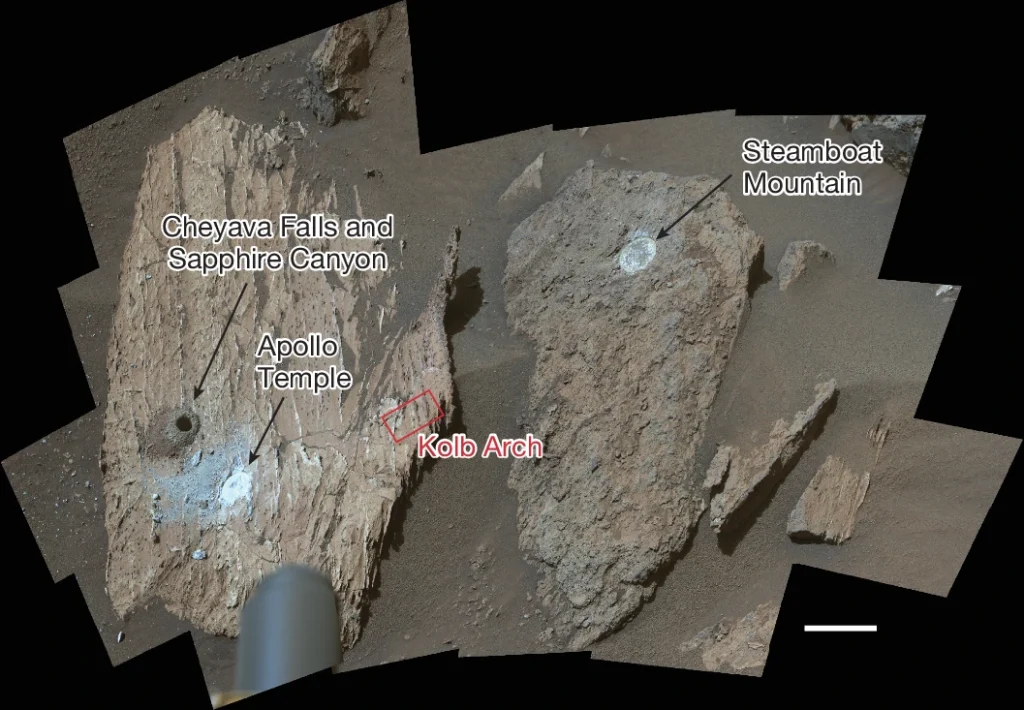
The sample, named “Sapphire Canyon,” was taken from a rock called “Cheyava Falls” in Jezero Crater on Mars.
Perseverance came upon Cheyava Falls in July 2024 while exploring the “Bright Angel” formation — a set of rocky outcrops on the northern and southern edges of Neretva Vallis, an ancient river valley about a quarter-mile wide, carved by water rushing into Jezero Crater long ago.

The striking thing about these samples was the presence of colorful spots. These could have been left behind by microbial life if it used raw ingredients such as organic carbon, sulfur, and phosphorus in the rock as an energy source.
Sapphire Canyon is one of 27 rock cores the rover has collected since landing at Jezero Crater in February 2021. Among its suite of science instruments is a weather station that provides environmental information for future human missions, as well as swatches of spacesuit material, so NASA can study how they fare on Mars.
What did they find on the Sapphire Canyon?
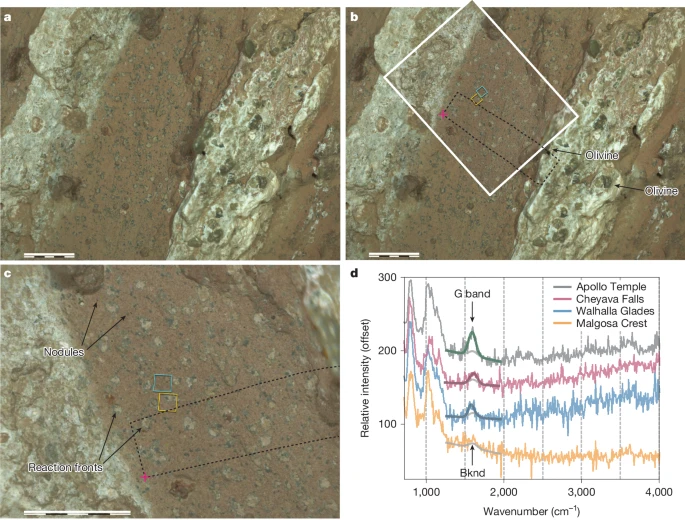
Onboard instruments such as the Planetary Instrument for X-ray Lithochemistry (PIXL) and Scanning Habitable Environments with Raman & Luminescence for Organics & Chemicals (SHERLOC), among others, were used to detect organic carbon and identify mineral phases at fine scales (submillimeter to millimeter).
The study examined nodules (small, discrete mineral inclusions) and reaction fronts (zones of altered mineral chemistry or rims) within the mudstones. The team analyzed how mineral composition and textures vary spatially (e.g., cores vs. rims) and in relation to organic matter.
In higher-resolution images, the instruments revealed a distinct pattern of minerals arranged into reaction fronts — points of contact where chemical and physical reactions occur — which the team called “leopard spots.”
The spots carried the signature of two iron-rich minerals: vivianite (hydrated iron phosphate) and greigite (iron sulfide). Vivianite is frequently found on Earth in sediments, peat bogs, and around decaying organic matter. Similarly, certain forms of microbial life on Earth can produce greigite.
What makes this discovery so special?
According to scientists, this combination of minerals, which seem to have formed by electron-transfer reactions between the sediment and organic matter, could be a potential fingerprint for microbial life, which would use these reactions to produce energy for growth.
However, it is also possible to get these minerals abiotically. So what makes them special?
While they can form without biological reactions — for instance, through sustained high temperatures and acidic conditions — the rocks at Bright Angel show no evidence of such conditions. It is also unknown whether the organic compounds present would have been capable of catalyzing the reaction at low temperatures.
Could there be more evidence for life on Mars?
Another fascinating aspect of the discovery is that it involved some of the youngest sedimentary rocks the mission has investigated. An earlier hypothesis assumed signs of ancient life would be confined to older rock formations.
This means that the Red Planet could have been habitable longer than previously thought. In turn, this creates another exciting prospect: if the newer rocks hold potential biosignatures, older rock formations could also preserve signs of life dating back further than the current samples.
What the scientists say
“This finding is the direct result of NASA’s effort to strategically plan, develop, and execute a mission able to deliver exactly this type of science — the identification of a potential biosignature on Mars,” said Nicky Fox, associate administrator for the Science Mission Directorate at NASA Headquarters in Washington.
“With the publication of this peer-reviewed result, NASA makes this data available to the wider science community for further study to confirm or refute its biological potential.”
“Astrobiological claims, particularly those related to the potential discovery of past extraterrestrial life, require extraordinary evidence,” said Katie Stack Morgan, Perseverance’s project scientist at NASA’s Jet Propulsion Laboratory in Southern California.
“Getting such a significant finding as a potential biosignature on Mars into a peer-reviewed publication is a crucial step in the scientific process because it ensures the rigor, validity, and significance of our results. And while abiotic explanations for what we see at Bright Angel are less likely given the paper’s findings, we cannot rule them out,” Morgan added.
References:
1 Redox-driven mineral and organic associations in Jezero Crater, Mars – Hurowitz, J.A., Tice, M.M., Allwood, A.C. et al. – Nature – https://doi.org/10.1038/s41586-025-09413-0 – OPEN ACCESS
2 NASA Says Mars Rover Discovered Potential Biosignature Last Year – NASA – September 10, 2025

I am an Assistant Editor and Severe Weather & Science Journalist at The Watchers, specializing in real-time severe weather coverage, geophysical event reporting, and research-driven scientific analysis. You can reach me at rishav(at)watchers(.)news.

Commenting rules and guidelines
We value the thoughts and opinions of our readers and welcome healthy discussions on our website. In order to maintain a respectful and positive community, we ask that all commenters follow these rules.