
Marine cores record Cascadia megathrust earthquakes followed by near-simultaneous San Andreas fault rupture
A new study published recently in Geosphere finds that some of the largest earthquakes along the Cascadia subduction zone may have triggered nearly simultaneous ruptures on California’s San Andreas fault. The discovery suggests that the “really big one” in the Pacific Northwest could cascade southward, affecting much of the U.S. West Coast in a single sequence.
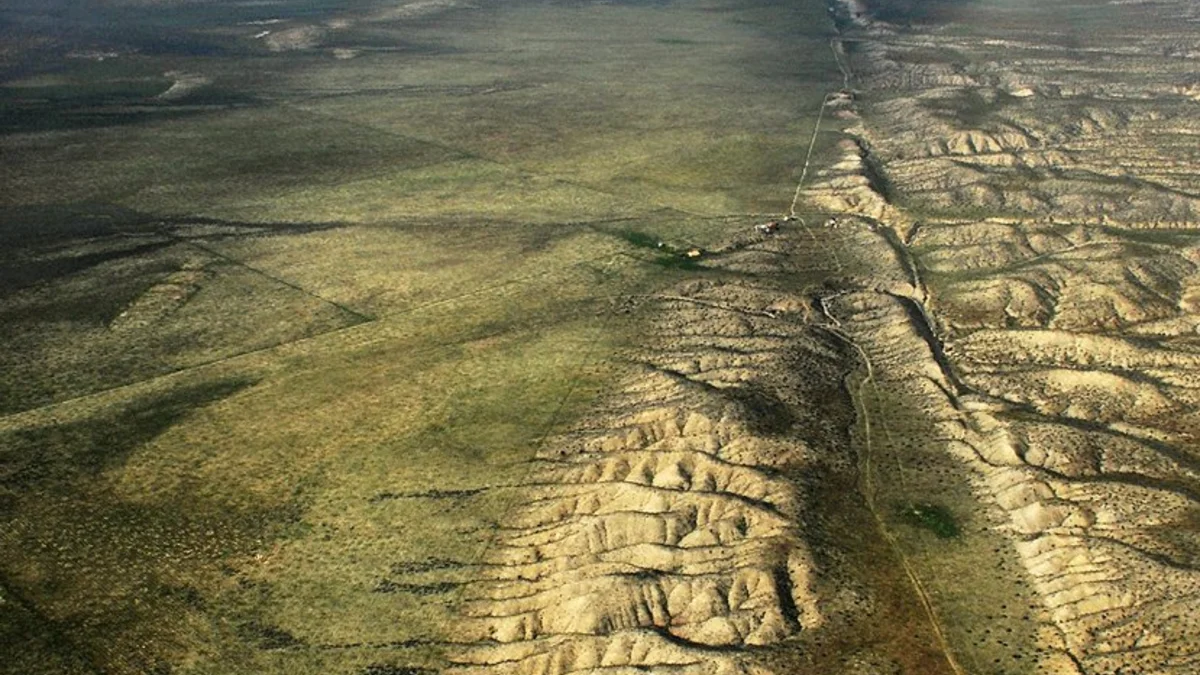
Aerial photo of San Andreas Fault looking northwest onto the Carrizo Plain with Soda Lake visible at the upper left. Credit: John Wiley
When the Cascadia subduction zone moves, the results are catastrophic. A rupture along its 1 000 km (620 miles) length can reach magnitude 9 or higher, shaking the entire Pacific Northwest and launching tsunamis that cross oceans. For decades, such events were thought to be confined north of Cape Mendocino, where the Juan de Fuca and Gorda plates slide beneath the continent.
South of that point, California’s San Andreas fault takes over as the main boundary between the Pacific and North American plates. It moves sideways rather than under, producing large strike-slip earthquakes such as the one that destroyed San Francisco in 1906. The meeting place of these two systems, known as the Mendocino triple junction, has long been viewed as a dividing line between distinct tectonic worlds.
However, the new study suggests the opposite. Sediments preserved off the coast of northern California record evidence that the two systems have occasionally ruptured in quick succession. That means a Cascadia megathrust earthquake might transfer enough stress to trigger movement on the northern San Andreas.
If so, a single tectonic episode could cause damaging earthquakes hundreds of kilometres apart. The entire U.S. Pacific coast could shake in sequence, creating overlapping crises from Washington to the Bay Area.
The discovery that started with a wrong turn
The idea of linked ruptures came from a chance mistake. During a 1999 oceanographic cruise, a graduate student entered the wrong coordinates for an overnight station. The ship ended up about 90 km (56 miles) south of its intended site, drifting from the Cascadia margin into San Andreas territory.
Dr Chris Goldfinger, a paleoseismologist at Oregon State University, initially thought the error wasted valuable ship time. But once they realized the location, the team decided to collect a core sample anyway. That unplanned decision, taken near the mouth of the Noyo Canyon off Fort Bragg, would reshape their research for decades.
When the scientists examined the sediment core, they found repeating layers of material called turbidites. These layers form when underwater landslides, or turbidity currents, sweep down submarine canyons during strong shaking. Each deposit has coarse grains at the bottom that fine upward as the flow wanes. What puzzled the team was that many of these deposits came in pairs.
In core after core, the lower layer consisted of finer sediment, topped abruptly by a thicker and coarser layer. Goldfinger described these “doublet events” as unlike any seen in standard earthquake sequences. The first hypothesis was that one came from a local slide and the other from an unrelated disturbance, but the pattern extended for thousands of years and appeared too regular to be random.
What the sediments reveal
By comparing cores from the Cascadia margin and the Noyo Canyon, researchers found that more than half of the turbidites on both sides of the triple junction were deposited at the same time, within the limits of radiocarbon dating. Over the last 3 100 years, the southern Cascadia subduction zone produced 18 major turbidite beds, while the northern San Andreas fault recorded 19. Ten of these pairs match closely in age, differing by an average of about 63 years, with a standard deviation of 51 years.
Eight of the paired events share a distinct internal structure. Each begins with a silty base and ends with a coarse, sandy cap, separated by a subtle erosional surface. The lower pulse is interpreted as the product of a Cascadia earthquake, while the upper, stronger pulse likely formed when the San Andreas ruptured soon after. In some cores, the boundary between the two layers is so sharp that the second appears to have been deposited within minutes or hours of the first.
Even historic earthquakes fit the pattern. The 1906 San Francisco event left a recognizable layer on both sides of the Mendocino triple junction, and the 1992 Cape Mendocino earthquake may have done the same. Yet neither shows the doublet structure, implying that while one fault’s shaking can affect the other’s sediments, the full paired-rupture pattern occurs only when both faults break in close succession.
The team ruled out other explanations such as aftershock sequences, hydrodynamic surges, or random slope failures. The simplest interpretation was that the two great faults sometimes move together. The similarity in recurrence intervals near the triple junction supports this idea. Instead of independent activity, the record appears to capture paired earthquakes happening so close in time that their sedimentary signatures overlap.
How the evidence was tested
To confirm what the cores suggested, the researchers compiled a massive dataset collected over two decades. They analysed 14 500 km (9 000 miles) of high-frequency seismic lines that reveal shallow layers beneath the seafloor, along with 137 cores taken from several research cruises between 1999 and 2022.
Each core was scanned for density, magnetic susceptibility, and grain size using computerized tomography at Oregon State University. The scientists also used radiocarbon dating on tiny foraminiferal shells found just below the turbidites. Ages were corrected for erosion and reservoir effects and then modelled using Bayesian software called OxCal, calibrated to the Marine20 radiocarbon dataset.
Results were remarkably consistent. The models achieved statistical quality indices above 93%, meaning the dated layers aligned across multiple locations. Marker horizons, such as the Mazama volcanic ash dated to roughly 7 680–7 580 years before present, provided firm chronological anchors. Bomb-carbon peaks from nuclear testing confirmed that the youngest deposits match known twentieth-century earthquakes.
The findings leave little doubt that the same sequence of shaking was recorded on both sides of the triple junction. The recurrence rate of major events is about the same as for either fault individually, indicating that these paired beds are not double-counting but reflect two related earthquakes. Some sequences may even extend into the early Holocene, suggesting that the faults have interacted for more than three millennia.
Why one fault can trigger another
Large earthquakes redistribute stress through the crust. When a fault slips, it increases or decreases the load on nearby faults depending on their orientation and distance. This process, known as Coulomb stress transfer, can either advance or delay the timing of the next rupture.
In the case of Cascadia and the San Andreas, the geometry at the Mendocino triple junction allows stress to pass directly from the subducting interface into the transform system. When the locked section of the megathrust breaks, its sudden motion could increase shear stress on the San Andreas fault just tens of kilometres away.
Dynamic triggering adds another possibility. Seismic waves from a magnitude 9 event would cross northern California within minutes, shaking the fault at frequencies capable of dislodging near-critical patches. If a segment were already close to failure, the additional stress might push it over the threshold almost immediately.
Examples of such chain reactions exist elsewhere. In Sumatra, the 2004 Aceh–Andaman earthquake altered stresses along the Sunda trench, and a second great earthquake struck the region two years later, just as models had predicted. The new marine record offers the longest and clearest case yet that similar interactions can occur between the Pacific Northwest’s greatest faults.
Implications for West Coast hazard planning
If Cascadia and the San Andreas can rupture in quick succession, the implications for hazard planning are profound. A magnitude 9 event on the subduction zone would devastate the Pacific Northwest, causing intense shaking, liquefaction, and a regional tsunami. Within hours, the same stress pulse could release along the northern San Andreas, striking California while the Pacific Northwest was still reeling.
Goldfinger, who grew up in the Bay Area, put it bluntly. “If I were in my hometown of Palo Alto and Cascadia went off, I think I would drive east,” he said. “There looks to me like a very high risk the San Andreas would go off next.”
Such a scenario would create cascading hazards for the infrastructure that connects the two regions. Power transmission lines, gas pipelines, and digital networks all run along the coast and across state boundaries. A paired-fault event could disrupt transportation, supply chains, and emergency response across several states at once.
Current U.S. Geological Survey hazard models treat Cascadia and the San Andreas as separate systems. The new data suggest that the assumption may underestimate the combined risk near the triple junction. Incorporating fault interaction into future simulations could better reflect the range of possible outcomes and help communities prepare for compound disasters.
What comes next
The researchers plan to extend their coring program farther south to test whether the pattern continues down the San Andreas. Improved three-dimensional seismic imaging will help identify subtle erosion surfaces between turbidite pairs, clarifying whether the events were separated by hours, days, or decades.
Onshore paleoseismic sites such as Vedanta Marsh and Lake Merced in California will provide an independent check. By matching these land records with the offshore sequence, scientists hope to refine the regional timeline of great earthquakes and test how stress travels through the triple junction.
Even with remaining uncertainties, the message is clear. The Pacific coast’s largest earthquakes may not be isolated events. Instead, they may come as linked episodes, where one megathrust rupture sets the stage for another.
For planners and residents alike, understanding that possibility means viewing Cascadia and California as parts of a single, interconnected system—a coastline where the next truly great earthquake could arrive not once, but twice.
References:
1 Unravelling the dance of earthquakes: Evidence of partial synchronization of the northern San Andreas fault and Cascadia megathrust – C. Goldfinger et al. – Geosphere – September 29, 2025 – https://doi.org/10.1130/GES02857.1
2 New in “Geosphere”: Could a Cascadia Megathrust Earthquake Trigger the San Andreas Fault? – Geosociety – October 3, 2025

I’m a science journalist and researcher at The Watchers, contributing to the Epicenter edition, where I cover peer-reviewed scientific research and emerging discoveries across Earth and space sciences. With a background in astronomy and a passion for environmental science, I’ve worked in shark and coral conservation in Fiji, conducting reef and shark-behavior research, contributing to mangrove restoration, and earning PADI Open Water and Coral Reef Certifications. I bring a blend of scientific rigor and storytelling to illuminate the discoveries shaping our planet and beyond.

Commenting rules and guidelines
We value the thoughts and opinions of our readers and welcome healthy discussions on our website. In order to maintain a respectful and positive community, we ask that all commenters follow these rules.