
Research shows atmospheric rivers fuel Colorado’s most extreme rainfall events
Landfalling atmospheric rivers contributed between 21% and 78% of top-decile precipitation events across Colorado between 2000 and 2023, according to a new study by the Center for Western Weather and Water Extremes (CW3E) and the National Weather Service (NWS).

NOAA’s GOES-17 captured this atmospheric river stretching from the Pacific to California, an important and sometimes disastrous source of winter storms and water supply in the region Image credit: NOAA GOES-17 satellite
Landfalling atmospheric rivers (ARs) were found to contribute between 21% and 78% of Colorado’s top-decile precipitation events between 2000 and 2023, according to a new study published in JGR Atmospheres.
Led by Deanna Nash and colleagues from the Center for Western Weather and Water Extremes (CW3E) and the National Weather Service (NWS), the results of the study challenge previous estimates, which attributed less than 30% of cool-season precipitation in Colorado to ARs.
Using a backward trajectory analysis of air parcels, the researchers traced the moisture responsible for extreme precipitation in 92 hydrologic sub-basins across Colorado.
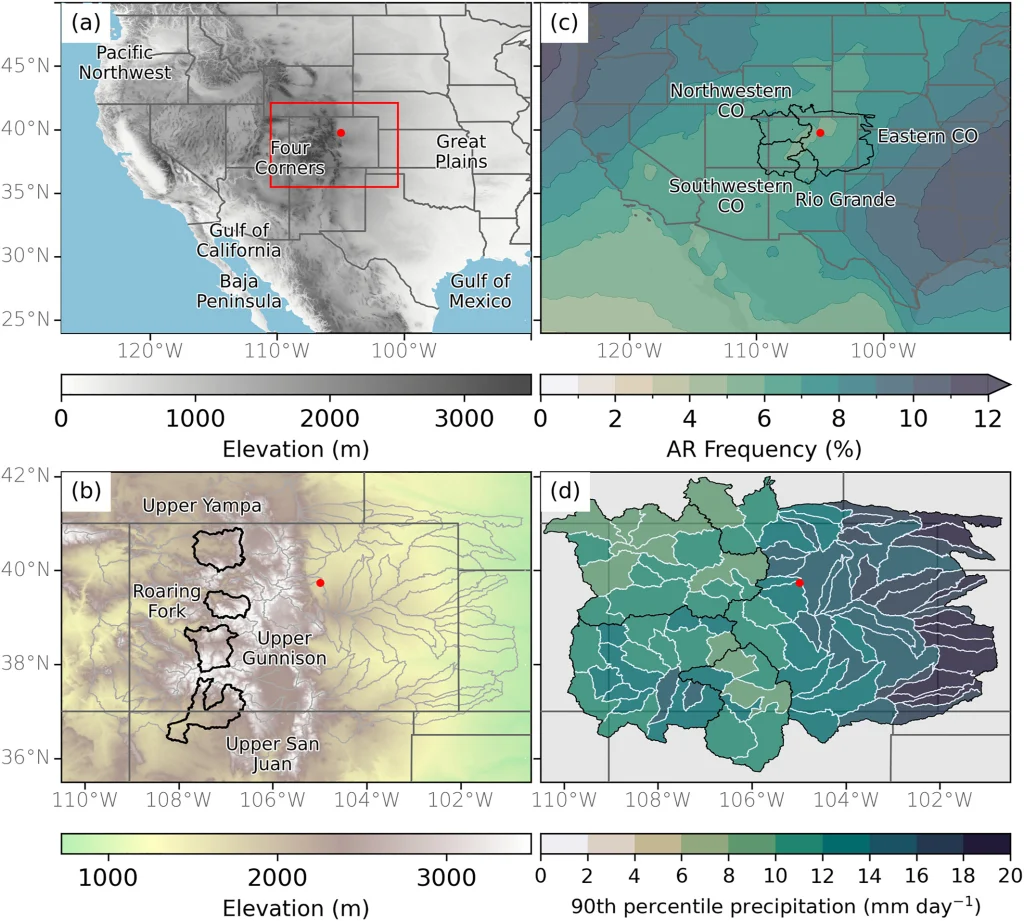
The method involved identifying when and where these parcels intersected a landfalling AR on the U.S. West Coast—specifically focusing on ARs defined by the tARgetv4 detection algorithm using ERA5 reanalysis data.
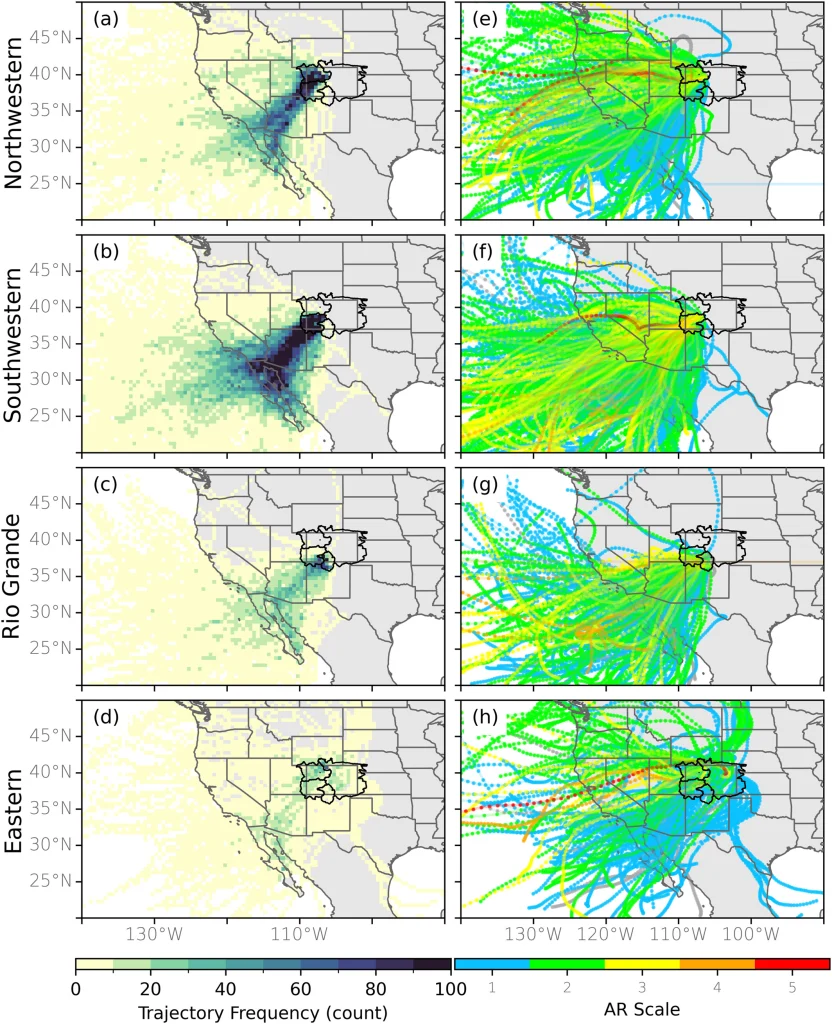
The highest contributions were observed in western Colorado, where the state’s complex topography interacts with persistent southwesterly AR pathways.
Up to 33% of analyzed trajectories, in the southwestern region, were associated with landfalling ARs. Key corridors included landfalls near Southern California and the Baja Peninsula, with AR moisture traveling inland through relatively low-elevation paths.
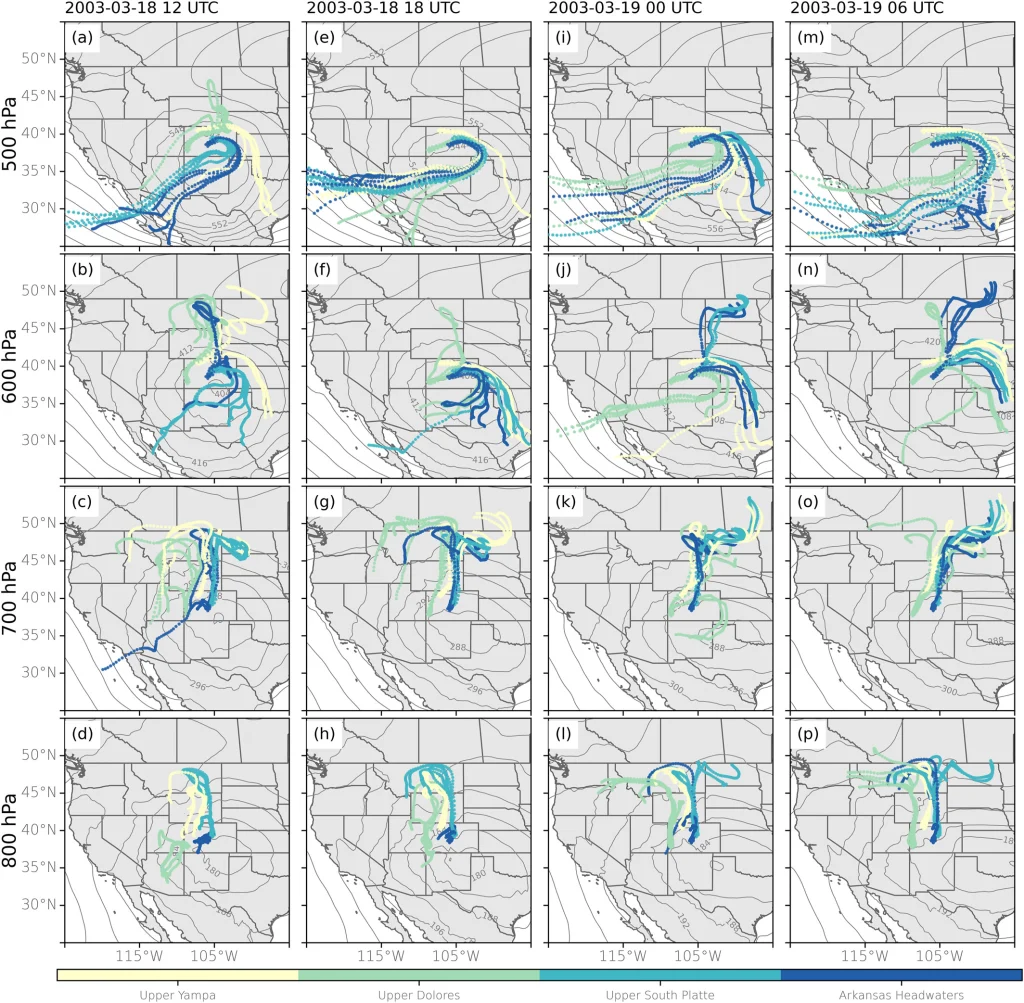
In contrast, eastern Colorado showed far fewer landfalling AR trajectories, around 2.7%, likely due to differing seasonal precipitation dynamics dominated by convective storms and moisture from the Gulf of Mexico.
The analysis focused on top-decile precipitation events, days exceeding the 90th percentile threshold within each sub-basin. Over 11 000 such trajectories were analyzed across 23 years, using ERA5 wind and moisture fields at hourly resolution.
Results showed that traditional “overhead” detection methods underestimate AR influence inland, particularly when the AR no longer meets its geometric or IVT (integrated vapor transport) criteria after traversing complex terrain.
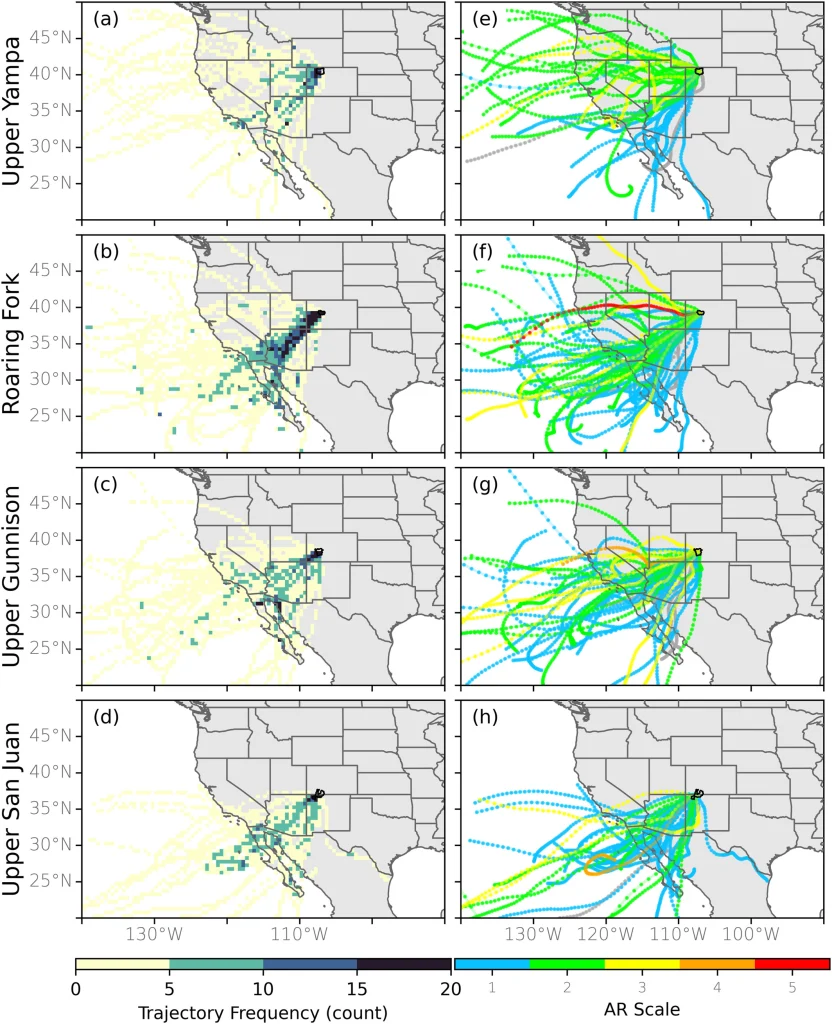
Synoptic analyses indicated that ARs entering through the Pacific Northwest and Gulf of Mexico, though less frequent, also contributed to some of the wettest days in northern Colorado sub-basins, such as the Upper Yampa and North Platte Headwaters.
The findings have direct implications for water resource forecasting and hydrological planning across the state, particularly in light of increasing AR activity linked to climate variability. The methodology developed here may improve future understanding of AR pathways into other interior regions of North America.
Atmospheric rivers are long, narrow bands of concentrated water vapor that transport moisture from subtropical oceans toward mid-latitudes. These systems can carry as much moisture as the Mississippi River discharges, and when they encounter terrain like the Rockies or Sierra Nevada, the uplift triggers intense precipitation.
While they are essential for seasonal water supply they can also cause damaging floods and landslides, especially during multi-day AR events.
References:
1 A trajectory-based method for estimating the contribution of landfalling atmospheric rivers to top-decile precipitation across Colorado – Nash, D., Rutz, J. J., Cordeira, J., Zhang, Z., Ralph, F. M., Sanders, K., & Walter, E. (2025). – Journal of Geophysical Research: Atmospheres – August 29, 2025 – https://doi.org/10.1029/2025JD043580 – OPEN ACCESS

I am an Assistant Editor and Severe Weather & Science Journalist at The Watchers, specializing in real-time severe weather coverage, geophysical event reporting, and research-driven scientific analysis. You can reach me at rishav(at)watchers(.)news.

Commenting rules and guidelines
We value the thoughts and opinions of our readers and welcome healthy discussions on our website. In order to maintain a respectful and positive community, we ask that all commenters follow these rules.