• Chinese researchers advocate for nuclear weapon use against asteroid threats

    Chinese experts propose using nuclear weapons as a last resort to protect Earth from potential asteroid crashes. The team, led by Zhang He of the Beijing Institute of Spacecraft System Engineering, stressed that current planetary defense technologies, including NASA’s DART mission, may be insufficient against larger asteroids. 

  • Low-velocity seismic structure discovered in Earth’s outer core

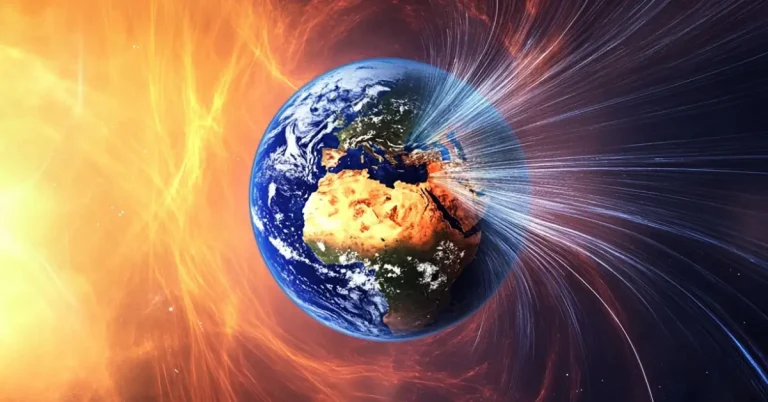
    Two Australian scientists discovered a ‘seismic abnormality’ in the Earth’s outer core — a “donut” of energy around the equator, where seismic waves move about 2% slower than in other core regions. Their study provides new clues about the dynamics of our planet’s magnetic field.

  • Researchers uncover critical role of Atlantic-Arctic mixing in regulating AMOC

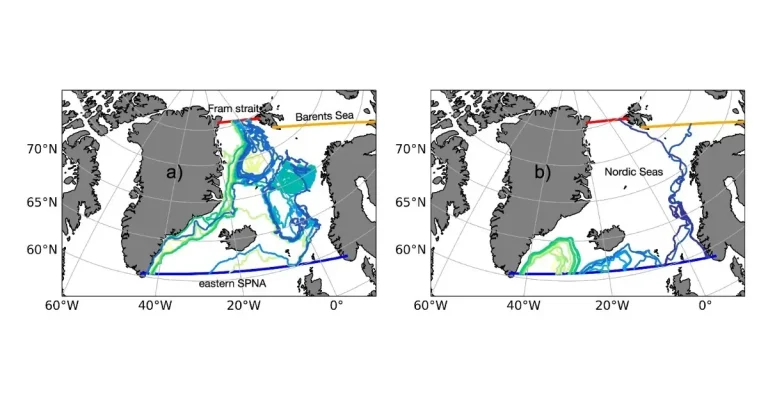
    A recent study led by Dipanjan Dey of the University of Southampton, in collaboration with international scientists, revealed the vital role that Atlantic and Arctic water mixing plays in maintaining the Atlantic Meridional Overturning Circulation (AMOC), an essential component of the global climate system.

  • Ancient asteroid impact shifted Ganymede’s axis by 7 degrees, changing its geological history

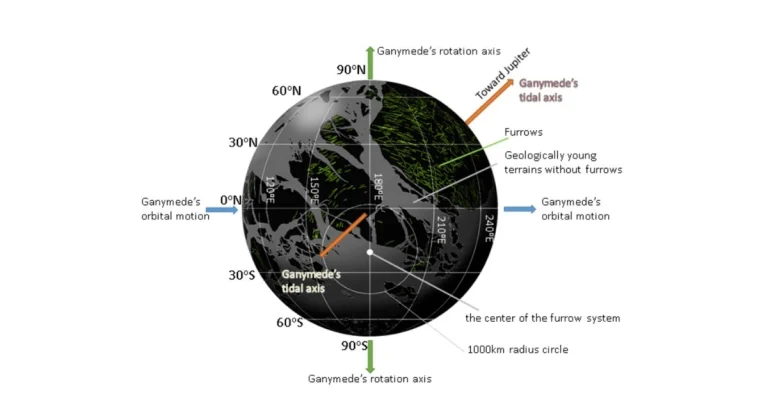
    A massive asteroid struck Ganymede, Jupiter’s and the Solar System’s largest moon, roughly 4 billion years ago, producing a significant shift in its rotational axis. This event, which formed the conspicuous Valhalla Basin, was so powerful that it shifted Ganymede’s axis about 7 degrees, changing the moon’s geological history.

  • Magnetic waves behind decades-long mystery of solar wind acceleration

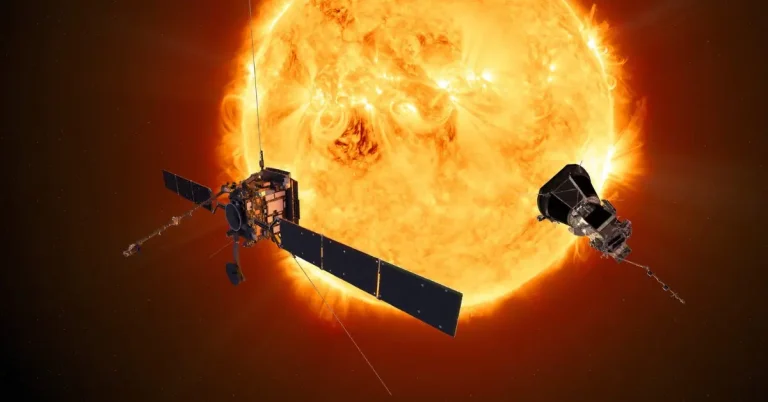
    A team of scientists compared data from NASA’s Parker Solar Probe and ESA’s Solar Orbiter and discovered that magnetic waves known as Alfvén waves, essentially a form of plasma wave, are responsible for pumping energy into the solar wind, causing it to accelerate and heat up as it travels away from the Sun.

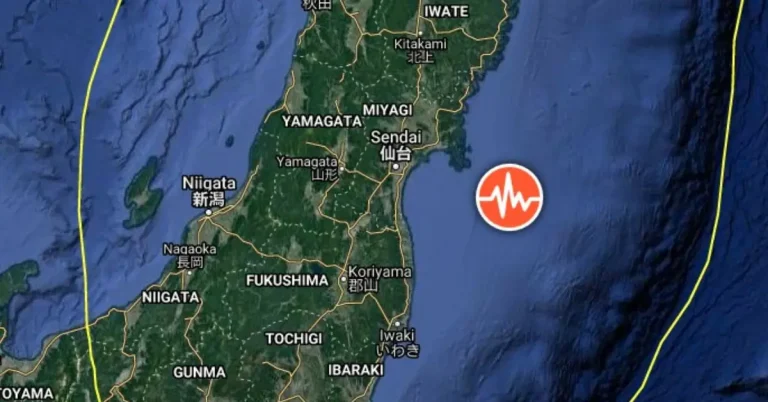
  • Study reveals precursors to the 2021 Fukushima earthquake through multi-parameter analysis

    A new study was conducted to understand the precursors to the 2021 Fukushima Prefecture Offshore Earthquake (Mj = 7.3), which occurred on February 13, 2021, off the coast of Fukushima, Japan, as an aftershock of the 2011 Tōhoku earthquake and tsunami. The investigation, led by Masashi Hayakawa and Yasuhide Hobara, focused on the Lithosphere-Atmosphere-Ionosphere Coupling (LAIC) channels and multi-parameter anomalies that occurred before the earthquake.

  • Researchers use AI to predict major earthquakes months in advance

    A recent study by Társilo Girona of the University of Alaska Fairbanks and Kyriaki Drymoni of Ludwig-Maximilians-Universität in Munich proposed a new machine learning technique for predicting big earthquakes months in advance. The study, published in Nature Communications on August 28, 2024, intended to improve earthquake predictions and public safety.

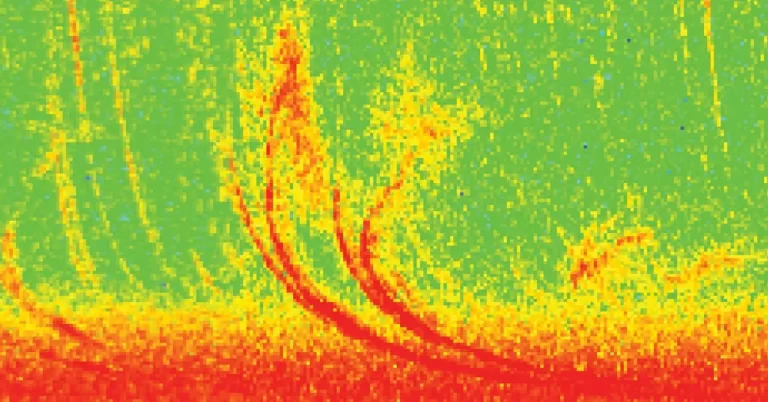
  • Discovery of electromagnetic wave reveals new phenomenon affecting Earth’s radiation belts

    Researchers at the University of Alaska Fairbanks identified a new electromagnetic wave called the “specularly reflected whistler.” This wave, caused by low-latitude lightning, challenged earlier notions by revealing that lightning energy can escape the ionosphere and enter the magnetosphere, impacting space weather dynamics. The discovery of the “specularly reflected whistler” which is an electromagnetic wave…