
Floods leave 34 dead and affect over 310 000 people in Malawi
Flooding triggered by heavy rainfall affected multiple districts across Malawi between March 15–18, 2026, leaving 34 people dead and 197 injured. The disaster impacted approximately 310 896 people across 69 088 households, with 6 155 households displaced and sheltered in 84 camps, according to the Department of Disaster Management Affairs (DoDMA).
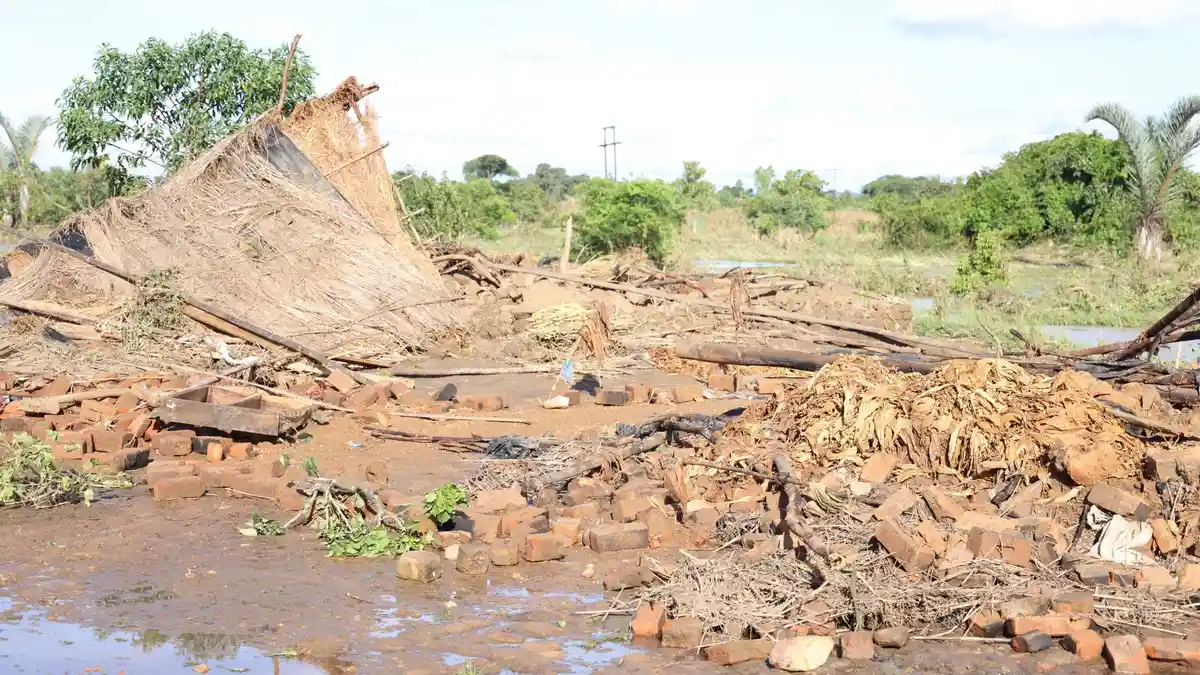
Floods in Malawi on March 19, 2026. Credit: Department of Disaster Management Affairs
Flooding triggered by heavy rainfall between March 15–18, affected 23 districts and city councils across Malawi, leaving 34 people dead and 197 injured, according to the Department of Disaster Management Affairs (DoDMA) under the Office of the President and Cabinet.
A total of 69 088 households, representing approximately 310 896 people, were affected nationwide. Authorities reported that 6 155 households were displaced and are currently being sheltered in 84 camps established across impacted areas, while ongoing assessments are expected to revise the figures upward as previously inaccessible locations are reached.
Chikwawa District recorded the highest level of impact, with 24 832 households affected and 1 828 households displaced into 24 camps. The district reported 9 fatalities and 25 injuries.
Machinga District reported 7 045 affected households, with 110 households displaced and sheltered in 2 camps, alongside 3 deaths and 32 injuries. In Balaka District, 3 409 households were affected, with 53 households displaced into 2 camps and 19 injuries recorded. Blantyre City registered 883 affected households, with 15 displaced households, 2 deaths, and 8 injuries.
Blantyre District separately reported 964 affected households. Dedza District recorded 530 affected households, with 36 displaced households, alongside 2 fatalities and 6 injuries. Karonga District reported 34 households displaced and sheltered in 2 camps.
Additional impacts were recorded across other districts, including Chiradzulu, Likoma, Mangochi (district and municipal), Mchinji, Mulanje, Mwanza, Neno, Nsanje, Ntcheu, Phalombe, Rumphi, Salima, Zomba City, and Zomba District.
In Lilongwe District, localized impacts included mudslides in Traditional Authority Mazengera, where 17 households were displaced and relocated to a community-based care center.
The DoDMA stated that the reported figures remain preliminary, noting that several affected councils are still conducting field assessments in areas that were previously inaccessible due to flooding conditions and infrastructure damage.
Government response efforts are ongoing, with authorities distributing relief assistance, including food supplies, tents, and blankets to displaced households across affected districts as part of coordinated humanitarian operations.

I’m a science journalist and researcher at The Watchers, contributing to the Epicenter edition, where I cover peer-reviewed scientific research and emerging discoveries across Earth and space sciences. With a background in astronomy and a passion for environmental science, I’ve worked in shark and coral conservation in Fiji, conducting reef and shark-behavior research, contributing to mangrove restoration, and earning PADI Open Water and Coral Reef Certifications. I bring a blend of scientific rigor and storytelling to illuminate the discoveries shaping our planet and beyond.
Published in the last 24 hours
- Flying glass cut a teacher in Russia but none of her 44 pupils, because when a meteor flashed across the sky in 2013, she told them to get under their desks Epicenter
- A South Dakota man put the widest and heaviest hailstone on US record in his freezer, and a power cut melted part of it before NOAA measured it at 8 inches across and nearly 2 pounds in 2010 Epicenter
- Black kites and brown falcons in northern Australia have been seen snatching smoldering sticks from wildfires, flying them into unburned grass and dropping them, starting new fires that send lizards, rodents and insects running straight toward the waiting birds Epicenter
- A levee protecting a highway north of San Francisco is pocked with animal burrows and only 3 feet wide in places, and a report warns this winter's El Niño could push water over the top Epicenter
