
Flash floods kill 3 and damage 1 999 shelters across 21 displacement sites in northwest Syria
Flash floods triggered by heavy rainfall between February 7–9, 2026 killed at least three people and inundated 21 displacement sites across Idlib and northern Latakia, northwest Syria. The flooding directly affected about 5 300 internally displaced persons, damaged or destroyed 1 999 tents, submerged homes, and forced evacuations of civilians and medical facilities, according to United Nations and local authorities.
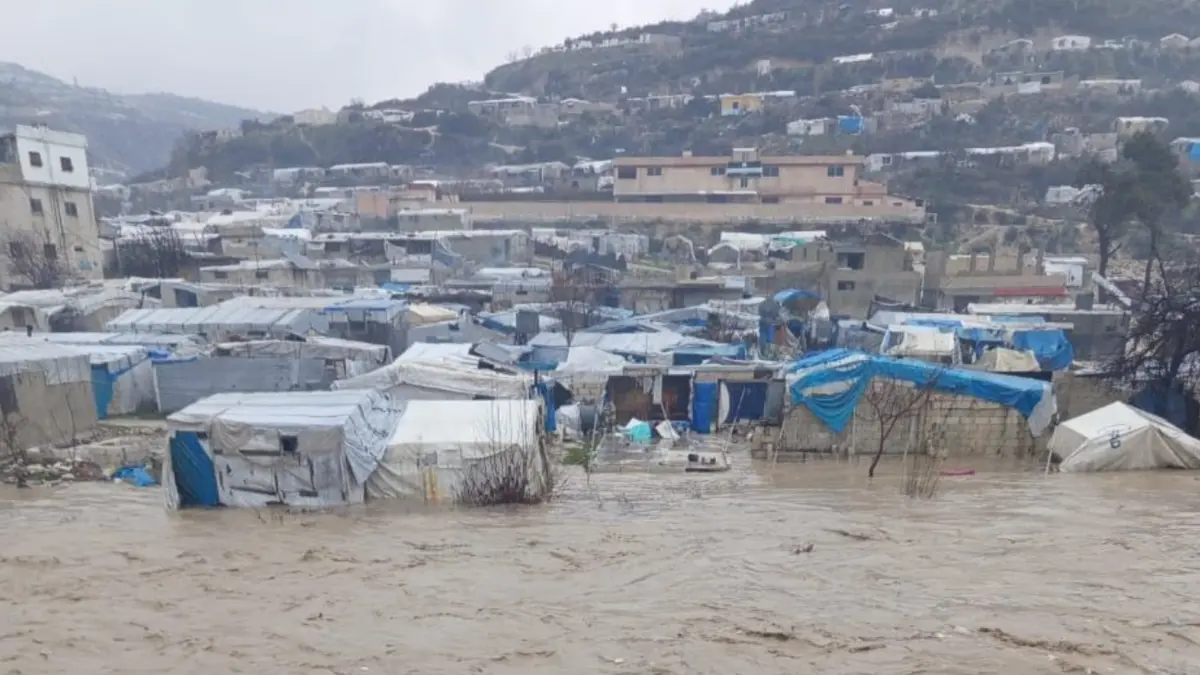
Floods in Kherbet Eljoz IDP camps in Badama sub-district, Idleb Governorate. Credit: CCCM Sector
Heavy rainfall between February 7 –9, generated extensive flooding across 21 internally displaced persons sites in the Kherbet Eljoz community in Badama and Darkosh sub-districts of Idlib governorate, as well as adjacent areas of northern Latakia countryside. According to the United Nations Office for the Coordination of Humanitarian Affairs, approximately 5 300 IDPs representing 1 263 families were directly affected.
Floodwaters partially damaged 1 850 tents and destroyed 149 others, bringing total shelter damage to 1 999 units. In surrounding communities, 30 houses and several shops were also damaged. Landslides and soil erosion disrupted access roads and internal camp pathways, constraining humanitarian movement and evacuation efforts.
In Ein Issa and Ein Bnar villages in Rabee’a sub-district of northern Latakia, two children died after being swept away by floodwaters. According to Syrian Civil Defense statements, the children were siblings. One child was rescued alive, while the bodies of the other two were recovered.
Rescue operations also continued in al-Asaliyah, where floodwaters swept civilians toward a tree, and in al-Badrusiyah and al-Sheikh Hassan, where families were evacuated after becoming surrounded by torrents. Some individuals were initially reported missing as search operations continued.
Separately, a Syrian Arab Red Crescent disaster response vehicle fell into a valley in Turkmen Mountain during nighttime operations, resulting in the death of the Disaster Management Coordinator and injuries to six SARC personnel.
Flooding rendered the Ain Al-Bayda private hospital in Kherbet Al-Jouz out of service due to structural damage after water inundated the ground floor. Patients and medical staff were evacuated to facilities in Jisr Ash-Shughur and Idlib. Seven mobile medical teams were deployed to affected camps and collective shelters, and ambulances were dispatched to support referrals. A 2.3-ton shipment of medicines and emergency health kits was prepared for delivery to the Idlib Directorate of Health.
Health partners reported increased cases of respiratory infections, hypothermia, and other cold-related illnesses, particularly among children and older persons, amid exposure to winter conditions and disrupted health services.
The flooding temporarily displaced 120 people in Badrosiyeh who were hosted by relatives. Earlier assessments also identified an additional 986 families displaced in the Kherbet Al-Jouz area, with figures expected to increase as access improves.
Three schools were designated as temporary collective shelters for newly displaced families. Five additional schools near Kherbet Al-Jouz and three schools in northern Latakia were prepared to receive further displacement. Many families chose to relocate to nearby camps or host communities rather than move into collective centers.
Authorities in Idlib and Latakia confirmed that 1 500 housing units in Afrin, 100 units in Latakia, and 2 600 caravans are ready to accommodate families returning to their areas of origin. Government representatives stated that assistance within affected camps should remain limited to essential life-saving services to avoid premature returns and reduce exposure to future hazards.
The Ministry of Emergency and Disaster Management established emergency response committees in coordination with the Ministry of Health and local governors. Minister Raed al-Saleh urged residents to avoid flood channels and areas of water accumulation and to follow safety instructions.
The Early Warning Department of the Ministry of Emergency and Disaster Management warned that the low pressure system responsible for the rainfall could bring additional heavy showers through February 7, with continued risk of runoff and localized flash flooding. Meteorological services forecast a temporary stabilization period followed by another low-pressure system expected to affect the region on the evening of February 11, raising concerns about renewed flooding in vulnerable camp locations.
Shelter and non-food item partners activated emergency mechanisms to repair tents, distribute blankets, mattresses, clothing, plastic sheeting, and heating materials. Drainage improvements and rehabilitation of damaged access roads are being prioritized to mitigate repeated flood impacts.
References:
1 Syrian Arab Republic: Flash Update No. 3 | Floods Affect Displaced Communities in Syria (As of 9 February 2026) – OCHA – February 9, 2025

I’m a science journalist and researcher at The Watchers, contributing to the Epicenter edition, where I cover peer-reviewed scientific research and emerging discoveries across Earth and space sciences. With a background in astronomy and a passion for environmental science, I’ve worked in shark and coral conservation in Fiji, conducting reef and shark-behavior research, contributing to mangrove restoration, and earning PADI Open Water and Coral Reef Certifications. I bring a blend of scientific rigor and storytelling to illuminate the discoveries shaping our planet and beyond.

Commenting rules and guidelines
We value the thoughts and opinions of our readers and welcome healthy discussions on our website. In order to maintain a respectful and positive community, we ask that all commenters follow these rules.