
Media claims of Mount Rainier tremor proven false by USGS and PNSN
Contrary to recent media coverage suggesting Mount Rainier had entered an unprecedented tremor phase, the U.S. Geological Survey (USGS) confirmed that no volcanic tremor is occurring at the volcano. The abnormal seismic signal detected over several days in mid-November 2025 originated from ice buildup and communication interference at the STAR station on Rainier’s west flank. Monitoring data from the Pacific Northwest Seismic Network (PNSN) show no signs of volcanic unrest, and the Alert Level remains at Normal.
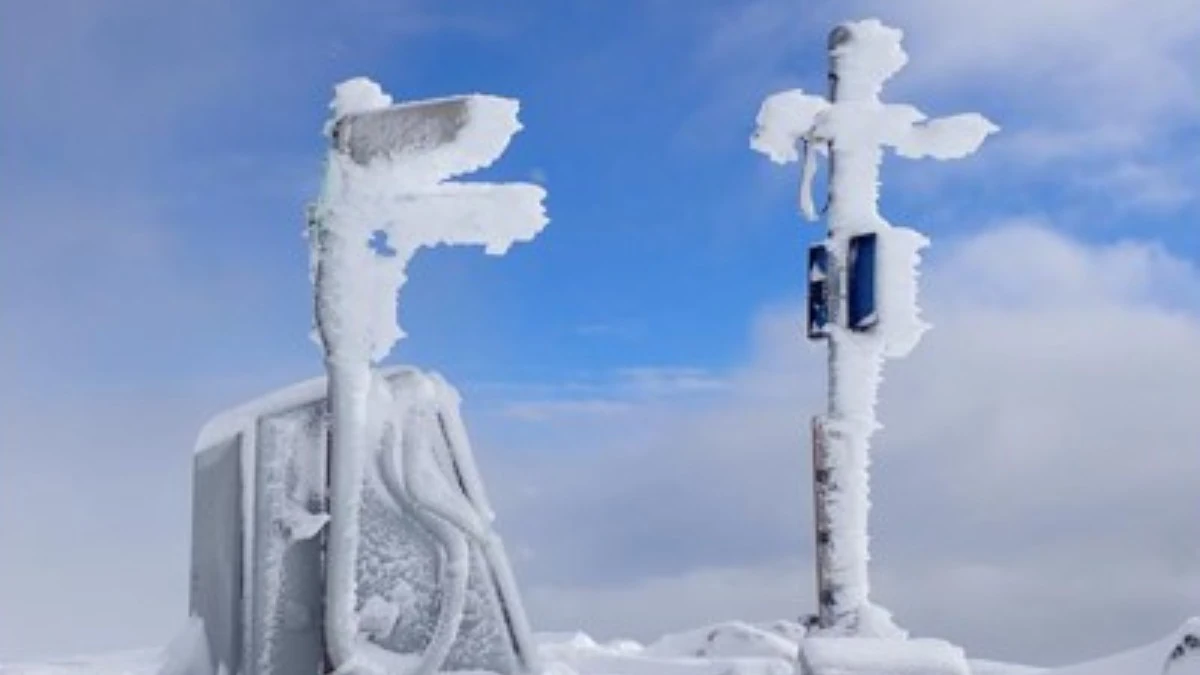
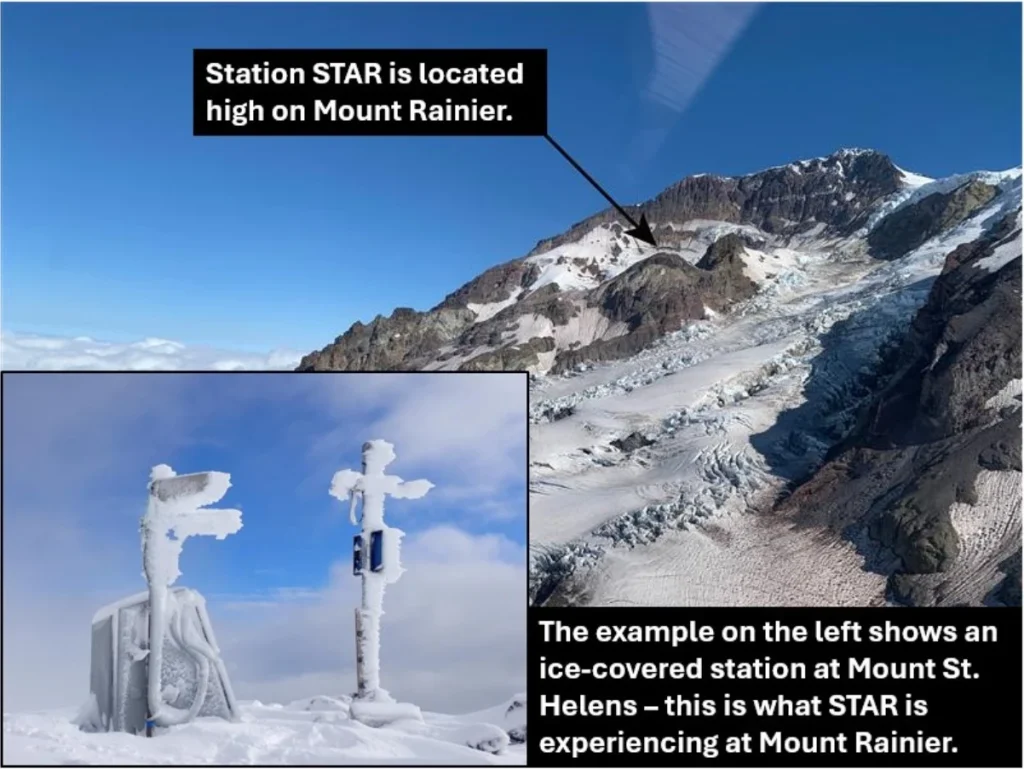
Ice-covered station at St. Helens - example of what STAR station experienced in November 15, 2025. Credit: USGS
The U.S. Geological Survey (USGS) confirmed that unusual seismic traces recorded at Mount Rainier between November 15 and 18, 2025, were not caused by volcanic tremor but by an instrumentation issue at a single monitoring site.
According to the USGS, ice accumulation and telemetry disruption at the STAR station (EHZ channel), located on the volcano’s west flank, produced continuous, high-intensity signals that visually resembled tremor on helicorder plots. The volcano remains at background activity with no change to its alert level.
Several media outlets reported that Mount Rainier was producing sustained tremor, a continuous vibration sometimes linked to subsurface fluid movement, but no monitoring data from USGS or PNSN supported these claims at the time. Inaccurate reporting of volcanic activity can compromise effective hazard communication by eroding public trust and obscuring the real signals that emergency managers rely on during genuine unrest.
Instrumented networks operated by the USGS and the Pacific Northwest Seismic Network (PNSN) did not detect any multi-station coherent tremor, no increase in volcano-tectonic earthquakes, no deformation, and no gas anomalies.
The STAR station malfunction was isolated to a single site and did not appear on other seismic stations around Rainier.
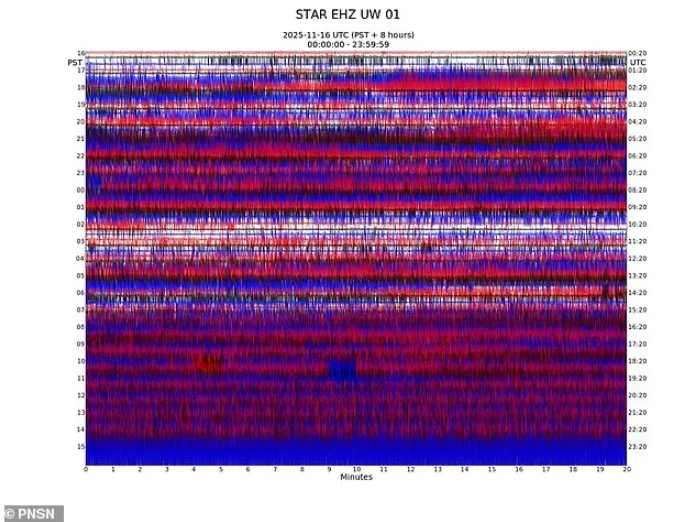
Ice-related interference is a known issue on exposed high-elevation instruments during winter months, where frozen moisture and transmission instability can generate continuous low-frequency noise. Such distortions may appear as dense, uninterrupted seismic bands but do not represent physical ground shaking.
The lack of parallel signals on other stations made it evident that the readings were faulty and not related to volcanic activity.
Confirming volcanic tremor requires observations across multiple stations, frequency-dependent analysis, and supporting measurements such as deformation or gas release. Single-station anomalies, especially those affected by weather or telemetry issues, cannot be used to infer changes in subsurface processes.
“Fact Check: There is no ‘tremor’ occurring at Mt. Rainier,” USGS volcanologists said. “Always check credible sources like USGS and PNSN for information about volcanoes. The station STAR is temporarily impacted by ice buildup, causing communication problems, resulting in an odd, but non-volcanic signal.”
“Unfortunately, sloppy journalism by non-scientists who don’t understand seismology nor check with those who do can generate confusion in the public and more work for those who need to correct the clearly incorrect information,” Steve Malone of PNSN said. “It is no wonder that some publications are only considered tabloids and should never be believed.”
This event follows a year marked by heightened public attention on Rainier’s seismic behaviour.
Earlier in 2025, beginning on July 8, the volcano produced a notable earthquake swarm with more than 1 000 small events over several weeks. The PNSN described that episode as a shallow, fluid-driven sequence, similar to hydrothermal or structurally induced swarms observed in past decades.
However, the volcano alert level remained unchanged throughout that period, and no precursory eruptive indicators were detected.
Mount Rainier is classified by the USGS as a “Very High Threat” volcano due to its extensive glacial cover, steep upper flanks, and history of large lahars, fast-moving volcanic mudflows capable of travelling tens of kilometres downvalley.
These secondary hazards pose the primary risk to communities in the Puyallup, Nisqually, and Carbon river valleys, where population centres of the greater Seattle–Tacoma region are located. However, current monitoring data indicate that Rainier is not experiencing any increase in unrest.

I'm a dedicated researcher, journalist, and editor at The Watchers. With over 20 years of experience in the media industry, I specialize in hard science news, focusing on extreme weather, seismic and volcanic activity, space weather, and astronomy, including near-Earth objects and planetary defense strategies. You can reach me at teo /at/ watchers.news.

Commenting rules and guidelines
We value the thoughts and opinions of our readers and welcome healthy discussions on our website. In order to maintain a respectful and positive community, we ask that all commenters follow these rules.