
Shallow M6.1 earthquake hits west of Macquarie Island
A strong earthquake registered by the USGS as M6.1 hit west of Macquarie Island at 16:33 UTC on May 23, 2025. The agency is reporting a depth of 10 km (6.2 miles). EMSC is reporting the same magnitude and depth.
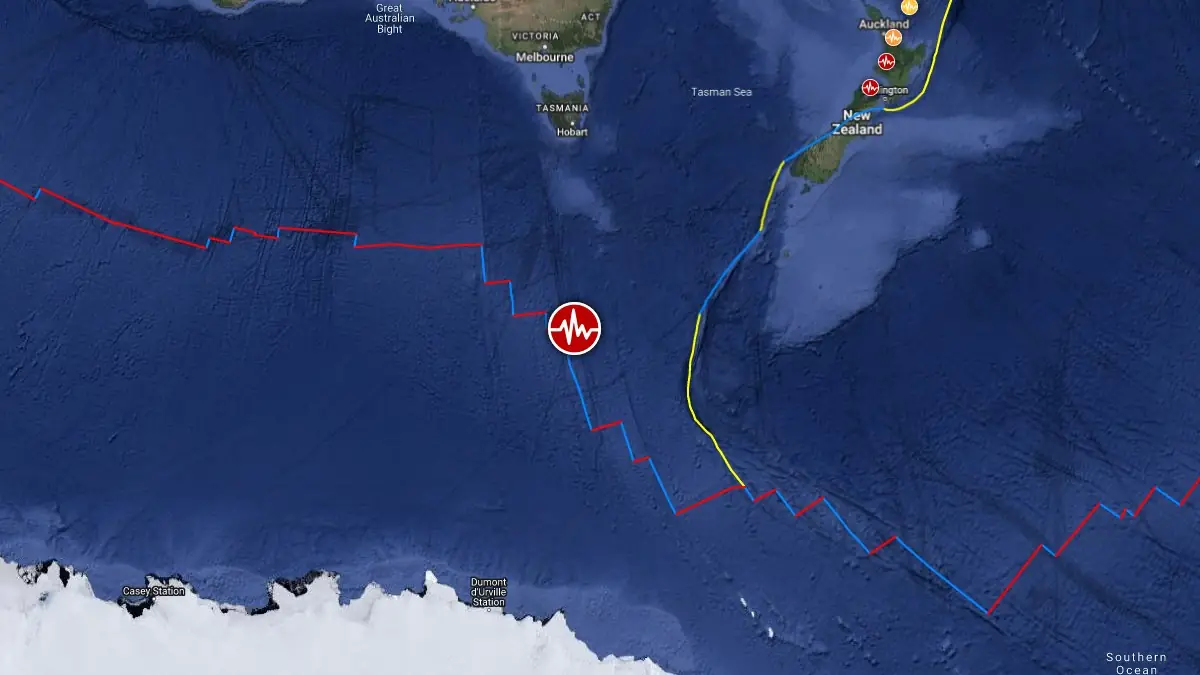
Epicenter of M6.1 earthquake west of Macquarie Island on May 23, 2025. Credit: TW/SAM, Google
The epicenter was located 1 480 km (920 miles) south of Geeveston, Australia.
There is no tsunami threat from this earthquake.
The USGS issued a Green alert for shaking-related fatalities and economic losses. There is a low likelihood of casualties and damage.
Macquarie Island is a remote sub-Antarctic landmass administered by Australia, with no permanent population and only a research station present.
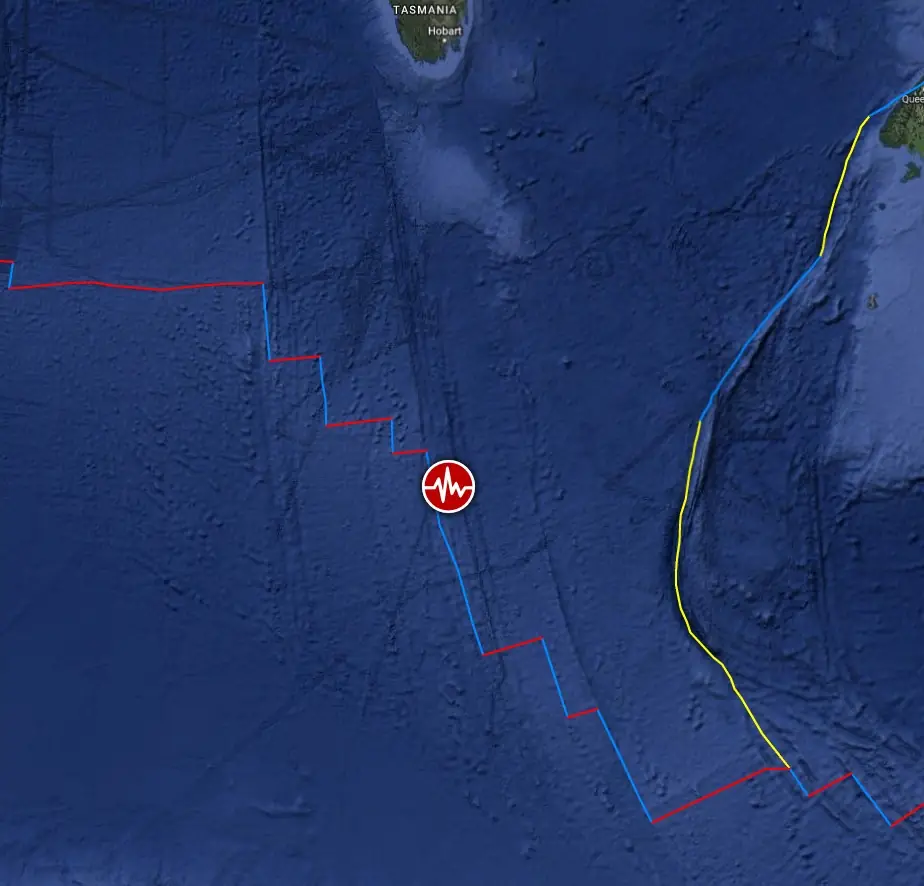
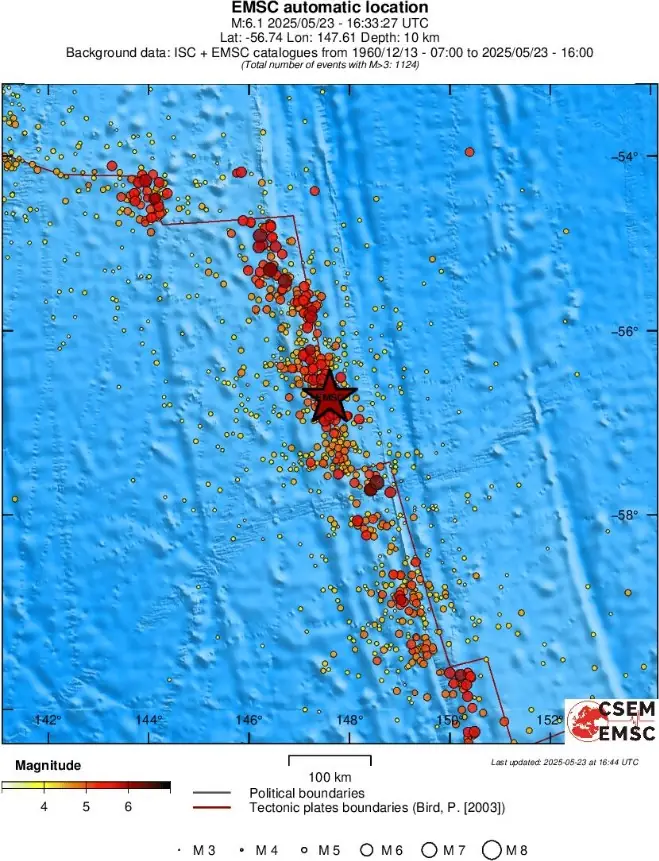
The island is situated along the complex boundary between the Australian and Pacific Plates and is known for frequent seismic activity due to the transform fault system in the region.
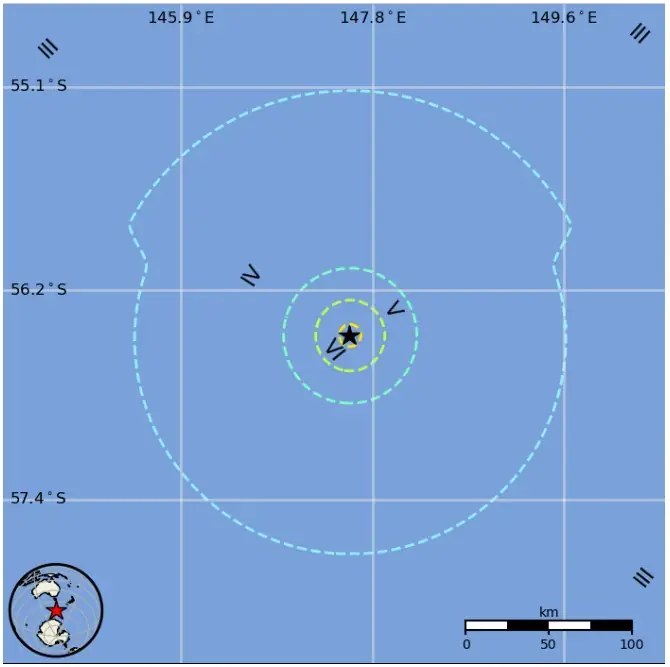
Estimated population exposure to earthquake shaking
Regional seismicity
References:
1 M6.1 earthquake west of Macquarie Island – USGS – May 23, 2025
2 M6.1 earthquake west of Macquarie Island – EMSC – May 23, 2025

Teo Blašković founded The Watchers in 2011 and edited it until 2026, covering seismic and volcanic activity, extreme weather, space weather and near-Earth objects. Articles on this page are his archive.
Published in the last 24 hours
- Odisha evacuated 983,642 people before Phailin crossed near Gopalpur on 12 October 2013 with winds of 200-210 km/h gusting to 220, and 44 died, against 9,885 in the 1999 super cyclone. Cyclone Akvan crossed the same coast on 20 November 2026. Epicenter
- Lava fountains reached 1,900 feet (580 m) at Kīlauea Iki in 1959, the highest ever recorded at Kīlauea, as USGS forecasts episode 57 fountaining at Halemaʻumaʻu for November 22-26. Epicenter
- Novarupta in Alaska erupted about 3 cubic miles of magma in roughly 60 hours from 6 June 1912, 30 times Mount St. Helens in 1980, and strong northwesterly winds lifted that same loose ash on 16 November 2026, prompting an NWS SIGMET. Epicenter
- A fog linked to about 12 000 excess deaths in London in 1952 puzzled scientists for decades, until researchers reconstructed how coal smoke formed acidic haze Epicenter
