
Increased ground deformation raises eruption concerns at Kanlaon volcano, Philippines
Ground deformation monitoring by the Kanlaon Volcano Network (KVN) has detected significant inflation in the middle to upper portions of the volcano’s eastern edifice since 19:20 LT on January 10, 2025, with data indicating a potential eruption driven by pressurization within the shallow magma conduit. PHIVOLCS maintains Alert Level 3, originally raised on December 9, 2024, and there is presently an increased chance for sudden explosive eruptions to occur and endanger communities at risk with life-threatening volcanic hazards.

A detailed satellite image of Kanlaon volcano captured on December 14, 2024, using Sentinel-2 L2A data. Image credit: CopernicusEU/Sentinel-2, EO Browser, The Watchers
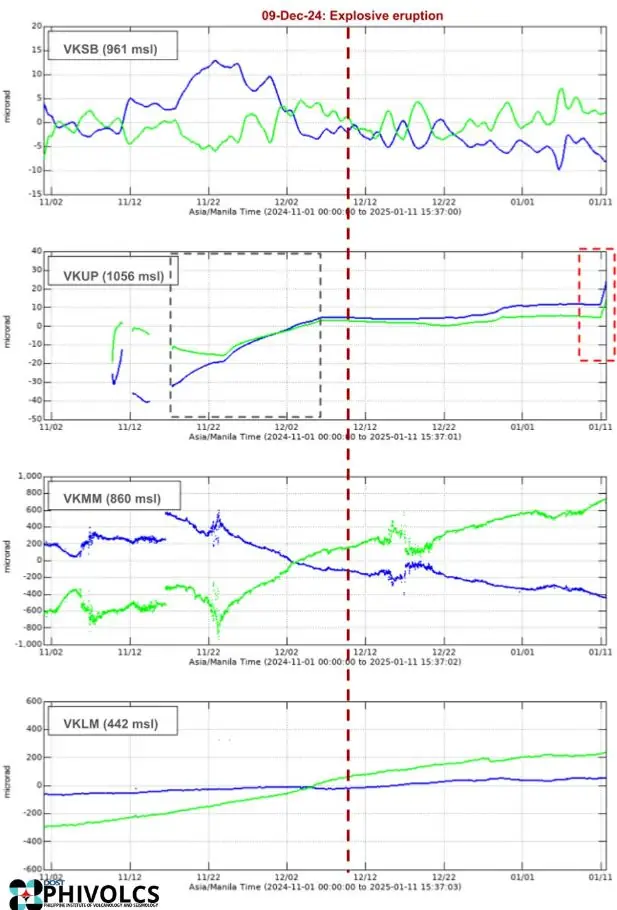
Ground deformation monitoring conducted by the Kanlaon Volcano Network (KVN) has recorded sharp inflation in the eastern edifice since 19:20 LT (11:20 UTC) on January 10.
Data from the Upper Pantao Observation Station (VKUP) on the volcano’s eastern flank at an elevation of 1 056 m (3 465 feet) revealed a sudden tilt increase and indicated pressurization within the upper magma conduit. The observation aligns with similar patterns observed before the eruption on December 9, 2024.
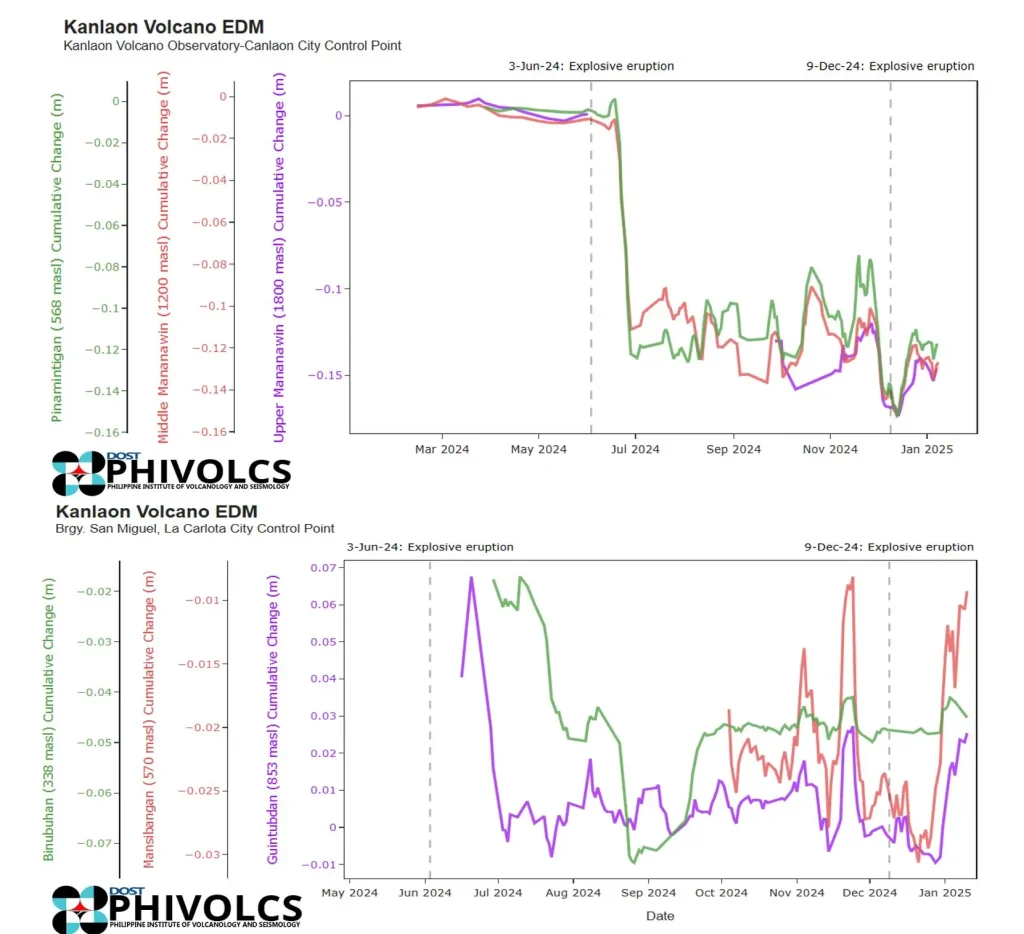
Philippine Institute of Volcanology and Seismology (PHIVOLCS) recorded contrasting deformation trends between December 2024 and early January 2025. It included inflation of the southeastern flank and deflation of the western flank. The ground movements reflect activity within the volcanic system while pointing to an active shallow magma conduit.
Sulfur dioxide (SO2) measurements on January 10 averaged 5 763 tonnes/day, close to average emissions since the June 3, 2024 eruption, but a significant drop to 2 029 tonnes/day was recorded on January 9.
PHIVOLCS noted that similar emissions preceded past eruptions including the December 2024 event.

“The public is reminded that Alert Level 3 (magmatic unrest) is raised over Kanlaon Volcano. There is presently an increased chance for sudden explosive eruptions to occur and endanger communities at risk with life-threatening volcanic hazards,” PHIVOLCS said.
The public is urged to stay clear of the 6 km (3.7 miles) radius danger zone around Kanlaon volcano to avoid hazards such as pyroclastic density currents (PDCs), ballistic projectiles, lava flows, ashfall, and rockfalls.
Local disaster risk reduction and management councils are advised to prepare for potential lahars during heavy rainfall which could affect barangays on the southern flanks, La Castellana and Canlaon City. Pilots are warned to avoid flying near the volcano because of possible ash emissions.
Kanlaon volcano exhibited sustained eruptive behavior from late 2024 into early 2025. PHIVOLCS documented 23 to 45 volcanic earthquakes daily between December 31, 2024, and January 6, 2025, including volcanic tremors lasting from 4 minutes to over 4 hours.
Gas and steam plumes were reported as high as 1.4 km (0.87 miles) above the summit while ash plumes rose to heights of 500 m to 1 000 m (1 640 to 3 280 feet) and drifted southwestward.
Read more:
Kanlaon volcano erupted at 11:05 LT (03:05 UTC) on December 23, 2024, and emitted an ash plume that rose approximately 1.2 km (0.75 miles). The ashfall affected communities in Negros Occidental including Bacolod City. Authorities recorded at least 15 volcanic earthquakes leading up to the eruption.
SO2 emissions peaked at 7 200 tonnes/day on December 22 while ground deformation data showed increasing inflation. Over 87 000 residents were evacuated from the danger zone with the National Disaster Risk Reduction and Management Council (NDRRMC) coordinating shelter and resources for displaced families.
Kanlaon has experienced multiple eruptions over its documented history, often resulting in phreatic explosions and ashfall. Its geological structure includes andesitic and basaltic lava flows, with a summit featuring a 2 km (1.2 miles) wide caldera and the active Lugud crater.
References:
1 Kanlaon Volcano Advisory – PHIVOLCS – January 11, 2025
2 Kanlaon Volcano Summary of 24Hr Observation – PHIVOLCS – January 11, 2025
3 Kanlaon – GVP – Accessed on January 11, 2025

Rishika holds a Master’s in International Studies from Stella Maris College, Chennai, India, where she earned a gold medal, and an MCA from the University of Mysore, Karnataka, India. Previously, she served as a Research Assistant at the National Institute of Advanced Studies, Indian Institute of Science, Bengaluru, India. During her tenure, she contributed as a Junior Writer for Europe Monitor on the Global Politics website and as an Assistant Editor for The World This Week. Her work has also been published in The Hindu newspaper, showing her expertise in global affairs. Rishika is also a recipient of the Women Empowerment Award at the district level in Haryana, India, in 2022.

Commenting rules and guidelines
We value the thoughts and opinions of our readers and welcome healthy discussions on our website. In order to maintain a respectful and positive community, we ask that all commenters follow these rules.