
G3 – Strong geomagnetic storm following CME impact produced by X1.3 solar flare

Image credit: Thomas Jorgenson via SpaceWeather
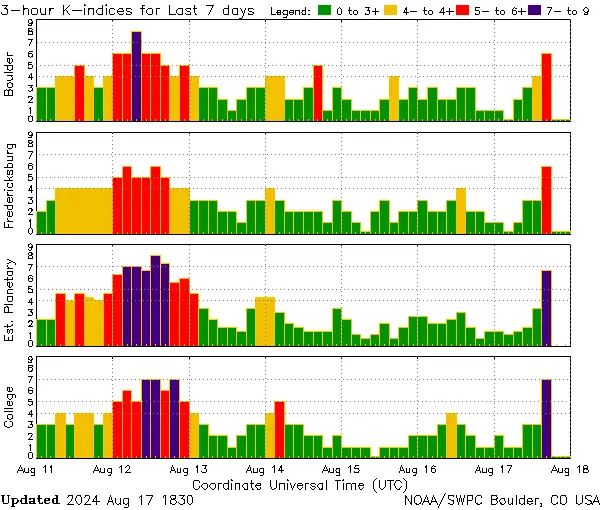
The coronal mass ejection (CME) produced by the X1.3 solar flare on August 14, 2024, impacted Earth at approximately 14:30 UTC on August 17, producing a brief period of G3 – Strong geomagnetic storming.
A Geomagnetic K-index of 5 (G1 – Minor geomagnetic storm) threshold was reached at 16:17 UTC, followed by a K-index of 6 (G2 – Moderate) at 17:12 UTC.
The G3 – Strong geomagnetic storm (K-index of 7) threshold was reached at 17:46 UTC.
A strong geomagnetic storm is a large disturbance in Earth’s magnetic field. It often varies in intensity between lower levels and strong storm conditions over the course of hours during the duration of the effect, NOAA SWPC forecasters said, adding that infrastructure operators have been notified to mitigate any possible impacts.

G3 – Strong geomagnetic storm is anticipated to impact areas primarily poleward of 50 degrees geomagnetic latitude. This storm could cause voltage irregularities in power systems, potentially triggering false alarms in some protection devices.
Spacecraft in low Earth orbit might experience surface charging and increased atmospheric drag, which could lead to orientation issues. Satellite navigation systems, including GPS, may encounter intermittent problems such as loss-of-lock and increased range errors, impacting positioning accuracy. High-frequency radio communications may also be disrupted.
Additionally, the aurora borealis could be visible as far south as Pennsylvania, Iowa, and Oregon, offering a rare viewing opportunity in these regions.
The strength of the impact was relatively unexpected as this was a weak-looking CME. However, taking into account the state of Earth’s magnetic field and other factors, it might not be that surprising.
This current #solarstorm arrived on the early side (close to NASA's prediction) and packed an initially strong G3-level punch! For those watching the indices, this high level is not sustainable. This storm is already dropping back to G1 levels. Expect #aurora to be dominated by… pic.twitter.com/s7zxlXF56H
— Dr. Tamitha Skov (@TamithaSkov) August 17, 2024
Solar activity was at moderate levels over the past 36 hours, with 3 M-class flares – M1.3 at 13:24 UTC on August 16, M1.6 at 10:33 UTC on August 17, and M1.1 at 11:44 UTC on August 17.
There’s a 70% chance of M-class solar flares through August 19 and 20% of X-class.

3780 – Beta-Gamma
3781 – Alpha
3782 – Alpha
3784 – Beta-Gamma-Delta
3785 – Beta
3786 – Beta
3788 – Beta
3789 – Beta
3790 – Beta
3791 – Beta
3792 – Alpha

I'm a dedicated researcher, journalist, and editor at The Watchers. With over 20 years of experience in the media industry, I specialize in hard science news, focusing on extreme weather, seismic and volcanic activity, space weather, and astronomy, including near-Earth objects and planetary defense strategies. You can reach me at teo /at/ watchers.news.

Commenting rules and guidelines
We value the thoughts and opinions of our readers and welcome healthy discussions on our website. In order to maintain a respectful and positive community, we ask that all commenters follow these rules.