
Long-duration X1.3 solar flare erupts from geoeffective region
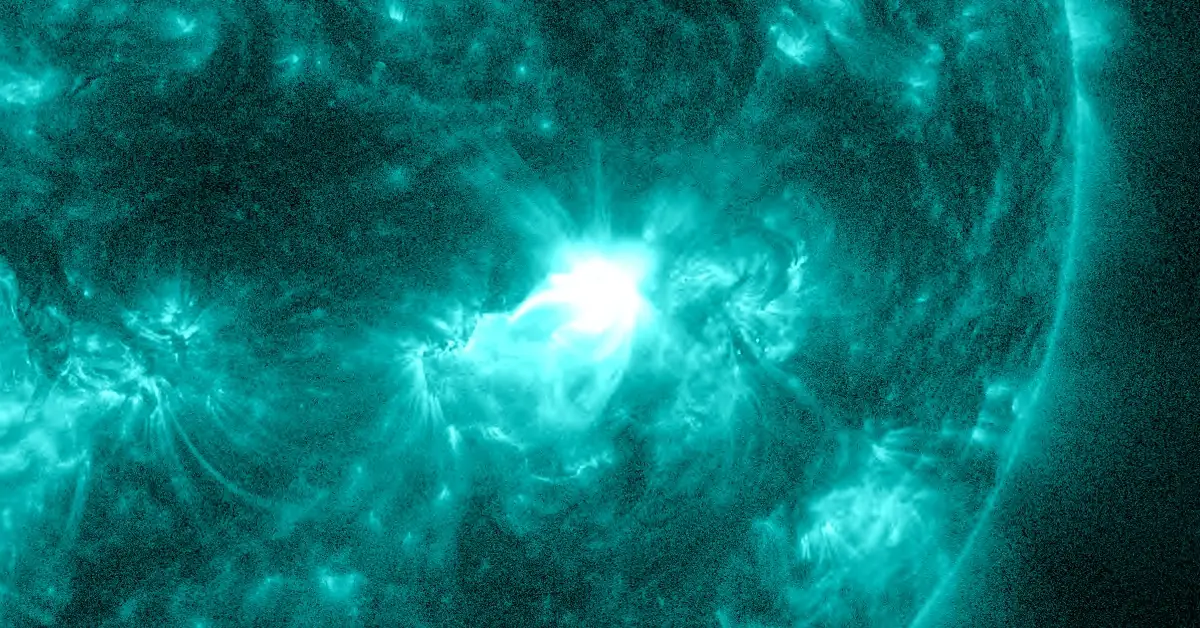
Featured image: X1.3 solar flare August 8, 2024. Credit: NASA SDO/AIA 131, Helioviewer, The Watchers
A major, long-duration solar flare measuring X1.3 erupted around Active Region 3777 / 3774 at 19:35 UTC on August 8, 2024. The event started at 19:01 and ended at 19:57 UTC.
A Type II Radio Emission, with an estimated velocity of 1 026 km/s, was registered at 19:29 UTC, suggesting a coronal mass ejection (CME) was associated with the flare event.
Radio frequencies were forecast to be most degraded over North America and the Pacific Ocean at the time of the flare.
In attenuation detection images from Solar Demon we observe the X1.3 class flare a shock wave . I await more data available. pic.twitter.com/vOitp4S9Gz
— Industrial Engineer Irene Quiroz (@nenecallas) August 8, 2024
X FLARE! The Sun just produced an X1.3 flare from AR3779 in the SW. It peaked at 19:31 UT and from the video it looks like a CME was launched to the southwest. Its in a prime position to affect the Earth so we may want to keep an eye out for geomagnetic storms in a day or two. pic.twitter.com/MJndVEH0VY
— Keith Strong (@drkstrong) August 8, 2024
RADIO BLACKOUT: An R3 (strong) radio blackout storm centered on North America was caused by the X flare mainly below 5 GHZ. This was the 34th biggest flare of this cycle which so far has produced 59 X flares. This compares to just 19 X flares at the same stage of solar cycle 24. pic.twitter.com/EQHbpJ3Sxm
— Keith Strong (@drkstrong) August 8, 2024
Due to the location of the responsible region, near the center of the disk, an Earth-directed CME is probable. However, we’ll have to wait for updated coronagraph imagery to confirm.


Several CMEs were observed in SOHO/LASCO C2 imagery in 24 hours to 12:30 UTC today. While the SE directed CME, observed beginning at 03:24 UTC on July 7, is not expected to be geoeffective, the CME associated with the M4.5 flare from Region 3774 and the CME associated with the M5.0 flare from Region 3777 were modeled and both show CME arrival late August 9 through early August 10.
Two coronal holes that are moving into the western hemisphere are predicted to become geoeffective on August 8 and 9, providing a weak enhancement.
Solar wind parameters are expected to become further enhanced with the arrival of the CMEs associated with the M4.5 and M5.0 flares late on August 9 and 10. As a result, a G2 – Moderate Watch has been issued for these days. Model guidance suggests a quick arrival during the overnight hours (UTC time) but the exact timing is uncertain.
References:
1 Forecast Discussion – NOAA/SWPC – Issued at 12:30 UTC on August 8, 2024

Teo Blašković founded The Watchers in 2011 and edited it until 2026, covering seismic and volcanic activity, extreme weather, space weather and near-Earth objects. Articles on this page are his archive.
Published in the last 24 hours
- Bay of Bengal system to become Cyclone Akvan, landfall forecast between Nellore and Tuni on November 20, India
- El Niño floods kill 2 in Guayaquil as 172.8 mm of rain swamps Milagro, Ecuador's toll rises to 14
- Southern Thailand braces for heavy rain, 15 provinces on flood and landslide alert for November 18-22
- Paraná River floods force 4 547 from homes as water tops evacuation levels in 10 Argentine towns
